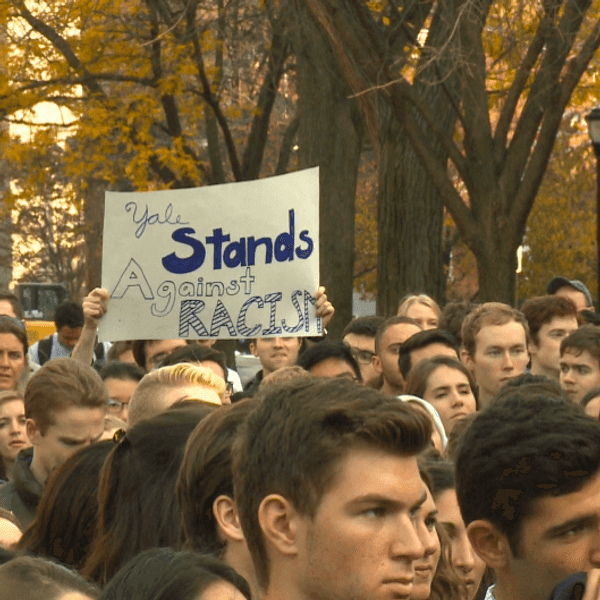

I’ll admit it. I’m a liberal democrat college student who can’t stand talking to most other liberal democrat college students. This is not due to their idealistic naïveté, nor is it due to their obsession with adding the prefix ‘cis’ to all nouns. It's that they aren’t even liberals to begin with.
In truth, most of them don't even engage themselves politically. Instead, my peers are convinced that the only means by which this ultimate aim of social justice can be achieved is through the practice of an intellectually infantilizing form of non-politics.
This toxic new breed--the denizens of which were rather accurately coined “Stepford Students” by writer Brandon O’Neil--is one which appears to be more invested in safeguarding emotional wellbeing and regulating everyday speech than it does combating systemic inequities or defending personal liberties.
Mainstream pundits typically characterize this new movement as a revival of the Political Correctness Movement of the 1990’s. This inaccurate for two reasons.
First, the two movements differ greatly in their intentions. Journalists Greg Lukianoff and Jonathan Haidt of the Atlantic explain in their recent article “The Coddling of the American Mind” where the two movements differ:
“[The P.C. movement of the 1990’s] sought to restrict speech (specifically hate speech aimed at marginalized groups), but it also challenged the literary, philosophical, and historical canon, seeking to widen it by including more-diverse perspectives…
“[However,] the current movement is largely about emotional well-being. More than the last, it presumes an extraordinary fragility of the collegiate psyche, and therefore elevates the goal to protecting students from psychological harm. The ultimate aim, it seems, is to turn campuses into “safe spaces” where young adults are shielded from words and ideas that make some uncomfortable. And more than the last, this movement seeks to punish anyone who interferes with that aim, even accidentally. You might call this impulse vindictive protectiveness. It is creating a culture in which everyone must think twice before speaking up, lest they face charges of insensitivity, aggression, or worse.”
The authors later cite the findings of numerous case studies, opinions of top psychologists, and statistical analyses, in their assertion that the establishment of these so-called ‘safe-spaces’ on college campuses is actually highly detrimental to both the quality of college students’ education as well as their mental health.
Second, where the original movement focused on unifying all identities under the banner of mutual progress, its millennial bastard child seeks to separate them based on the principle of mutual mental safety.
Upon closer examination, the differences between the two are so numerous that to call this movement ‘political correctness’ would be about as inaccurate as it is insulting. The PC movement of the 1990’s, for all its unpleasantness, was a progressive movement with socially-conscious goals. This movement is not only regressive and anti-social, it is by its very nature non-political and factually incorrect.
By now, some immediate caveats and clarifications must be stated, to ward off any misunderstanding.
1. Yes, I really am a card-carrying, big-government loving, Piketty-reading liberal, and no I am not claiming my liberalism is in some way superior to the liberalism of my peers. I’m claiming that a growing number of people in my age group (who usually identify themselves as feminists, liberals, libertarians, or some breed of radical) are committing themselves to a false ethos that is actually to the detriment of the very issues they claim to support.
2. Yes, I’m aware there are a great deal of bonafide Liberals currently attending college. I am not attacking modern Liberals or college students; I am attacking the newest mutation of a very old ideological strain called intolerance, which can exist under the guise of any ethos I can think of.
3. Contrary to what conservatives like to tell themselves, they are just as keen on limiting speech for the sake of emotional comfort as liberals are. They just do so in a different fashion.
British journalist Brendan O’Neill explained this duality in a September 2014 column for the Spectator:
“I told [the Stepford Students] that at the fag-end of the last millennium I had spent my student days arguing against the very ideas they were now spouting — against the claim that gangsta rap turned black men into murderers or that Tarantino flicks made teens go wild and criminal — not so much as a flicker of reflection crossed their faces. ‘Back then, the people who were making those censorious, misanthropic arguments about culture determining behaviour weren’t youngsters like you,’ I said. ‘They were older, more conservative people, with blue rinses.’ A moment’s silence. Then one of the Stepford's piped up. ‘Maybe those people were right,’ he said.”
Lastly, I claimed earlier that the rise of these so-called Stepford Students has been detrimental to the cause of Social Justice and to modern Liberalism as a whole. While this is partly due to the sheer ridiculousness of their demands, some would argue that the biggest tumor from this cancer lies in their use of elitist, faux-academic buzzwords. Namely, terms like “microaggression,” “trigger-warning,” or “Positionality”; phrases such as “check your privilege” and “calling out” are also included.
These newly introduced terms first originated in the feminist “blogosphere” within the last year or two, and are regarded by many Stepford's as the tools by which they may enact social change in everyday communication. Normally this wouldn’t be such a bad idea. The introduction of new terms challenge contemporary viewpoints and often have a tremendous influence on our way of life.
However, what many liberals (authentic and Stepford alike) do not understand is that the best way to introduce new concepts to an apprehensive public is to disguise them a few familiarities. The early Christians proved this when they modeled the physical image of God after Zeus, and Franklin Roosevelt knew this when he sold the New Deal by talking like a conservative--e.g., the beaming geriatric smile, the one-on-one voice of his fireside chats, his gentle demeanor, all of which stood in stark contrast to the virulent bombastic progressives of his day.
The standard Stepford rebuttal to this would probably involve the insistence that all those opposed to the new jargon are just attempting to cling on to the privileges they feel are threatened by it.
Thus, the marriage of a misguided, socially divisive ethos to a highly-academic vocabulary does considerable damage to the cause of Social Justice. And if it wasn’t already abundantly clear, liberals must reject and oppose wholeheartedly the false parameters of Stepford discourse if we wish to avoid irrelevancy in the mainstream political discussion.