

Nobody likes being sick. Even the common cold bothers people. However, what happens to our personal lives and psyche when we discover that we have a chronic illness, whether grave, curable, or not-necessarily life threatening? Do our lives end from there?
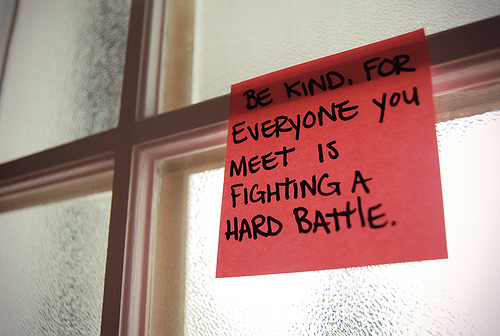
"Be kind, for everyone you meet is fighting a hard battle." - Unknown
I never truly understood the meaning of the words above until I faced an illness. At age 19, I was diagnosed with a genetic kidney disease known as Polycystic Kidney Disease. When I received the diagnosis from my doctor, I thought my life was going to end. I thought to myself, "Great. My health is in decline. What outlook do I have now?"
Of course, one instantly thinks of the worst possible outcomes when being diagnosed with any disease. We think that because we are seemingly doomed with life-long illness, we are perpetually despaired. However, I realized that the disease was not going to end my life but rather revitalize it. It has been over two years since I was diagnosed, and I learned four important lessons that allowed me to better my outlook and actions.
1. A person is not the master of his or her own personal health.
This is a constant struggle that I have to come to terms with. Being diagnosed with illness and having learned as much as you can about it, a person (sometimes) automatically thinks that he/she knows what is best for the body. That is not necessarily true. The phrases, "It is my illness" and "I can handle it myself" are often said.
With my father previously having the disease I had, I thought that I knew best on how to handle myself. Lies. I am still trying to learn how to properly diet, take medications, and maintain health. From personal experience, the best solution is to not react to illness with childish responses. It is not necessarily about acting grown-up but rather acting smart.

2. Do not the take support from friends and family for granted.
Now, this part is often overlooked and ties in with the first lesson. When I was first diagnosed with the disease, I knew that I had to control my alcohol intake and diet. I told my friends about certain signs to look for as well as stop me from doing certain things such as overeating or over drinking, and if I tried to outsmart them, they should automatically take the things away from me. That was not really successful. I fought with friends and family on such moments because I wanted to enjoy my life.
This lesson made me realize that even with the constant "nagging" and reminders, the ones who truly loved me were looking out for me and had my best interest in mind because they would rather see me in the real world having a fun fulfilled life rather than one clinging to a hospital bed and dialysis machine.
3. A disease is not equivalent to the end of the world.
Put simply, your life is not over as soon as you are diagnosed with an illness. Sure, we may complain or have worrisome thoughts, and that is perfectly natural. A person does not really spend his or her life in anticipation of an illness to be diagnosed, so when that moment hits, he or she thinks that everything will turn for the worst. Again, not necessarily true.
I often thought of my genetic kidney disease as a dooming fate though not intentionally brought upon by my family. Doctor to doctor and hospital visits to testings, I learned that the disease was in the early stages and would not fully result in total renal (kidney) failure in my lifetime so long as I maintain my own health and took it seriously. I witnessed a revitalization of my own life because I did not let despair take over. I can still live while having it. Sure, there are occasional worries of ever having kidney failure one day, but who am I to anticipate negative outcomes when they can be prevented or at least delayd for a decent amount of time?

4. Resources are available if you allow yourself to look and/or ask for them.
This lesson cannot be stressed enough. Many clinical studies are made and there is a plethora of material to read either in online or printed materials. Talk to your doctor and be honest with him or her. Consult with your family on how to reorganize the daily plans to help make living with illness manageable. Reach out to those who have/had the disease for advice. You have a wide variety of resources at your reach.
While this article brings into light my own personal health as well as the realities of those with any health condition, I kindly ask that in additional to raising awareness to diseases, please donate to foundations so that they may be able to find cures. In an attempt to not sound like an online infomercial, your support really does make an impact in the long run. After two years, the famous ALS Ice Bucket Challenge produced life-changing results. The same can be done for any disease.
For information on Kidney Disease, click here, and click here to donate to the National Kidney Foundation.