
Books sleep on the shelves, untouched, lying in a state of dormancy when closed. Events infused into the pages of their innards bounce back and forth between the hardcover and over to the copyright section. The story un-jumbles itself, putting itself together piece by piece, page by page when opened. Only when the reader sets their gaze onto the individual pages, in the specific order the author intended, does the story start to make sense. It settles from a firestorm of words, metaphors, dialogue, and themes to a linear path unfolding with every step progressed on the narrative path. Blank, wordless gaps mark the end of a chapter and the beginning of another. Placeholders jut out high above the pages, breathing air unobstructed to indicate where the reader left off. Otherwise they would be left lost and confused in a expressive maze of words.
Reaching the end, finessing cover to cover, does not mean escape from the maze. The purpose of books themselves serve as an escape, but should not be seen as an ordeal to survive—for the most part. It is rather an enrichment of culture, knowledge, and awareness. A passion for reading is the fuel burned to power literary drives, pushing off calling it a night after just one more chapter. Beyond an ordinary love for books, there is a special sensation associated with finishing a book, especially one considered a masterpiece. There is that omnipresent feeling we all possess in the pit of our stomach, neither the butterflies of love nor a medical commonality. It is the achieved feeling of being satisfactorily complete, enhanced by a newfound bit of wisdom. Contrarily, that same feeling of being lost or embittered may attribute to an emptiness inside, the dearth of direction or ability to comprehend.
As readers, we walk away from a book with a little bit of it inside us. Moral virtues, character recognition, entire ideological systems, a better understanding of the world. Simple ideas injected into thinly compressed layers of lumber live on through readers' ingestion of them—taking them in, letting them bubble and boil—until these ideas stir up something new inside the consumer. A new door is opened, a beast of thought awakened, new pages to our own stories written. Their characters rewritten to fit the plot they want to follow.
For the past year, I have submitted myself to the elementary school slogan admitting "knowledge is power." The pursuit of this knowledge I accredit as the cause for whatever changes I have done on my character, more so subconscious actions from the books I read. With each closing of a book's covers, I walk away embodying a spec of their messages and a piece from a character's introspection. Readings allows for a type of narcissism to be mimicked, where we think the story is about us, we are the protagonist, his narrative, and all the emotions that rage in the background. People are naturally egotistical, perhaps living with the message delivered, thinking we are the messengers, lets the message hit a lot closer to home than we expect from scraps with writing on them.
From generations recent and "lost," critically acclaimed authors know exactly how to spread around an idea and, even more valuable, the methods of keeping it alive, an immortal gift for future generations. Some of the selections on my list may appear on some summer reading lists, but never be discouraged from giving a great work a try. It is not that you are behind on reading these books, but that you have not been introduced to the ideas they represent. Give them a chance, and observe how the changes they may evoke from within.
This is my year in books.
"A Clockwork Orange" (1962) by Anthony Burgess
"Hello, my fellow droogs", as "our Friend and Humble Narrator" Alex would introduce himself. Our ultra-violent, sociopath protagonist Alex stalks the streets of a dystopian city with his squad of friends, also like minded juvenile prestoopnicks. All Alex looks for is a real horrorshow night of mindless vandalism, murder, vandalism, and robbery. That is, until his mates turn on their "Master and Leader."
Burgess' novel presents itself as a critique on the rise of youth gang violence in England. Set in a future with a destabilized central government lacking a full capability to enforce its laws, the city, of what is presumed to be a debilitated London within an exaggerated form, is overrun with the carnage of escalating gang violence. The delinquents lack the morals stopping them from indulging in senseless mayhem, while a similar decay perspires inside what is left of the government. Part of his punishment, Alex is put through a behavior modification experiment, leaving him a shell of his former self, physically unable to partake in his horrid pastimes.
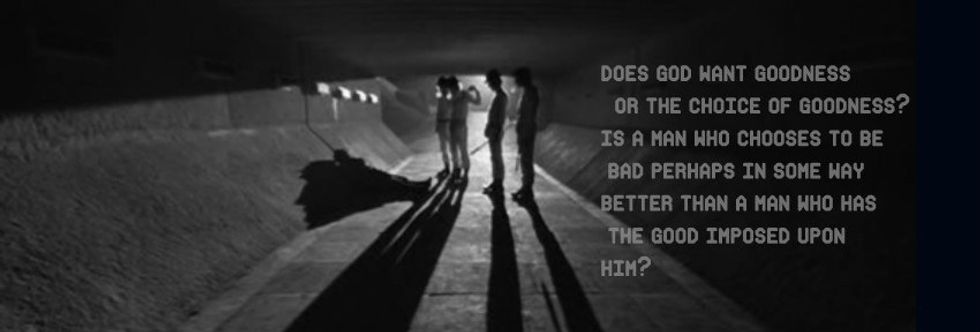
Burgess wonders about the possibilities of punishment through torture via subliminal penetration, or messaging. Can a man be taught good or should it be shoved down into him, like Alex? Ironically, Burgess used a bit of subliminal messaging in his story as bits of Russian slang called Nadsat were subconsciously taught to the reader with their appearances throughout the book, thus explaining the italicized words in the first paragraph.
(droogs= friends, prestoopnicks= criminals, real horrorshow= really good)
"The Siege of Mecca" (2007) by Yaroslav Trofimov
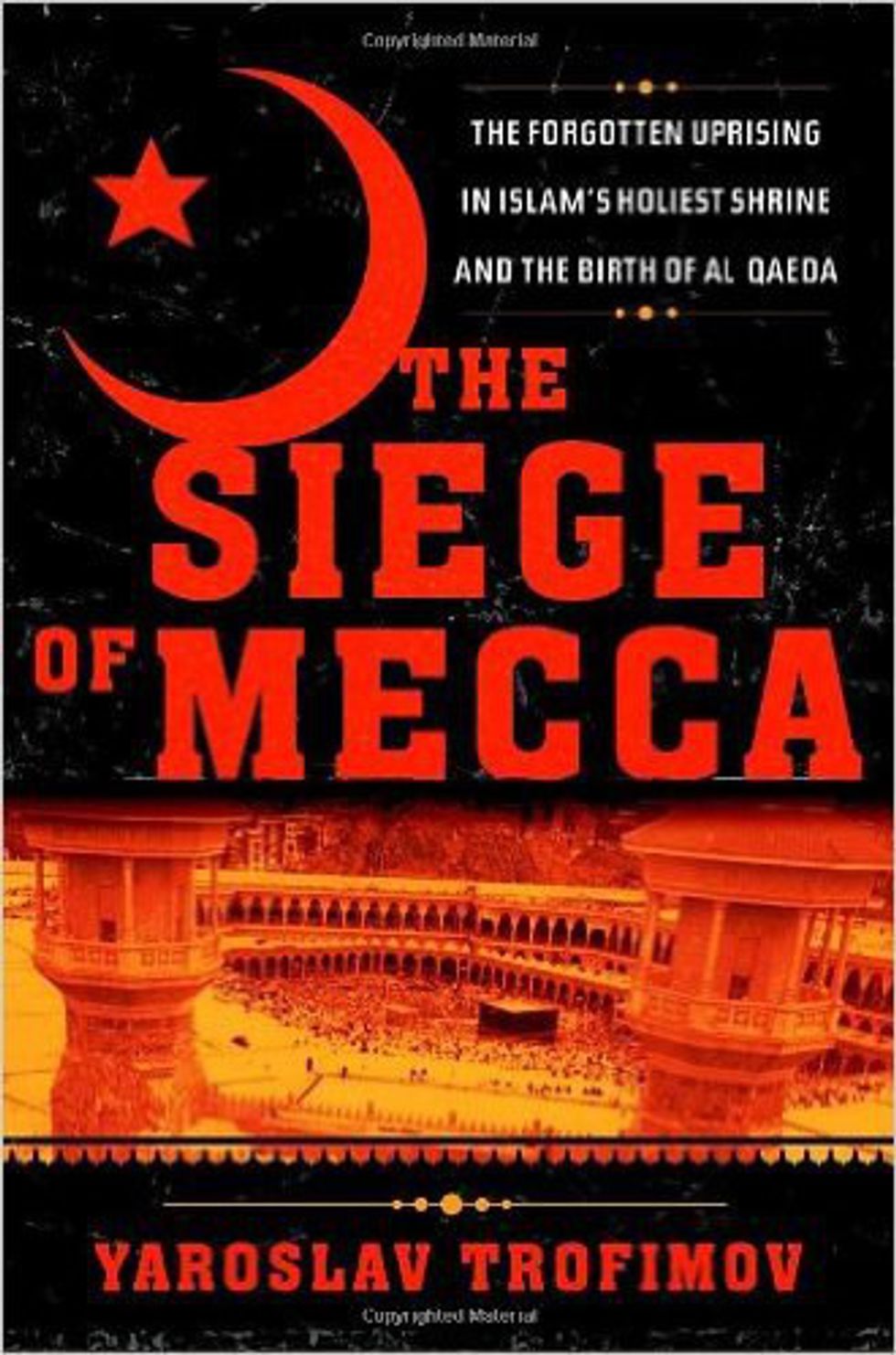
The full title is The Siege of Mecca: The Forgotten Uprising in Islam's Holiest Shrine and the Birth of Al Qaeda. Last time I checked, my only non-fiction read through all of 2015. Longtime Wall Street Journal foreign correspondent Yaroslav Trofimov knowledgeably sets the scene for the taking of the holy city of Mecca in Saudi Arabia on November 20, 1979.
The men behind the attack were led by Sunni preacher Juhayman al-Otaybi and his associate Mohammed Abdullah al-Qahtani, thought to be a prophesized messiah-esque figure called the Mahdi. They sought to take back the Muslim shrine from the Islamic leaders they saw as corrupting their faith. The standoff between the radicals and the Saudi Arabian guard lasted for two weeks, with the national guard outrageously suffering hundreds of casualties
Trofimov does not spare any of the details and it is clear he has done his research. He interviewed survivors, soldiers from both sides of the crisis, and various American and European representatives or government operatives trying to piece together what was happening at the time. The beginning of the book describes the history of rivalry and warfare involved with the Arabian clans hundreds of years ago.
Definitely a must-read for anyone interested in learning more about watershed moments in not just Saudi Arabia or modern Islamic history, but also U.S. history, as foreign involvement released a ripple effect onto the relationship the United States has with some of the Middle-Eastern countries.
"Go Set a Watchman" (2015) by Harper Lee
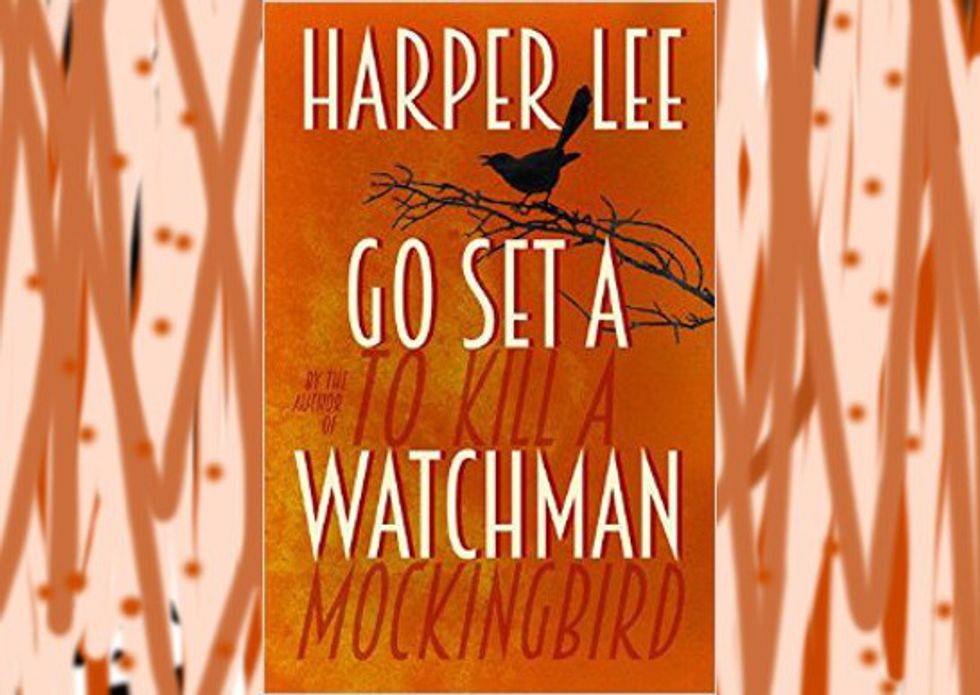
A re-introduction to Harper Lee's American treasure To Kill a Mockingbird, Go Set a Watchmen brings readers back to the small Alabama town of Maycomb, home to the Finches. Originally what was meant to be published instead of Mockingbird, Watchman now acts a sequel as it takes place 20 years after Mockingbird's events. Critics and avid readers alike ranted opposition to the new stylization of their hero, lawyer Atticus Finch, the moral compass every high school junior pointed North towards. In regards to segregation and race relations in the southern states, Lee has made it clear the vast differences between the North and the South, calling the South an entirely different country. Lee based Atticus off her own father, who represented an initial cracked morality, and her writing was able to persuade him into supporting integration. The dissatisfaction with the re-telling of Atticus is explained in an earlier article, as are some of the other prevalent themes.
"Fight Club" (1996) by Chuck Palahniuk
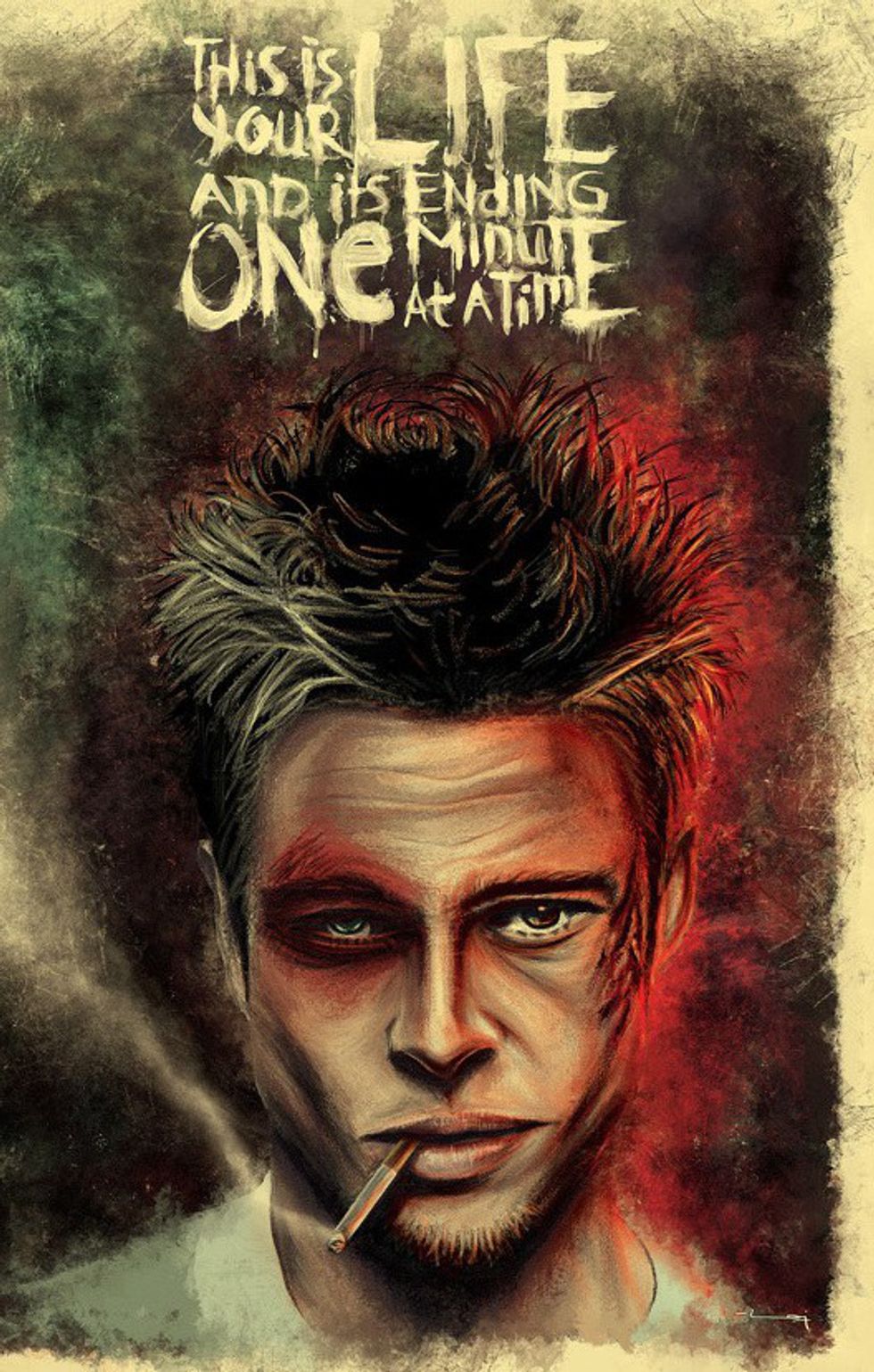
Probably the best, and one of the only few, reincarnation of modern nihilist, even though Palahniuk identifies as a romanticist. Warning: do not binge watch the first season of Mr. Robot and dive right into reading Fight Club all in the same week. Side effects include questioning the meaning of our lives, rebellion from corporate entities, and refusal to get out of bed to start the day in a timely manner. Nihilism was deeply enrooted in Shakespeare's Hamlet, we just could not understand what they were saying to get the message.
The life of The Narrator, who is sometimes referred to as Jack and is identified as Edward Norton in the film, breaks from the monotonous, consumerist cycle and has a more than coincidental encounter with jack of all trades Tyler Durden, or bad boy extraordinaire Brad Pitt in the film. Together, with their late night sparring matches catching the interest of others, they form the titular Fight Club with bylaws written to contradict the very existence of the club. In the confines of a circle of screaming men, fighters could finally take control of their own lives every other night by beating each other mercilessly, for recreation, for sport, for finally gaining a sense of command over themselves from outside forces.
I cannot even tell which has a bigger cult following: Fight Club, the film, or Fight Club, the novel? If you have seen the movie, then you have seen a majority book. Even the way the book is written is reminiscent of a movie script; narrations make up a majority of the writing, but the points are kept short to keep up with the pace of cinematic narration; sexual innuendos pop up in the text similar to how Durden is credited towards splicing film of inappropriate scenes into the movie's own film, some pop up too fast for the audience to see them. Palahniuk even praised the film adaptation for the presentation of the disestablishmentarianist themes, characters, and that one twist we all should see coming by now.
I am Joe's Analytical Eyes.
"Slaughterhouse-Five" (1969) by Kurt Vonnegut
I was first introduced to Kurt Vonnegut when I picked up a copy of his novel Jailbird a couple of summers ago, a commentary on mega corporations through a fictional Nixon cabinet member, for a couple of bucks from my hometown record store; Jack's Music in Red Bank has been known to be frequented by Bon Jovi and Bruce Springsteen, so even their dollar store priced books should be held in high regard.
Through his sharply true yet humorous commentaries, I cannot help but surmise Vonnegut to have been a whimsically sarcastic old man. He has an overarching habit of personifying himself into his stories as the hermit science-fiction author Kilgore Trout, Vonnegut's alter ego. In Slaughterhouse-Five, or The Children's Crusade: A Duty-Dance with Death, Vonnegut returns to the trauma of having been a World War II soldier surviving the firebombing of the German city of Dresden in the February of 1945. A story he had struggled to find the words to tell for several decades after.
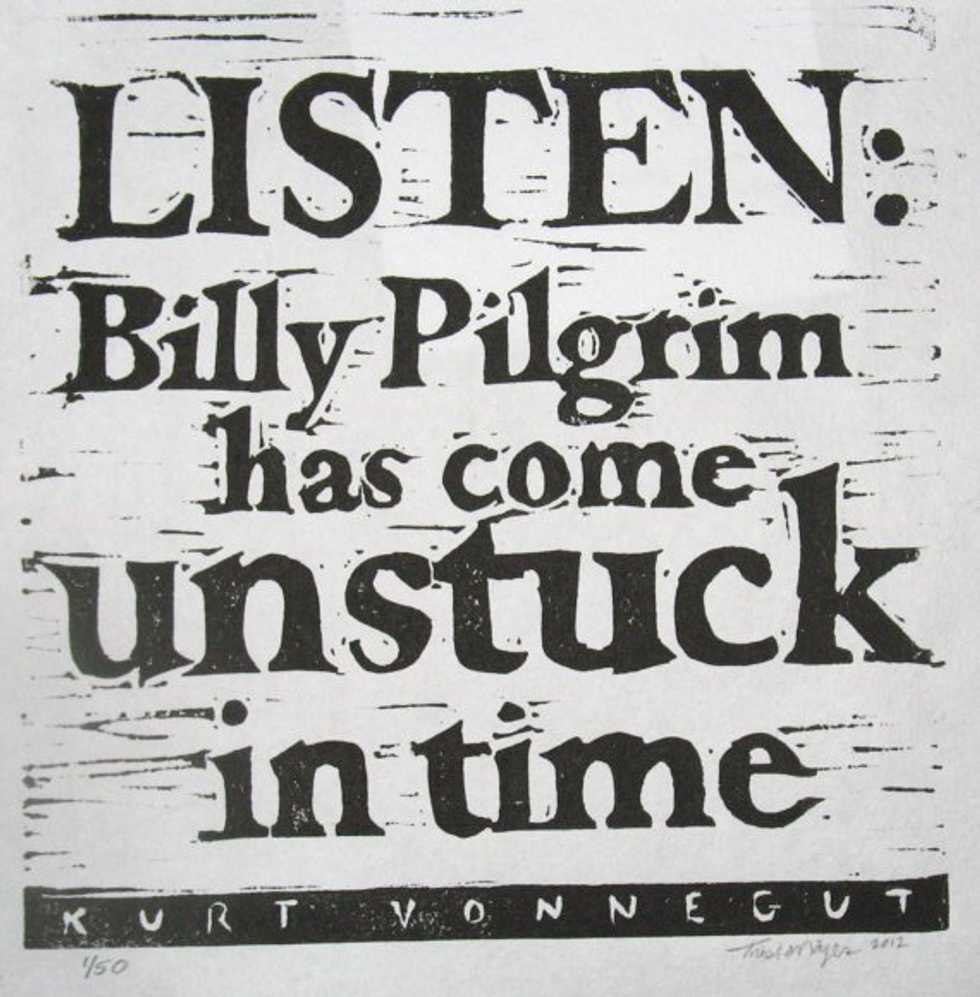
Billy Pilgrim is the vehicle for Vonnegut's wartime experiences, an oddly comical fact as Vonnegut gives himself dialogue by pointing out he is in the same prisoner of war camp as Pilgrim along with Kilgore Trout making a trademark appearance. Pilgrim suffers from a condition where he spontaneously travels forward and backwards in time. He sees the span of his life unfold as he jumps in and out of his aging body, and then clamp down as he regresses back into youth, endlessly.
The book conveys fatalistic notions of knowing what is going to happen to you while believing it impossible to change the future. "So it goes," as such a belief is summarized within the book. Vonnegut felt he could not escape the horrors of having survived the Dresden firebombing. The book directs the focus on the "children" that fight in wars, young, naive men ill prepared to take another life let alone go to war. As a promise to the wife of a friend, who also survived the bombing, Vonnegut promised to give it the alternate title of The Children's Crusade.
"Fahrenheit 451" (1953) by Ray Bradbury
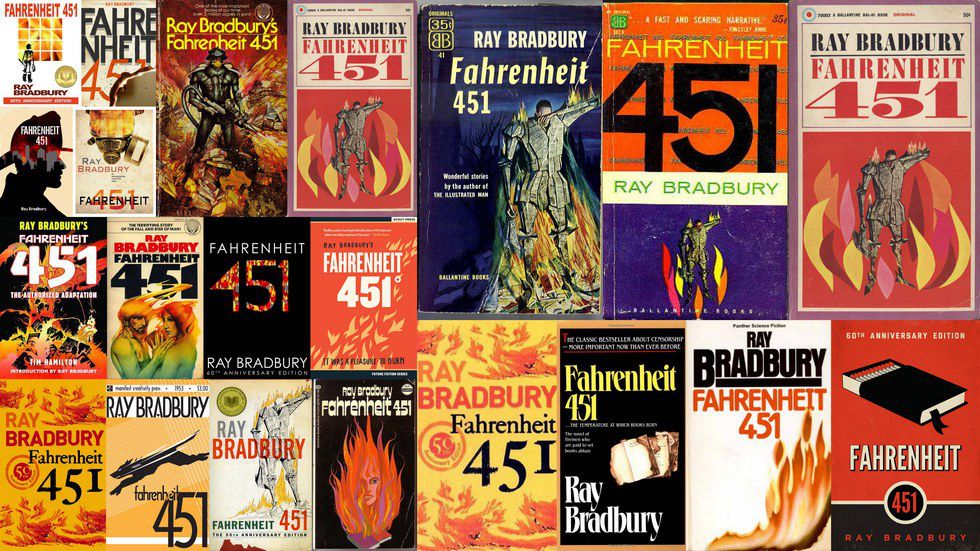
Ray Bradbury wrote Fahrenheit 451 within nine days using a rented typewriter at UCLA's Powell Library. Frustrated by censorship brought on by the McCarthy era's persecution of writers, Bradbury issued a biting response, outlining the ramifications book burnings, censorship, and reduction of free speech could cause. Born from a brand of speculative fiction, Bradbury paints a portrait of the potential future with the tagline of "if this goes on".
451 Fahrenheit, the temperature at which paper burns. In a world of an extreme example, Guy Montag is literally a fireman, an agent of public service assigned to carry out censorship's dirty work: burn books and torch the owners' homes with a flamethrower. The controversy over offensive reading materials has led the government to ban all books in the hopes of deterring citizens from feeling sad, anxious, or just any emotion. Suspicion is beamed on people going for casual strolls, driving at safe speeds, or any lackadaisical activity allowing for introspective free thought. Conflicted with the nature of his job and the realized dullness of most of the characters around him, Montag gives in to the temptation of reading, stashing books away to avoid punishment from his superiors.
Bradbury encapsulates the process of how governments, mainly totalitarian, go about suppressing the people, starting with the suppression of knowledge. Destruction of knowledge in the form of books is one way to kill an idea, weakening society's chances at form independent thought. Books are the curators of ideas, harboring them between their pages inside the covers. It made me realize every last book was worth saving, and reading, and making it a part of my character.
"1984" (1949) by George Orwell
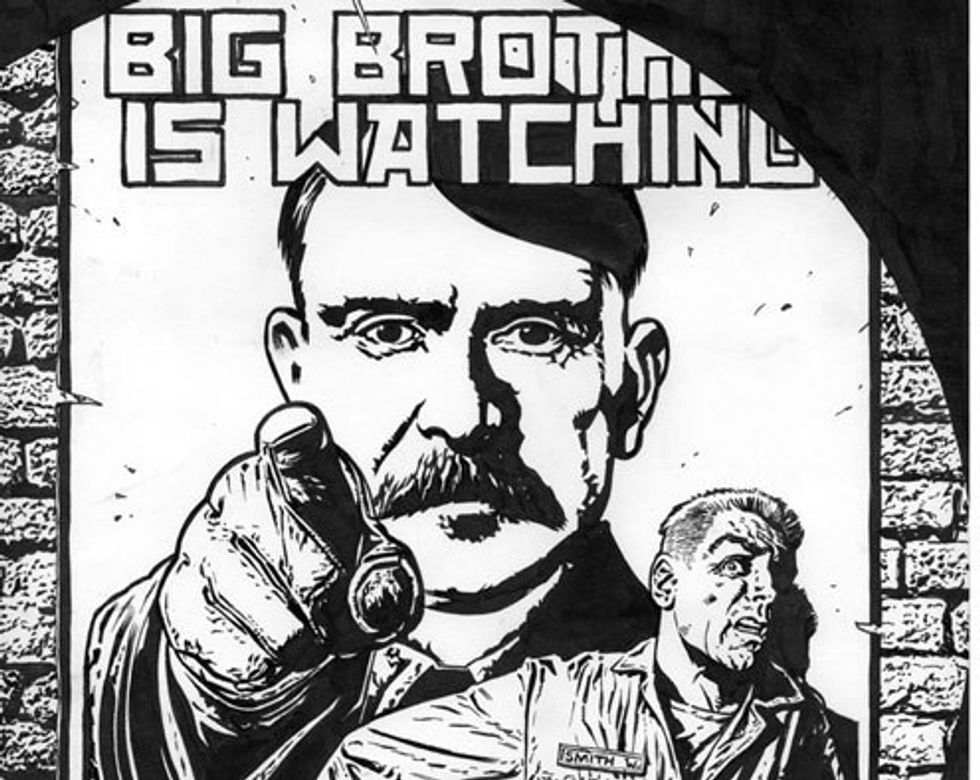
Aware of their parallel ideas behind 1984, I was compelled to read the origin of the term "Orwellian", referring to a constant surveillance by authoritarian governments, after Fahrenheit 451.
Another novel set in a future- for Orwell, it was- dystopia, set in what the protagonist Winston Smith believes to be the year 1984, the novel alludes to constantly changing wars and alliances between what has become the world's three major powers: Oceania, Eurasia, and Eastasia. Winston works for Oceania's Ministry of Truth, his job: to author old and current newspaper articles altering the past to match up with the present's history. Similar to Guy Montag, Smith commits a most heinous crime: writing in and keeping a journal, huddling the truth away from the view of the mandated telescreen in his house. Smith conjures up negative emotions towards the government, long bottled away, with his secret expression of self. Not too long, Smith fears he will tried as a thoughtcriminal for withholding a distrust for the government, a simple act they see as treason.
Literally a fear of government surveillance critics anywhere, Orwell's future is personified by the political figure Big Brother who may or may not be an actual person, but assures the people of Oceania he is always watching. Posters bearing his likeness remind people of their conformist loyalty to the government, telescreens peering into the private homes of everyone, children report their parents to the government on the grounds of being suspected spies. A circle of distrust is formed with any and all offenders punished by the Ministry of Love.
Coming before Bradbury, Orwell goes a step further by not just denying people the right to read and self educate, but denies his characters the right to be aware of the world's actual history. Smith even admits that the Proles, the immigrant class who are looked down upon, could easily create a successful uprising if it were not for their suppression. Orwell leaves the ending as a sad reminder of what is stripped from a person when they enslave themselves to hardcore nationalism. People do die, but ideas, harmful or beneficial, may live on.
"Racing the Rain" (2015) by John L. Parker, Jr.
Parker returns to runner Quenton Cassidy's saga, but this time as a boy, a young high schooler learning the joys and competitive thrills of running. I would love to talk about Parker's latest prequel in his finally finished trilogy, but I already have. Click here to hear all about it.
"American Psycho" (1991) by Bret Easton Ellis
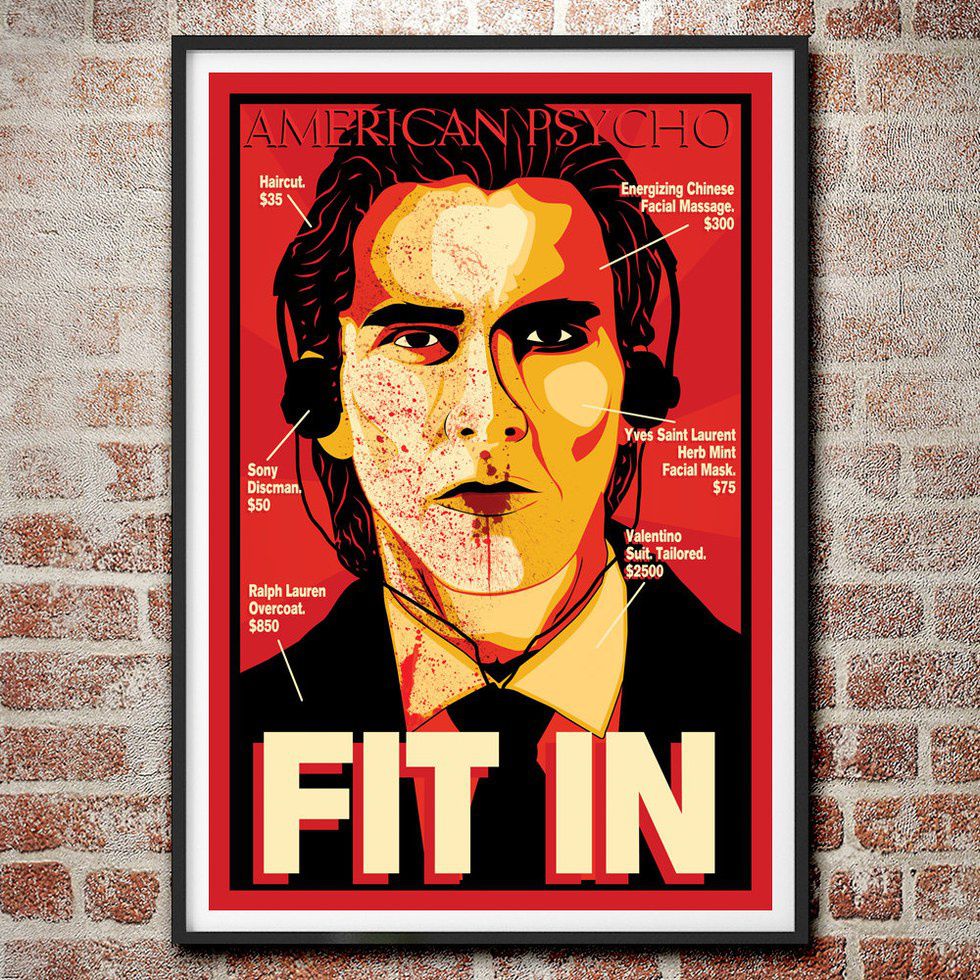
I always assumed Bret Easton Ellis' 1991 novel was exactly like Mary Harron's film adaptation from 2000 starring Christian Bale. I could not have been more wrong with what I found.
Please note, that American Psycho is not for the casual reader. Like several scenes from the movie, some chapters are a mix of extreme violence, sexually explicitness, and downright disgusting acts. There were moments where I had to re-read what I just read, look away from the book, and take a break for a couple of minutes. While the movie tries to emulate the source material, it falls short in its depth of themes, literal translations to metaphors from the book, and gut-wrenching madness of the...protagonist, anti-hero, narrator? I really do not know what the main character is.
Patrick Bateman is an investment banker on Wall Street. To be more precise is the vice president of mergers and acquisitions for the investment firm Pierce & Pierce, as are all of his friends and co-workers described to look nearly identical to him, constantly being addressed as one of them. But more importantly to the story, Patrick Bateman lives a secret life as a serial killer. A member of the "new money" yuppie generation created by the Wall Street boom in the 1980's, the 20 something-year-old Bateman does not use his class to mask his criminal activity. The subtlety of his escaping punishment for all of his murders characterizes the conformity constant in the materialistic lifestyle of being young and wealthy at the time.
American Psycho covers Bateman's escapades with other women behind his not so serious fiancee, diners and recreational drug use with friends, his killings, his descent into madness, reviews of popular artists' latest albums, and a 20 page dialogue over who is making reservations where, when, with who, and how- easily the most insane part of the entire book. The movie stands alone from the book, or any other movie, as it incorporates a Huey Lewis and the News song into a murder. All Bateman really wants is punishment- his crimes a metaphor for attempting to stray from the pack of conformity- but no one notices the clear signs, continuing with their endeavors of fine dining and cheating.