

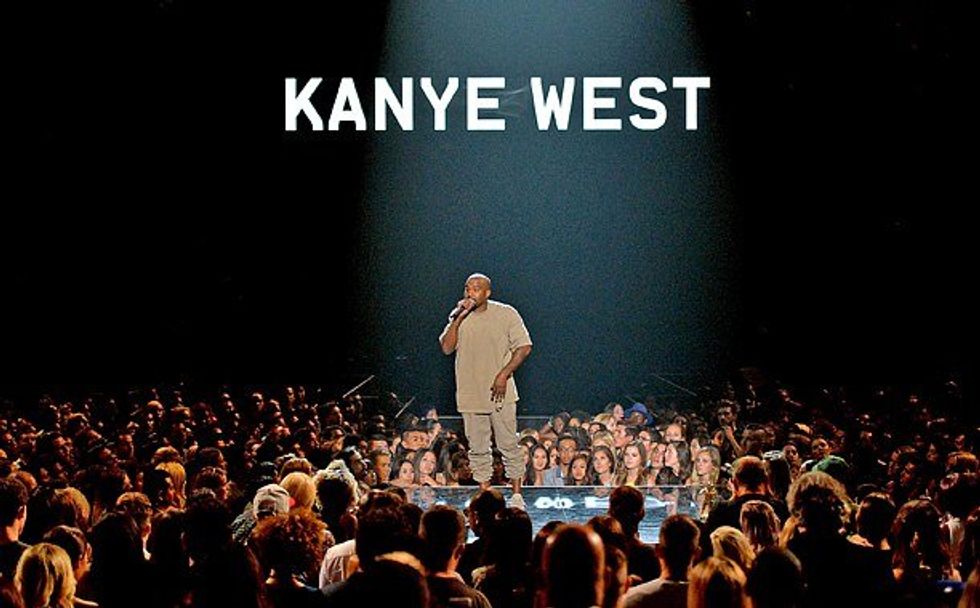
This past Sunday, infamous rapper and controversial fashion pioneer Kanye West inspired some, dazzled many, and confused most of the 5.25 million people who tuned in to the 2015 MTV Video Music Awards. West was honored with the prestigious MTV Video Vanguard Award for his impressive music career, but media attention has focused on his passionate, scattered, and emotionally-charged speech following his acceptance of the award. While many dislike West's personality, a fact he made clear that he's well aware of, his speech was arguably the most talked about portion of the night in news and on social media, making it clear that people are listening to the 38-year-old.
West spent nearly twelve minutes touching on multiple topics—including his infamous interaction with Taylor Swift at the 2009 VMAs, personal growth, and his feelings about art. The off-the-cuff tone of the speech was likely due to his passion, but confused viewers nonetheless. West’s message, though unclear to many, is an important one. I believe that the speech has been the most public display yet of a message that has begun to pervade popular culture in a big way, but gone unnoticed by many.
The music industry is in a horrible place due to the work of corporations, and artists are begging for a change.
In the food industry, the taste, convenience and inexpensiveness of fast food over a healthier option has been glamorized in advertisements all around us. It is easy to see the negative effect the work of corporations here, since one-third of Americans are obese. The work of corporations in the music industry has been more covert, but just as horrible. A set of seven to 10 similar-sounding songs dominate radio play and Billboard charts for months at a time. Musicians are told that their success as artists hinges on record sales, radio spins, and YouTube views. West and many others are frustrated that the music industry, like most other aspects of culture, has become driven by money—he ironically cited the fact that the network he was speaking on dramatized his infamous interaction with Taylor Swift to excite the public, boost ratings, and ultimately maximize revenue.
Kanye West is not the first major public figure to express such frustration. Pop icon Lady Gaga’s 2013 album "ARTPOP" (panned as her worst commercially and critically) communicated the idea that culture was undergoing a shift. Andy Warhol put a Campbell’s soup can on the canvas at the dawn of the age of celebrity-worship to make popular culture be considered as fine art, and now at the dawn of the age of self-love and self-expression, it is time for artists to put their fine art on the soup can and utilize modern technology to make art readily accessible to the general public.
This week, West struggled to express his frustration in the fact that corporations “put artists in a box” and thus he feels he must “die for an artist to have an opinion.”
West has written and performed critically and commercially successful music for over a decade and designed the Yeezy Boost, arguably the most anticipated shoe of 2015. However, like other musicians, he can pour his time, money, and heart into the production of an album and likely only be asked questioned by his record company for three or four tracks that fit the “hit single” mold of a three-and-a-half-minute length, a hook, catchy beat, and appeal for purchase to as many demographics as possible. Suddenly, no one seems to care about what the intent or message is behind Kanye’s work, and work to dilute his art down to a science. The artist is treated as simply a vehicle to deliver a promotional campaign to the public calculated to maximize sales. He is also encouraged to “stay in his line” and focus on churning out albums rather than pursuing his initially less profitable interests in fashion. The artist is trapped in a box, so it's clear why West is so angry.
The rise of the Internet has revolutionized the music industry by allowing heightened accessibility of music, radio, videos, and ubiquity of entertainers in our daily lives. While corporations have seen this as an opportunity to drill fast-produced, cheap art into our daily lives like junk food for mass consumption and maximum profit, artists like Lady Gaga and Kanye West propose the idea that the Information Age can be used to make quality art accessible at a level it never has been. To do so, we must take the power out of the hands of the corporation and put the power into the hands of the artists who can emphasize the only thing that should matter—their work.
West touched on the idea that it is the job of millennials to clear up the blurred lines between art and commerce. Millennials have an opportunity to change things by not trying to control their children with branding and calculated, lukewarm art. West realized the problem when Nike executives stymied his pursuit of ideas about clothing design despite his immense popularity, influence, and ability to garner public interest in whatever he puts out, an idea expressed on the track "New Slaves" from his most recent album "Yeezus."
West's speech ended on a high note as he declared that he doesn't care if people like him and will “die for the art.” Visionaries in the music industry seem eager to put art at the forefront of pop culture, and West’s speech should empower, not confuse. Millennials have a moral imperative to put power back into the hands of the artists and suffocate the corporation. While Kanye’s speech seems like a warning to corporations to listen to a generation eager to experience things and value true art (re: listen to the kids, bro), it can only happen if youth begin to listen and become passionate about this necessary cultural transition.

















