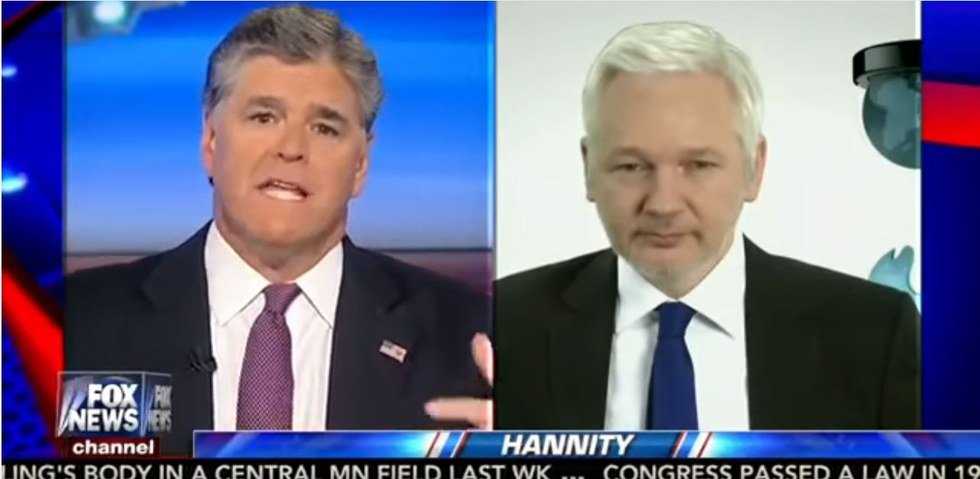
Last night Sean Hannity aired his exclusive interview with Wikileaks founder Julian Assange, held in the Ecuadorian Embassy in London. The hour-long interview included a variety of topics and provided a look into the life of a man both reviled and praised. Whether or not you agree with what Assange and his associates have achieved over the last 10 years, it is obvious that the results have impacted the lives of many, for better or worse. Here are some key moments from Assange’s exclusive interview, with analysis:
- Assange wants us to know three things: "We’ve never got it wrong; we’ve never reveled any of our sources; and there is not a single instance of anyone coming to physical harm as a result of our publication." There is no explanation really needed for these statements, but I will say this: Wikileaks is not an ill-intended entity. That is, there is no intended malice involved in their reporting. Assange wants everyone to know that ultimately, he is seeking to change the way that people perceive the world around them, even if that must be done by presenting information that he knows will not be well-received.
- Russia is a distraction, and a bad one at best. Obama is playing “lawyer games”, in Assange’s view. The expulsion of the 35 Russian diplomats, and the 12 sanctions placed on Russia this past week by the President are a farce. Repeatedly, Assange asserted that Wikileaks has found no evidence of Russian interference in our election process and that the Obama Administration will continue to say otherwise, as will its allies, in order to distract from the internal failures of the Democratic Party and the scandal-laden campaign of Hilary Clinton. While Obama pats himself on the back for actually responding (for once) to Russia, Putin will really be the one celebrating, for he has successfully outmaneuvered the most powerful political player in the world by simply not responding. To Assange, attempting to distract with Russia-this and Russia-that is a disservice to American people. The Obama Administration alludes to the connection between Russian hacking and the outcome of the 2016 election(s), but it cannot make the ultimate, solidified correlation because there is no source. Assange notes, and takes special care to amplify, that Wikileaks is not mentioned in connection to any kind of source to prove these allegations of Russian interference by any spokesperson from the U.S. government at this time. Assange made a motion with his hands to indicate how the Obama Administration attempts to skew the perception of the American public: Wikileaks being raised on one level and the Russian hacking allegations being on another; he means to connote that these terms can be used in the same paragraph, but not in the same sentence. Furthermore, while Assange repeatedly denied Russian involvement, he could not mention much more; he stated that his source was not a state party, and staunchly evaded the possibility of offering any other evidence to suggest that the source was inside the U.S.
- The collusion between the mainstream media and the Clinton campaign has been exposed, now the DNC must answer. Assange is very careful with his word choice by using “collusion” to describe the relationship between Clinton and the DNC. Collusion is more or less a descriptive for conspiracy, but not quite. A conspiracy is “a secret plan by a group to do something unlawful or harmful”, whereas collusion is “secret or illegal cooperation”. Cooperation is key here. There may not be a cooperative plan, but to merely have acquiescence should be considered a serious and authenticating factor in determining the inappropriate relationship between Clinton and the DNC.
- “Wikileaks changed the result of the election”; this is a simultaneously true and false statement. Assange claims that his motivation has been to publish true information that is otherwise unfavorable. He notes that this is indeed a political agenda, but not a party one; it is philosophical in nature. “The best type of government comes from a government that is scrutinized by the people.” This is a tried and true statement made by the likes of political theory professors, pundits and even some fortune cookies. There is no greater government than one that earns the consent of the governed. For Wikileaks to try to alter that balance, that special relationship that our government has cultivated with the people over the last 250 years, would be opposite of it’s main goal, which is to expose the public to as many truths as possible so to avoid the corrupt nature that energized democracies may develop. This is a new reality of reporting the truth, and not just the news.
- On the topic of his sexual assault allegations: Assange maintains that his detainment is illegal without charges and notes that his family should not be subjected to the same kind of treatment. I was initially somewhat confused as to why there was so little airtime given to this topic considering the fact that Assange’s enemies use these claims against him at every turn. I was expecting, to some degree, that he would want to defend himself as much as possible. This was not really the case. Assange had a very defined answer to Hannity’s questions on this topic: the DOJ continues to try to undermine him and distract from the work of his organization by upholding the investigation.