


The conformity and boredom of 1950s America had its citizens in the midst of a collective identity crisis. This crisis bled into, and exploded in, the 1960s and 70s. Here, people found their voices and sense of expression, and they found it in music. Countless influential musicians made their way into the popular music scene preaching peace, nonconformity, justice, and rebellion. But John Lennon’s plead for peace and coexistence in the midst of hate and violence made him of the few artists that continued to affect change decades later. His effect on society proves the power a talented lyricist can have on a country’s social and political scene. Though it may seem that music’s effects are only personal and shortly lived, it actually has the power to affect change, not only at its time of release, but even decades later in.
John Lennon made his name known world-wide by being one-fourth of the hugely successful rock group The Beatles, but he is remembered for much more than pop tunes and guitar riffs. In his solo career, Lennon became quite out spoken about his political beliefs, especially those regarding senseless violence, war, and civil rights. John’s beliefs were expressed most notably in his 1971 album Imagine.
The album’s title track took the world by storm, quickly topping the charts and staying there, as the lyrics of the song urged its listeners to imagine a world in which there is “nothing to kill or die for” (Lennon) and “no need for greed or hunger, a brotherhood of man” (Lennon). During this time, the horrors of World War II were still in people’s hindsight while the current perils of the Vietnam War were apparent in daily life. A song that spoke of peace amongst nations, as “Imagine” does, became the anthem to end the seemingly endless fighting. Lennon acted on this vision in which his song inspired by paying for billboards to be made around the world that said “The War is Over! If You Want It”. By doing so, he implied that each individual has not only the responsibility but ability to bring this violence to an end. John Lennon became a leader after his album gained worldwide attention, and he continues to lead today.
John Lennon set an example for his fans that talking about an issue is not enough but rather to take peaceful action and stand up for what they believe in. That has continued to this day as fans still regard his songs as protest anthems and tunes of peace. For example, the recent terrorist attacks in Paris left millions of people around the world with an array of feelings ranging from disgust to fear, anger to sympathy. But no matter who is asked, everyone agrees on feeling the desperate desire to have peace amongst mankind.
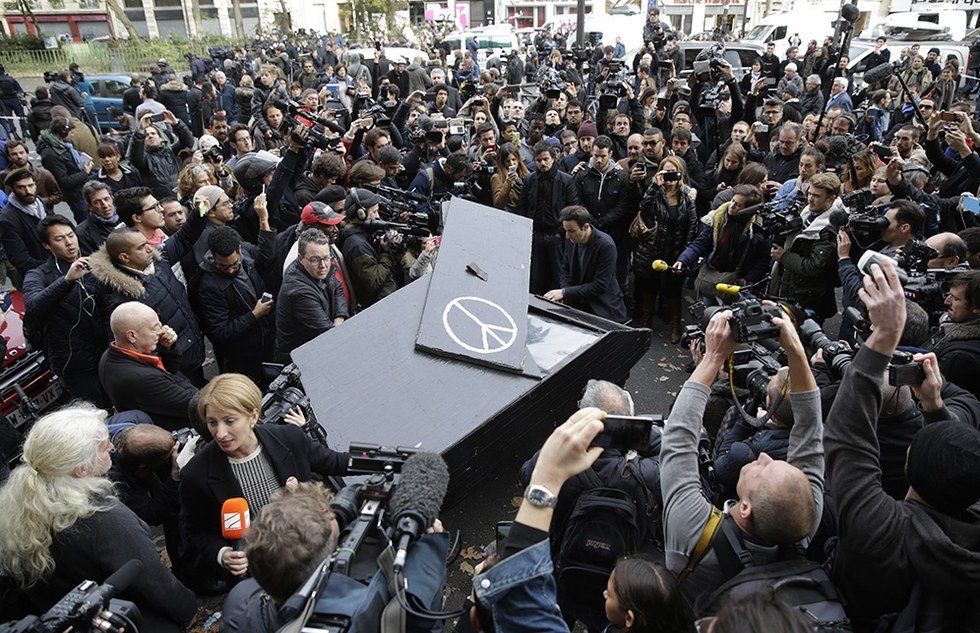
Davide Martello felt especially moved and “felt it his duty” (Bucks) to help those who were directly affected. He did so by paying tribute to the victims of the attacks. He was in a pub in Germany when the attacks began, within minutes he decided to drive 400 miles through the night with his grand piano attached behind his car in a trailer so that he could play for the people effected. He did so the day after the attacks because he said “I just knew I had to do something. I wanted to be there to try and comfort, and offer a sign of hope” (Bucks). He set up his piano in the street where the attack had only just happened hours ago. So fresh was the attack that he said there was blood on his piano from the previous night. Even so, he sat down, and played “Imagine” by John Lennon. Quickly, a large crowd gathered around the pianist and listened to the tune in close to silence. Many wept, embraced, placed flowers in the road, or simply stood in reflection. Gathered in peaceful and quiet protest of the horrific events, “Imagine” gave the citizens comfort and inspiration for the future, all hoping, as the song does, that one day “the world will live as one” (Lennon). Afterwards Martello said, “I can’t bring people back but I can inspire them with music, and when people are inspired they can do anything. That’s why I played ‘Imagine’”.
Works Cited
Anderson, Daniel. "The Life and Influence of John Lennon - Rhombus Magazine." Rhombus
Magazine The Life and Influence of John Lennon Comments. N.p., n.d. Web. 09 Dec.
2015.
Bucks, Johnathan. "Paris Attacks: Pianist 'drove 400 Miles through the Night' to Pay Tribute."
Theguardian. N.p., 15 Nov. 2015. Web.
Lennon, John. Imagine, John Lennon. EMI, 1988. CD.
Semino, Elena, and Jonathan Culpeper. Cognitive Stylistics: Language and Cognition in Text
Analysis. Amsterdam: J. Benjamins Pub., 2002. Print.
















