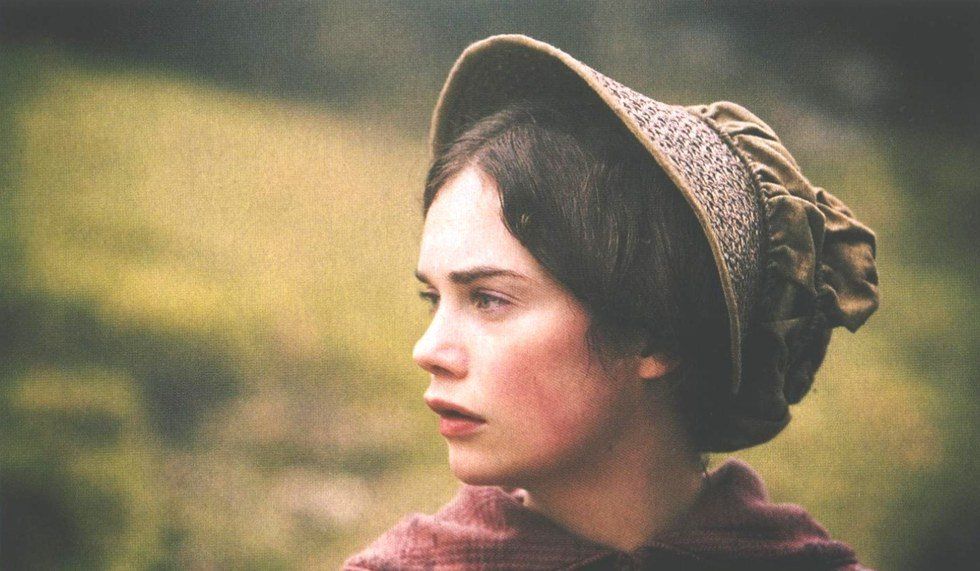
I am particularly humored by the fact that my first article for Odyssey employs a 19th Century British novel. I say this because, by and large, I really despise Brit Lit. The sentences are lengthy and composed of various clauses that have a circumlocutory vibe to it. I found the books confusing, because everyone was named Charles, Edward or Darcy. Was there no variety, for God’s sake? In my senior year AP Lit class, which put almost a semester's worth of focus on Brit Lit, I got into the routine of putting on my "Victorian Face" (as I call it) and elongating words with the most obnoxious British accent I could muster. My teacher definitely loved me saying "Dahhcy" over and over again.
However, in spite of this horrendous disposition I have with this genre, there is one story that lingers in my mind, even after more than two years following my first reading of it. Charlotte Brontë’s Jane Eyre is, I believe, among the most revolutionary novels ever written. It is one of my favorites, too. I read it in AP Lit against my own reluctance. I was seventeen, and was not keen on reading some "stupid romance novel." What ended up happening, though, was something completely beyond expectation. I didn’t think "Jane Eyre" would affect me like it did; I certainly didn't think it would change my ideology so forcefully, and it is with this in mind that I love "Jane Eyre" so much.
Not only is it now one of my favorite stories, it was one of the first things that helped me to realize, understand and embrace feminism. I'd always been for gender equality; thanks in part to my parents, who raised me to be conscientious. I will never shy away from the term "feminist", either. I am a feminist by and by. All that being said, I had a hard time conceptualizing ideas on gender equality, because I lacked a very important element: empathy for women. This is certainly not to be confused with pity. Women are highly intelligent and capable people. No- what I lacked was empathy: the ability to understand and share the feelings of others. It was with the help of the masterful narrative of Jane Eyre that I was able to begin to empathize with the plight of women. Before "Jane Eyre" I was really a product of the world in which we live; implicitly misogynistic, or if not that much, just ignorant of it all. I didn’t really think about what was going on beyond the billboard of the beautiful woman. “Oh, she’s nice to look at,” I’d think, and move on. I wasn't able to see further than the pretty lady. It was in my reading of "Jane Eyre"- getting the chance to experience misogyny through the eyes of a woman from adolescence to adulthood- that incited a kind of internal revolution that got me on my feet, proudly adding the word ‘feminist’ to the list of things I identified as. Soon after, I took to reproductive health rights. I went so far as to wear a hot (as in temperature, definitely not attractiveness) Batman onesie and cheap mask and donned a sign that read “WOMENS RIGHTS NEEDS A HERO” and paraded up and down the street of my very socially conservative hometown, all the while having insults hurled at me by people.
"Jane Eyre" has impacted my life in such a way that I believe I would not feel as strongly as I do now about gender equality. It is with this reason that I encourage all people (especially men) to read the book. If for nothing else, male readers are at least being introduced to the sexism that (unfortunately) many women still endure today; sexism that men would otherwise be ignorant to. If you, reader, have not read Jane Eyre yet, by all means do. You'd be surprised at what ideology lies in those pages.