Personalities: We all have them. It is what sets us apart from one another and makes us unique. It is what motivates us, drives us, and inspires us to venture out, or, perhaps urges us to stick close to home. From the time we enter into this world, we present an open mind. In our environment, in our home, the people around are nurturing and influencing the several components that make us who we are. Our temperament, which is genetically determined, gives way to how a child approaches the world or how they discover more about their environment. As we begin to sprout from infancy into adolescence, our cognition grows profoundly, allowing formation of specific qualities and quirks. Even into adulthood, personalities come and go and as we are introduced to a new day everyday, we are given the opportunity to face each day with a new perspective. However, the two "main" categories of personality types, introversion and extraversion, are solely dependent on the wiring of one's brain.
In the late 20th century, Carl Jung, founder of the school of analytical psychology, took it upon himself to develop a theory of psychological types based upon attitude, perception, and judgment. From this, the terms introverted and extroverted were introduced. Extraversion and introversion can best be described as a person's energy expression. As an introvert myself, I have a tendency to find pleasure by myself and exert energy into my passions quietly and delicately. Retrospectively, an extrovert has a higher level of energy when surrounded and encouraged by others.
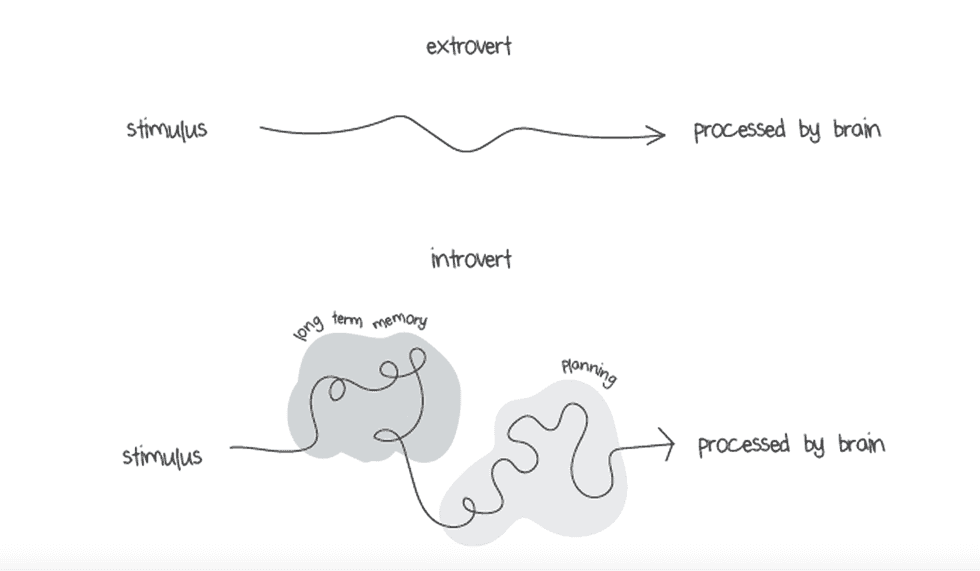
In a study displayed in Medical Daily back in 2012, researchers conducted an examination looking into the mind of introverts and extroverts and found a significant structural difference. An introvert's brain showed to have a higher percentage of gray matter, the part of the brain that conducts messages and allows for abstract thought, in comparison to extroverts. The following year, Discovery Magazine released another study highlighting an extrovert's happiness from an environment and connecting it to their larger right hemisphere in the amygdala.
More so during my high school years, I discovered my true self when faced with a major shift in my environment. Having moved from public school where I knew nearly everybody to a private institution where my slate was wiped clean. The adjustment took a while as I found making friends to be difficult in classrooms as opposed to sports, since I spent nearly every day with my teammates for hours each afternoon.
Once I entered my junior year, I decided to test out the waters and enroll in several AP and Honors courses; AP Literature was my kryptonite. In a classroom surrounded by many outstanding voices, I shied away, keeping my thoughts to myself for the fear of not bringing insight to any of my peers. As an introvert, it took a while to break out of my shell, but consequently, judgment seemed to settle in.
Stuck-up. Rude. Standoffish. Even in social settings with some of my classmates (or even strangers), I became insecure because I felt as if introversion was a curse and that free-thinking to myself was meant to always be shared. It took all I had to speak up in Socratic Circles. I found myself drained after each class because I was bombarded with so many strong opinions and felt that what if what I had to say was not good enough? In a room full of extroverts, my introverted nature surely shined.
All too often, negativity comes forth when discussing introversion versus extroversion. We are the ones who stand out like a sore-thumb in massive crowds, or the ones who are outspoken when all we need is a little more time to think. But, this is not who we are or what we stand for.
We like to dwell on situations, we like observations and not being interrupted. We can't always be the wittiest responders when surrounded by new acquaintances, but get us in a group with our familiar crowd and that's when you can see our happiness blossom. Just like extroverts, we, too, have imaginations and are creative. We will accept encouragment, in fact, we still need it from time to time, but understand we need to recharge ourselves with time alone. We can't pull conversations from thin air, but we are more easily engaged with smaller groups.
Being an introvert has paved the way for what I wish to do beyond my schooling. It has given me the push to speak my voice more openly via social media. It has allowed me to take on opportunities, such as The Odyssey, and feel more poised in my expressions. Lead me to a quiet room with a pen and paper (or a laptop) and I can create something as intricate as my personality.