
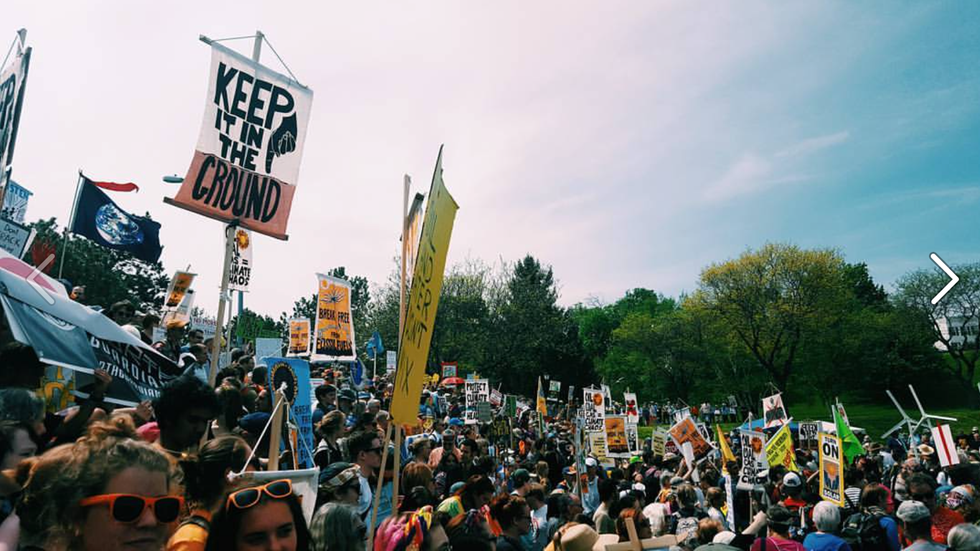
Several weeks ago, 350.org organized just over 20 international protests against the fossil fuel industry as a part of the Break Free from Fossil Fuels movement: the largest ever series of global civil disobedience actions. There were four actions throughout the United States, and the Northeast action happened to be in Albany, NY—nearly 20 minutes from my home. I managed to mobilize 20 Dartmouth students to participate in the action with me on May 14. The action plan: meet in Lincoln Park, listen to speakers in the community that are directly affected by the industry, march throughout the streets of Albany alongside thousands of concerned citizens, and finally end our pavement-pounding with a human blockade literally on the tracks of the trains that carry oil and gas from the Bakken shale through the city of Albany and then up and down the coast. The entire weekend was filled with a lot of subtle and not-so-subtle social nudges (Take a look at Nudge: Improving Decisions About Health, Wealth, and Happiness by Richard H. Thaler and Cass R. Sunstein for more on this topic), which influenced a lot of peoples' behaviors. Looking back, there was one moment in particular where one unique chant encouraged hundreds of protestors to unify their voices and actions beyond the trains.
As we marched, we carried signs that said: “oil and water don’t mix” and “stand up to big oil” and yelled chants like: “keep it in the ground” and “ain’t no power like the power of the people ‘cause the power of the people don’t stop.” Our signs and our chants certainly served as a specific kind of nudge—some more pervasive than others, yet they all certainly encouraged those curiously watching us from the sidewalks to wonder why they weren't marching in the streets, too. Those that spoke to the protestors before the action consistently stressed that all of us protestors consider the intersectionality of climate justice and racial, social, economic, political, indigenous peoples’ etc. justice—an element that is so vital, if not the most vital of vitals in the movement to dismantle systematic failures. What happens in most of the environmental protests I have participated in is that eerie “mob mentality” quickly dissolves the intuitions of the individual, and we all tend to quickly assume a role as just another one of the "masses". Marching, chanting, singing, and moving as one collective unit surrounded by thousands of like-minded individuals is extremely powerful. Yes, there is something to be said for that someone that actively does not succumb to the movements of the masses on a daily basis. But, the point of a protest is to demonstrate unity and that, to a certain point, the concerns and wills of the individual should be overshadowed by the larger movement in order to demonstrate firm togetherness.
The issue on May 14, though, was that the importance of recognizing intersectionality quickly faded from the action itself as we began to move—something that typically happens during organized protests. We chanted and sang songs about climate change, environmental degradation, pollution, our futures, etc., and even though those directly affected by the fossil fuel industry in greater Albany are primarily minority communities, no one started any chant for racial justice. The students I was with noticed this about halfway through the march and decided it was time to reframe our mindless voices and make our words more active and representative. We nudged the crowd to consider the presence of environmental racism in Albany by starting a “Black Lives matter” chant. At first, it was clear that we were alone in our decision to reframe our movement in order to highlight the intersectionality between climate and racial justice. Soon though, the people joined us. Before we knew it, hundreds of people were sincerely--not mindlessly--chanting “Black Lives matter” throughout the streets of Albany. The handful of students that made a decision to reengage our voices with the initial intentions of the action truly managed to change human behavior for a few fleeting moments. From then on, we overheard conversations about race, class, how the fossil fuel industry directly affects marginalized communities, and more. We chose to add three more words to the conversation, and those three words quickly revolutionized the movement. Our subtle yet powerful nudge encourage thousands of people to change their tone, their voices, and their actions.