“Dude, there's, like, zero diversity in our cast this year.” His words may not have been particularly eloquent or poetic, but my classmate, Jeremy, still had a valid point.
“I think you’re right,” I chuckled, “I might just be the sole minority in the entire musical.”
“Yeah, but you don’t really count,” he said, elongating each vowel sound in a condescending manner, “I mean, you’re not, like, actually Spanish. I’m talking about, like, real minorities, you know?” Jeremy’s statement was fundamentally erroneous; its ignorant and misguided interpretation of what defines authentic minority heritage lacked any clarifying guidelines. And yet, I understood exactly what he meant.
As an actress, my versatility and emotional empathy enable me to alter my identity in order to portray myriad emotions and physicalities. In a sense, actors are chameleons; because our existence is so largely defined by our ability to transform ourselves, our true personalities become muddled with those of our characters. Likewise, I frequently find myself shifting between two distinct, and oftentimes contradictory, realities.
My parents were both the first of their families to leave Argentina. What was initially intended to be a temporary study abroad to the United States quickly became a permanent move, as they had ultimately found themselves with stable careers and three children. Being raised in an exclusively immigrant household, my upbringing was primarily reflective of the Argentine culture my parents were familiar with and raised in themselves. While other moms baked cookies and brownies for class bake sales, Mami would proudly showcase her homemade alfajores de maizena. While my peers often received an allowance upon completion of their chores, Papi scoffed at the thought of rewarding behavior conclusively expected of all family members. “What, do you want a prize for flushing the toilet, too?” he would say.
During the holiday seasons, most of my peers would drive to their grandparents’ homes. I, too, would sometimes visit my grandparents, but I would have to travel by plane. In the United States, Christmastime meant snow, hot cocoa, sledding, and snowmen. In Argentina, Christmastime meant summer, maté, sand boarding, and dips in the pool that lasted hours. While my friends woke up christmas morning to find presents under the tree, I stayed up until midnight Christmas Eve, nervously awaiting the arrival of Santa (i.e my uncle wearing a cheap costume and a hastily glued beard). For them, Christmas dinner consisted of honey glazed ham, mashed potatoes, and pumpkin pie. For me, Christmas dinner was held on Christmas Eve and consisted of asado, tarta de espinaca, alfajores, y helado de dulce de leche.
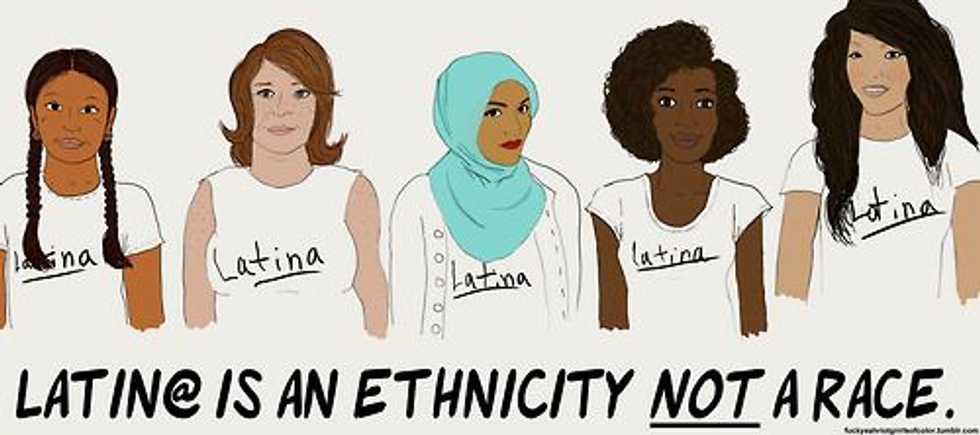
My white friends embodied an American culture that, despite having been fully immersed in from birth, I could never fully identify with. As a result, integrating with them socially was an immense struggle for me throughout elementary and middle school; I simply did not fit in with them culturally, and could not relate to many aspects of their lives. However, they couldn’t understand why: in their minds, I was nothing like the other first generation Latino Americans they knew. My external appearance, for example, did not at all conform to the physical traits frequently, and usually incorrectly, associated with Hispanic ethnicity by my classmates. Ultimately, my heritage and identity were rejected by my white peers, simply because they failed to reflect their already firmly implemented idea of what my heritage should be.
Because of my pale complexion, I have frequently been on the receiving end of privileges most Latinos — many of my own family members included — are denied. My presumed whiteness, for instance, has enabled me to enter any public space without suspicion. I have never been harassed by strangers for my ethnicity, or accused of being an illegal immigrant. When Donald Trump makes racist remarks about Latinos, I doubt he envisions someone who looks like me. By virtue of being merely a few shades lighter than my parents, aunts, uncles, and cousins, I am automatically exempt from many of the struggles they face in America every day. As a result, I am left in this awkward middle ground: I don’t belong in white culture, but I also can’t claim to experience all aspects of Latinidad.
By being white-passing, yet not actually white, I have become neither identity. I am nothing, and I belong nowhere. I suppose that’s why acting comes so easily to me: both spectrums of my cultural identities have such rigid expectations of homogenous ethnic conformity, I am forced to alter my persona one way or another in order to be accepted. I am a chameleon; I can switch from Latina to American with ease. But ultimately, chameleons are merely disguising themselves. I am not one or the other: I am both. And when I discard one identity in favor of the other, I am not just being an actress, or a chameleon. I am being an imposter.