


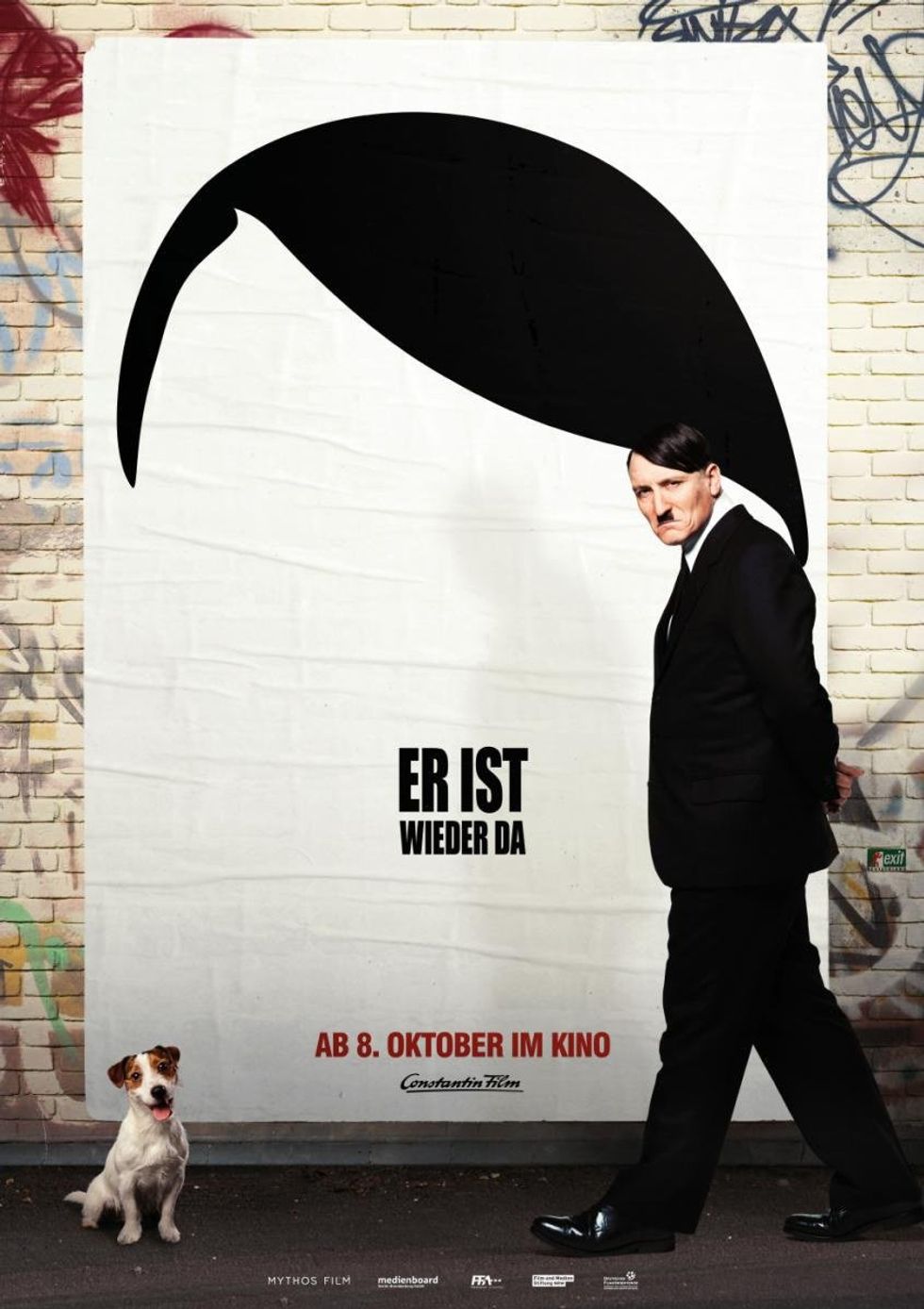
The rise of Adolf Hitler and the Nazi party have long been difficult to poke fun at without raising outrage. Past cruelties and horrors linger in the minds of those who witnessed them or heard stories from their parents, grandparents, and teachers. With rising tides of immigration in Europe, some locals are returning to ideas such as "Germany for Germans." I didn't expect to find an in-depth analysis of the modern immigration crisis and international xenophobia in a German comedy. "Er ist weider da" (Look Who's Back), based on the novel by Timur Vermes and directed by David Wnendt, provided just that.
The film opens in the year 2014 from the view of a confused, recently reincarnated Adolf Hitler at the site of his suicide. As Hitler stumbles about finding his bearings in the modern world, a filmmaker named Fabian Sawatzki is busy filming for a documentary on underprivileged children and captures Hitler’s rebirth in the background. Hitler wanders off into modern day Berlin, viewing everything through the perspective of the real leader of the Third Reich. However, the crowds of Berlin misinterpret him to be a comedian who is just overcommitted to his character. He arrives at a newspaper trailer and faints upon realizing what year he’s awoken to. After waking up in the care of the trailer’s owner, Hitler begins to read up on the loss of the war, modern German culture, and the current political climate of Germany. Meanwhile, Sawatzki has had his documentary rejected and is reviewing the unused footage. Upon noticing Hitler in the background, Sawatzki sets out to find Hitler. The two meet at the newspaper trailer, and Hitler agrees to travel across Germany with Sawatzki to make a Borat-esque documentary about the political opinions of Germans. What follows is a series of unscripted scenes where Hitler interacts with native Germans, asking about what they are most concerned about with Germany’s politics. Many of them respond with an animosity toward the immigrant population that has been moving into Germany over the years. Sawatzki shows the footage to a Berlin TV station, who begins to feature Hitler as a character on many of their shows. The on-air exposure leads to the rise of Adolf Hitler as an internet sensation. His jokes about “Germany for the Germans” and other remarks slowly evolve into an actual political movement with these policies. Though Hitler is dropped from the TV station after footage of him shooting a dog is released, he finds his footing by writing a book about his experiences with the modern world. This serves as a second "Mein Kampf," and results in a movie production of his interaction with the modern world. As the movie becomes widely popular, Hitler plans his rise to the top of German politics on the wings of xenophobia. The film ends with Hitler’s voice over real-life footage of anti-immigration violence and demonstrations saying, “I can work with this.”
This movie tackles a prevalent subject in modern day politics. The most likely candidate for the American Republican Party nomination, Donald Trump, is using similar xenophobic rhetoric to build his campaign. Mr. Trump has publically announced plans to build a wall across the United States-Mexico border on multiple occasions. His website places the blame for America’s economic problems on illegal immigrants from Mexico. This blame was followed by the suggestion of expensive plans to deport those immigrants and remove the rights of their children born on American soil to citizenship. The anti-immigration plan doesn’t stop there. Mr. Trump has also suggested not only the documentation of every immigrant for a national database (this started as just Muslim immigrants, but his stance has changed), but also that all Muslim-Americans be registered into a database and carry special cards to
Adolf Hitler started out his political career in a similar fashion by declaring that the post-World War I economic problems of Germany were caused by its Jewish (a.k.a. non-German) citizens. Jews were forced to register and carry special papers to identify themselves. Non-Germans were second class citizens. This parallel might seem small and coincidental, but it is often said that no one expected the Holocaust to result from the registering of Jews. Hitler was undisputably a powerful public speaker who knew how to cater to his audience, much like Mr. Trump. His fear-mongering, hate-generating rhetoric has now passed on to a new generation and a new nation. The climate that the Trump Campaign is trying to build is exactly the kind of thing that Hitler saw at the end of the movie and decided he could utilize to return to power.
The film, currently available on Netflix with English subtitles, is intended as a wake-up call to the German people to check their animosity toward the immigrant and refugee population. Americans should recognize the similar situation in our own country. I hate to be that guy who sits around and compares every politician he doesn’t like to Hitler. However, the parallels drawn by the film woke me to some eerie similarities between time of the rise of Nazism and modern day immigration issues in Europe and America. This article is a reminder that history can and will repeat itself given the opportunity. Please, heed it’s warning. Stop the hate.
















