In Todd Boyd’s The New H.N.I.C: Death of Civil Rights and the Reign of Hip Hop, he states that the acronym used in the title of his book is a reference to “a phrase in the 1970s- head nigger in charge. N-i-g-g-e-r, for so long was considered a derogatory word” stemmed from slavery and racism. However, hip-hop has evolved and “changed the meaning of that word - N-i-g-g-a." Tupac Shakur, one of the greatest artists of all-time, said that abbreviation stands for “Never Ignorant Getting Goals Accomplished.” So now, for many people that word is a modern demonstration of declaration.
Here is a list of some political hip-hop albums:
Mos Def's "Black on Both Sides”
Tupac’s “Strictly 4 My N.I.G.G.A.S…”
N.W.A’s “Straight Outta Compton”
Jay Z’s “The Black Album”
Talib Kweli’s “Beautiful Struggle”
Beastie Boys’ “Licensed to III”
Nas’ “Untitled”
Kendrick Lamar’s “To Pimp a Butterfly”
Beyoncé’s “Lemonade”
This list of albums has changed the meaning of hip-hop from what some used to describe as meaningless noise, and an obnoxious youthful movement to rebel against society. Over the past twenty-years, hip-hop as a culture has developed from a subcultural trend from the South Bronx to being a passionate, transcendent and honest art, speaking against modern day corruption. Though the roots of hip-hop are informed from impoverished Black and Latino youth groups in South Bronx, New York, this culture has revolutionized since and has developed into a phenomenon that has had a tremendous impact globally.
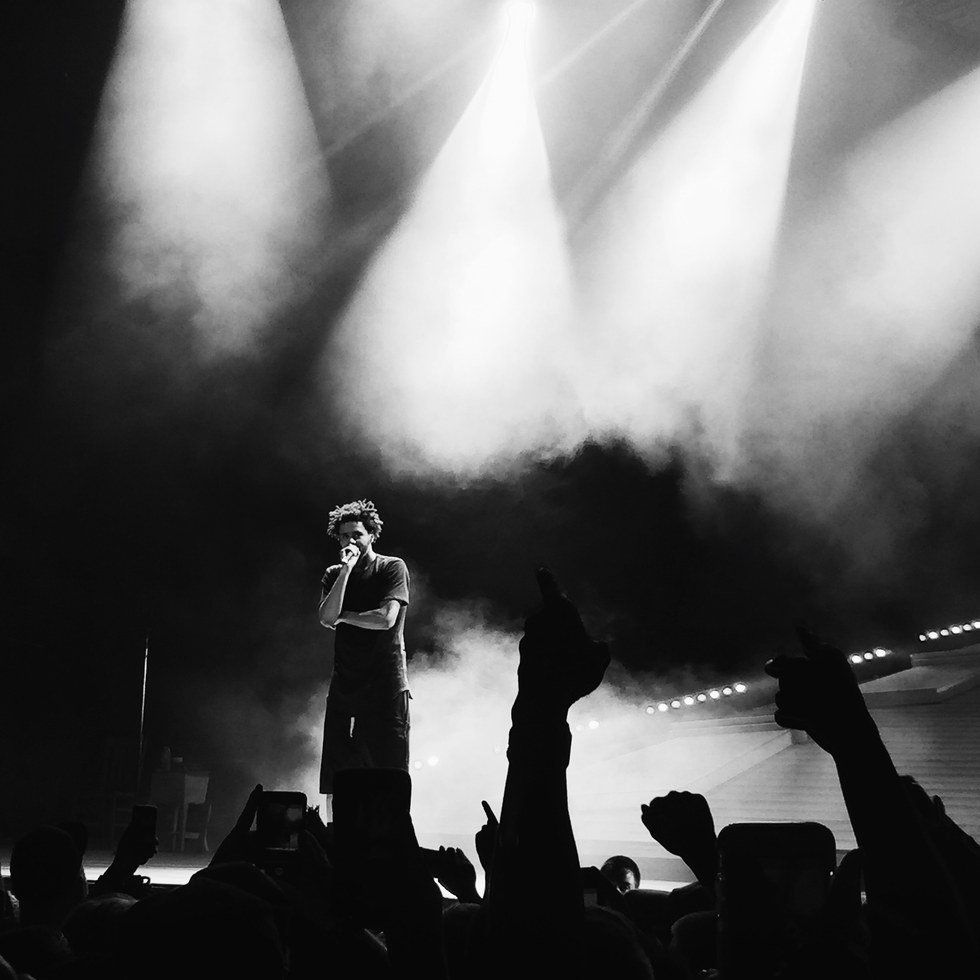
J.Cole’s “Be Free,” is a tribute song in response to the murder of Michael Brown, an 18-year-old Black man who was shot by a White police officer, Darren Wilson. This shooting is commonly known as the “Ferguson Shooting.” This tragedy sparked a global-level controversy over police authority and racial profiling. In his song, J.Cole repeatedly sings, “All we want to do is break the chains off/All we want to do is be free,” alluding to the injustice of African Americans that is still happening today. He also sings, “Can you tell me why every time I step outside/ I see my niggas die.” In these lines, Cole sheds light on the oppression Black people face at the power of law enforcement. Cole includes a recording of an eyewitness who was walking with Mike Brown. He uses the witness’s claim to help listeners visualize what truly happened. When J.Cole released “Be Free” on August 15, 2014, he sent out a message saying: “Rest in Peace to Michael Brown and to every young Black man murdered in America, whether by the hands of White or Black. I pray that one day the world will be filled with peace and rid of injustice. Only then will we all Be Free – Cole.” Cole uses this heartfelt message and tribute song as an opportunity to voice his condolences and attract national attention to shed light on a recurring problem.
In Kendrick Lamar’s 2016 Grammy performance he entered the stage shackled with chains while his band was in jail cells, demonstrating slavery and racism. Before concluding his performance, he showed the word Compton over an image of Africa. This controversial performance was one of the most legendary political statements to step foot at the Grammy’s. As Kendrick spits “The blacker the berry, the bigger I shoot,” he speaks directly to the modern day experience for African Americans in America. This song is also a modern day spin off of Tupac’s “Keep Ya Head Up.” In Tupac’s song he raps “The blacker the berry, the sweeter the juice,” suggesting that darker women are more beautiful, a statement that contrasts to the modern sentiment of lighter skin being a mark for beauty. While in Kendrick’s song, he uses these lyrics to expand on the idea that all Blacks experience political turmoil, despite their gender. Kendrick uses his song as a tribute to Tupac’s, expressing similar values about Black beauty.
Another memorable performance was by Beyoncé at the 2016 Super Bowl Halftime Show. Beyoncé appeared on the stage singing “Formation,” a Black Power anthem. She took the field dressed in a black leotard, in reference to the Black Panther party. The song is an obvious social injustice anthem in response to recent tragedies and her way of expressing appreciation to her heritage. An example of this is demonstrated in Beyoncé’s recreation of Hurricane Katrina in her music video. Beyoncé includes Messy Mya’s famous quote, “What happened at the New Wil’ins?” during the recreated scene of Hurricane Katrina. Messy Mya was a raw and politically incorrect New Orleans comedian who was the victim of an unresolved murder. Beyoncé including this in her song encourages listeners to question the murder of Messy Mya and the protection of Black people in New Orleans after Hurricane Katrina. The government failed to protect the people of New Orleans, sparking attention to the inequality and racism that is still prevalent across the United States. Therefore, the quote, “What happened at the New Wil’ins?” is a relevant question for many of the deaths of unarmed Black men and women at the power of law enforcement. Beyoncé’s performance and powerful lyrics are important to the Black Lives Matter movement considering her fame and influence among many people. Beyoncé uses her praise as a powerful platform to speak out about the injustice that is still occurring in modern day America.
In the White America, which we inhabit, the African American culture has experienced more societal trepidation than the dominant social class. The underlying social structure integrated in our society limits Black people’s mobility to gain power and equality, ultimately perpetuating inequality between classes. Therefore, the use of political hip-hop has given people an opportunity to express societal struggles regarding the conflict of assimilation. This music genre has been used as a nod to Black Lives Matter and seeking justice for Black people. Through the art and rhythmic poetry that hip-hop embodies, it is evident that it is a contemporary form of a post-civil rights movement.