
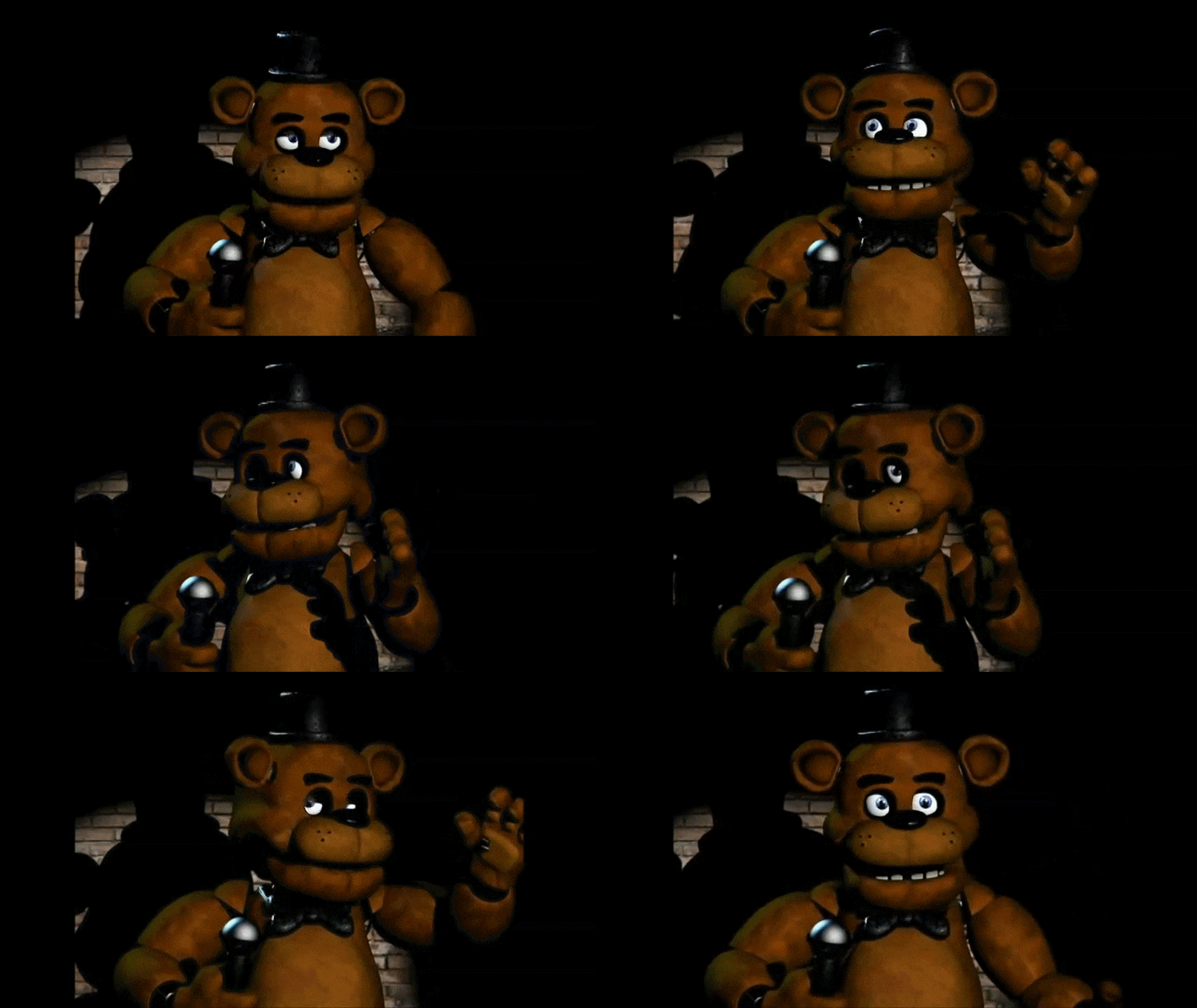
Since its release in August 2014, I've grown incredibly attached to the gaming phenomenon known as "Five Nights at Freddy's." Its unique take on the horror genre in video games has struck me in a soft spot I have yet to show towards other movies and games. The way the game forces you to watch your potential death (in the game, of course) creates a fear no other horror game has made me feel. While the story sounds ludicrous on paper, the way its one-man development team, Scott Cawthon, uses the eerie style of Playstation FMV sequences makes the murderous animatronics all the more terrifying. Oh, the chills I felt when I first saw Bonnie staring into my soul! It puts "Dead Space" to shame!
Imagine my surprise when Warner Brothers came out in April and announced that they have struck a deal with Scott Cawthon to produce a "Five Nights at Freddy's" movie. I instantly texted almost everyone in my phone's contact list. Ask any of my friends and they'll tell you I'm like the crazed, obsessed ex to "Five Nights at Freddy's," looking over its shoulders and asking, “Whatcha doing? Who is that you're texting? Whatcha thinking about? When will you start the next sequel? Send me a pic? You were supposed to check in with me two minutes ago!" Indeed, this past month has been a non-stop hype train for me, searching any bit of news I can find on this newly-developed adaptation.
But, that word got me thinking for a while: "adaptation." Most Hollywood films, in recent years, have not exactly been the most original. It seems like every film these days has to be from some other time period in the form of a reboot, remake or rehash. Most of the time, it doesn't even work out. "But, Tyler," you say, "what about films like 'Dredd,' '21 Jump Street,' and 'The Avengers?'" Those are good examples of recent successes, but when you look back, some of the more notable movies that are based on properties with enormous fan bases tend to strike out, critically and/or financially. Films like "The Last Airbender (2010)," the "Mortal Kombat" movies from the '90s, the "Twilight" series, "The Thing (2011)," "Battleship (2012)," and the infamous "Super Mario Brothers" movie from 1995 have served as reminders that adaptations rarely work out.
However, when you look at it from a filmmaker's standpoint, there are a lot of questions to be asked, and often, do they conflict with each other. The first issue that always needs to be solved is, "How much freedom do I have with the property?" While filmmakers should be free to express themselves and build a story they want to tell, it doesn't really work out too well when adapting a popular franchise. Just because Joss Whedon managed to make a success doesn't mean every adaptation will be. Some directors tend to stray too far away from their adapted subject. "Super Mario Brothers" had, practically, no resemblance to the "Super Mario" series. When have you ever played a game of "Battleship" where aliens attacked, before the movie was made? Too much freedom in an adaptation could lead to the film looking nothing like its source material. It's important to be careful and highly advised to work with the original creator as closely as possible. Spielberg did so with "Jaws," and he even had the author of the book adapt and write the screenplay. Look how amazing that film turned out to be.
The second question a filmmaker should ask themselves is "How close to the source material should I get?" This is where adaptations get a little conflicting. The filmmaker could follow every detail from its source material and the whole movie could still go horribly wrong. "Doom (2005)" followed the same concept as the video games, following mercenaries through a space station that is overrun by mutated monsters. Unfortunately, its execution was poor with bad writing, bad acting and a badly animated first-person sequence that was supposed to pay tribute to the video game series. In order to avoid this, it's important that the filmmaker finds an appropriate balance between the film and the source material. One example of this would be "Lemony Snicket's A Series of Unfortunate Events (2004)." The film captured an art style similar to illustrations from the book, and the story was able to squeeze three books into a story that made the film its own unique entry in the Lemony Snicket series. And if that wasn't enough, Jim Carrey managed to portray Count Olaf like the schmuck he was in the books.
The final question the adapter should ask is, "Who is my audience and what are they expecting?" The team for the "Five Nights at Freddy's" movie is going to have a really hard time solving this filmmaker's riddle. Since the fabrication of the first "Five Nights at Freddy's," I've slowly learned over time that the series has developed an enormous fan base, and that fan base consists of three completely different age groups: adults (ages 23 and up), adolescents (ages 10 to 22) and children (ages 3 to 9). Yes, there are children in kindergarten who are big fans of the "Five Nights at Freddy's" series. I have a friend who works as a teacher and all of her 5-year-old students love it—a game about murderous animatronics, haunted by the ghosts of dead children who were brutally murdered by a mysterious serial killer.
There are a number of ways that "Five Nights at Freddy's" can be developed for a movie. It could be an animated family movie with tons of antics and hijinks between the animatronics. It could be an R-rated horror movie with intense gore and language with the gritty atmosphere of a "Texas Chainsaw Massacre." It could even be a horror-comedy and end up like "Piranha 3D." And the one thing that makes this whole project more fatigue-inducing and stressful in every demographic is that there is a very slim chance the "Five Nights at Freddy's" movie could satisfy all three age groups.
Let's pause for a minute and ask ourselves this. When was the last time a movie received a PG rating from the Motion Picture Association of America, gave off a scary feeling of any kind (creepy, freaky, dark, disturbing, etc.) AND entertained all three age groups? Think far back, almost a decade ago, to 2006, when Columbia Pictures, Robert Zemeckis and Steven Spielberg brought us "Monster House." The dark fantasy told us a tale about three kids, determined to take down a possessed house. With the eerie backstory and frightening structure of the house itself, it became a pretty memorable film and is still enjoyable to watch to this day. Some horror fans may be entertained by the way the film pokes fun at the clichés found in the common slasher flick. I screened it with my friends, with my younger brother, even my parents enjoyed it, and we ended up watching it for a couple Halloweens after our first viewings. It has that perfect balance of humorous and slightly frightening that gives a true experience for “the whole family to enjoy" without going over the edge on being too childish or too frightening. While the mention of "Monster House" may bring hope to the "Five Nights at Freddy's" movie, it's important to note that "Monster House" was not an adaptation.
While we've established an example for scare value in a family-friendly movie, "Five Nights at Freddy's" still has a big obstacle to face: the source material. Since the first installment in the series, "Five Nights at Freddy's" has provided a somewhat obscure backstory on what happened in the game's fictional restaurant, Freddy Fazbear's Pizza. We know that children were murdered and are now haunting the restaurant's animatronic characters, but there are still questions that even the developer can't answer, or, at least, that's what he wants us to think. The fans still don't know what exactly happened in "The Bite of '87" and the identity of the Purple Guy killer is still unknown. The only reason we've managed to figure out any sort of backstory is mostly from fan theories.
This is where the source material is going to get challenging. Too much of the source material may turn the film into more of a fan service than a respectable film. Too little of the source material may cause an uproar among fans and make them regret the film's existence entirely. The filmmakers will have to be selective on what details get written into the movie and which of the fan theories makes the most sense for the story. Of course, this may cause some sort of outrage among the fans. However, "Five Nights at Freddy's" is the type of game where there isn't enough plot to confirm backstories, but there is enough to figure out what might have happened. It provides a story that leaves the details open to interpretation.
While it may be concerning to think about everything that can go wrong with this project, it's important that we still give the team, whoever they may be, our faith and respect, at least when the movie is finally released. Adaptations, however, should not be taken lightly and given a heavy amount of consideration and thought before production begins. Never should an adaptation serve as a product wearing the skin of its source material, only to turn out something completely different and horrendous. I'm looking at you, "Battleship," "Mortal Kombat," "Super Mario Brothers," "Doom," "Golden Compass," "Chronicles of Narnia," and the film companies producing adaptations of Tonka trucks, Hungry Hungry Hippos and Monopoly.
Dear reader, don't be surprised when I return to the subject of film adaptations soon. Larry Kasanoff is under close watch on my dirtbag radar and things aren't looking too bright for his career, especially after the way he handled that "Tetris" movie announcement earlier this year. You hear me, Kasanoff?! I'm watching you, and I'm not too happy! It was bad enough when you were put in charge of "Mortal Kombat," and we don't need another good franchise to be bombarded. I'll be coming for your "Tetris" smut in a few months.