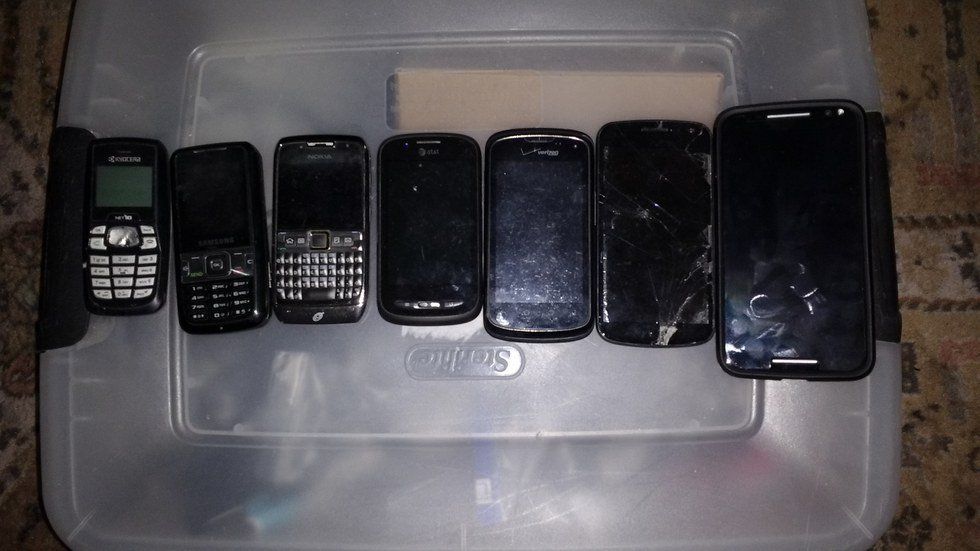
My first cell phone was a Kyocera.
Even by 2008 standards, it sucked. It had no camera, had a black-and-white screen and was slow, but it did (at that time) everything I needed it to: send texts and make and answer phone calls.
It was originally my stepdad’s phone, with service through Net10. By the end of 2009, it was not only obsolete, but I was embarrassed of my phone in a QWERTY world, where my friends in college had phones with cameras, color screens, and better texting capabilities. Some of them even had BlackBerries, and one of my friends from college had a BlackBerry (and oh, was I jealous!).
I bought a new phone.
It was a Samsung slider phone. In comparison to the phone it replaced, it had a full keyboard (so I could send proper texts), a color screen, a camera (a whopping two megapixels) and storage. I liked it, and it did its job for almost three years. It did what I needed it to do, and after a cell tower was built a mile from my home, made perfect calls. However, it wasn’t perfect either, and I had a cell carrier which charged me every time I used the phone for even trivial stuff.
I bought a second phone.
As it turned out, this new phone (a Nokia E71) was a dying breed. Today, it’s practically useless due to its obsolete operating system, and I doubt Android could go on it. However, compared to my Samsung, it had a larger screen, had app support, and a better camera with flash. After a year however, Nokia announced (unofficially, that would come later) that it’s SymbianOS was done for and that Microsoft was taking over, for the most part. Nokia was BlackBerry before there was BlackBerry.
I bought a third new phone.
With what little Christmas money I had saved, I bought a new phone on my way home from my grandmother’s funeral in January 2012. It had the Android OS on it, so I could start using certain apps again (in particular Swarm by Foursquare). It had a larger camera. Quickly I outgrew this phone as between little internal memory and AT&T’s preloaded apps, I found myself often deleting things.
AT&T probably realized it, as the model (AT&T Avail) was replaced by a second revision. And after some problems with Net10 made him reconsider his relationship with the Tracfone family, my stepdad put the entire family on a Verizon plan.
I ended up with a fourth new phone.
The Pantec Marauder was the combination of the best of my Android phone and my Samsung phone. Unlike the ZTE Android phone, it had close to 4GB of onboard storage. I could do much more that I couldn’t originally. The Pantech phone served me well through a miserable 2013, a slightly better 2014.
Towards the end of 2014, I ran into a problem, well--- two problems. First, like with my original Android phone, the Marauder couldn’t handle the larger smartphone apps that have become prevalent. The larger problem was that the power button on the phone stopped working one day, so I was suddenly without the ability to turn it off. In order to make it through the day I started relying on a battery booster and plugging it in whenever I could. I had just started a new job and didn’t have the money for a new phone.
You can guess what I did!
I bought a new phone. Wanting a better interface with little money, and unsure what the future cellular-wise held in store, I bought a discontinued Samsung Galaxy Nexus. It had great features, with ample internal storage, a camera with flash, but like my older phone, had a problem: poor battery life, to the point I’d be desperate for a charger.
With my stepdad again threatening to tell a cell provider to take a hike, I needed a solution and fast. For months, I had been looking at a resurgent Motorola. In 2011, Motorola spun off its cellular line to Google for much needed cash, and Motorola made good on that. The Nexus 6 smartphone was designed and built by Motorola (and shares several features with the Moto X). Motorola even opened a plant in Fort Worth, Texas to assemble Moto X’s (which closed about a year after in opened in 2013). I was sold, and in a way, I jokingly called myself a Moto evangelist. Motorola Mobility does not lie in regards to their “Pure Android” experience, with a light “skin” compared to other Android handset manufacturers (part of the reason why I’ve shied away from Samsung phones, as the TouchWiz interface looks too cartoon-ish). With some determination (and Christmas money), I bought a Moto G at a Best Buy in Midtown Manhattan and signed up for an AT&T contract.
That bus ride home back to my stepdad’s apartment in New Jersey was one of the happiest of my life. I finally had a phone I really liked, a phone that did what I needed it to, and without bloatware. I had a fantastic phone I was completely happy with. I got my updates directly from Motorola, and not my carrier. But by the end of 2015, I outgrew it. The lack of internal storage limited how many apps I could have, the camera was too tiny and I wanted some higher-end features (like near-field communication, or NFC, for payment and other purposes). In January of this year I spent $600 on a Moto X Pure Edition, which is probably the best cell phone I’ve ever had. Originally I was under the impression that due to API issues that the Moto X Pure Edition would not see Android 7.0 Nougat, but it looks like I will be getting a software update after all. I have a combined 192GB of internal storage, and I probably could (with a new microSD card) bump that up to 320GB, even though Motorola says the maximum microSD card it can handle is 128GB. Having purchased a replacement (and having gotten the original phone back too) I’m not going to purchase a new phone until the end of 2017 or the beginning of 2018 at the earliest, but if Motorola can bring the best aspects of the Moto X to the Moto Z, I’m willing to forget my Google Pixel aspirations.
I’d also like to see Motorola make a second generation Moto Z with better battery life, more frequent software updates and generally make it a more competitive phone, as the reviews have been generally unfavorable.
My relationship with Motorola has been mixed. Their phones have received mixed reviews, and after two years of using their products, I have to agree. Motorola has made as many changes too soon (including dropping the Moto E, including support for said phone and soon, the Moto X) to their lineup and the Moto Z, while useful, isn’t 100% recommendable. The sale of Motorola Mobility to Lenovo has left me also less than impressed, as I have a rebaged Lenovo tablet I was never happy with. However, I’m not entirely convinced that the new Pixel lineup from Google can match Motorola’s fantastic (as I found out last week and the week before) customer support and diverse model lineup. Motorola’s extended warranty for the Moto phones is impressive, with the ability to have up to three damage claims in a fifteen month period. Seeing how I rarely damage or drop phones, I only had to dip into that claim when my Moto X was damaged by my stepdad over Thanksgiving. It’s not like Motorola has gone silent on the ad front: the Hello Moto commercials are coming back.
There are Apple fanboys. There are Samsung fanboys. However, I’m sticking with the company that (indirectly, since it’s now Lenovo) gave the world the coolest phone of 2003 and 2004: the Razr flip phone. I do plan to send a letter to Lenovo addressing my concerns with the Moto series.
Maybe Apple’s business model does actually work: keep it simple, stupid.