
How Did It Start?
Everything started in 2001, when Greece tricked its way into Eurozone by concealing part of its debt with some help from Goldman Sachs. In 2011, the former European Central Bank Chief Economist Otmar Issing said to Bloomberg Business that “Greece cheated to get in” the Eurozone. The entrance of an indebted country with surreptitious proclivities to a fragile and untested monetary union naturally led to many catastrophes for both people and national governments.
Political Reactions
Inevitably, an economic crisis brought up a political crisis since Greek people were more or less accustomed to living with money coming from the European Union. In other words, the Greek economy was based on thick grants coming from Europe. Parts of these grants obviously never found their way to the betterment of Greek economy and winded up in a circle of corruption before they “disappeared.” The problem was that the then Greek governments failed to utilize these grants, which were supposed to aid in the development of the Greek economy, because of misuse and personal interests. Overall, political incompetency and lack of political will along with a deeply rooted system of clandestine kleptocracy led the country to major political frustration.
The political crisis became more visible through the citizens’ political swing. Since the beginning of the crisis in 2008-2009, Greek people have elected three different political parties within seven years, PASOK, Nea Dimokratia, and Syriza, while they also saw Mr. Papademos for a short term as an appointed Prime Minister in 2011-12. Mr. Papademos had served a long term (about eight years) as the Governor of Bank of Greece.
Bailout Programs and Austerity Measures
Intensive attempts to rescue the Greek economy were made by the European commission, European Central Bank, and International Monetary Fund in cooperation with Greek governments during the past few years. Most of the reforms that were recommended and eventually implemented in the country were based on austerity and proliferation of taxes.
Prominent economists have argued against austerity policies since they believe that they make things worse instead of ameliorating the economy. Paul Krugman and Joseph Stiglitz, both Nobel laureates in the field of Economics, have supported that austerity measures have not helped the Greek economy to relapse. On the contrary, they became part of the problem and not the solution. In fact, Stiglitz has written in a Project Syndicate article, “I can think of no depression, ever, that has been so deliberate and had such catastrophic consequences.”
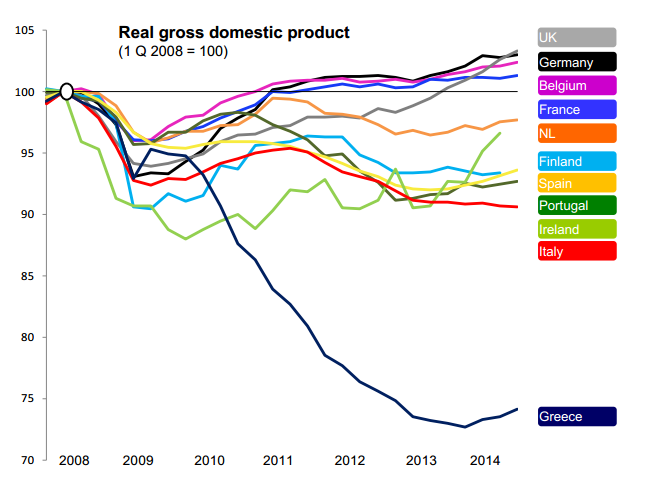
In the long run, austerity measures did not have the desired results. In fact, they severely undermined Greece’s chance to a viable economy, as it can be seen in the graph below.
Latest Negotiations and the Referendum
According to New York Times, the refusal of European institutions to accept financial reforms that were deemed rational by the government of Syriza could be the reason why the Prime Minister Alexis Tsipras decided to call for a referendum. The question of the referendum was if Greek people accepted the reform program coming from the European institutions. The reforms included a massive tax raise on hotels, which was translated as a direct attack to Greece’s most profitable asset, tourism, and were already denied by the Greek government.
“After five months of tough negotiations, our partners ended up with a proposal in the form of an ultimatum,” the Greek Prime Minister said, while he characterized the proposed measures “unbearable.”
A fierce debate immediately started within the country between proponents of “YES” and “NO.” The debate expanded to the main social classes of Greece and led thousands of people to the streets to peacefully fight for the preponderance of their opinion. In the meantime, the peoples of Europe urged Greeks to vote for “NO” and demonstrated their support with protests against austerity.
In the background, panic was evident after the closing of banks due to the ECB’s decision to terminate bank liquidity though the ELA (Emergency Liquidity Assistance). On top of this, national and international pressure started lingering over Greece from people who promoted the European institutions’ proposal. During this promotion, the major Greek private channels were reprehended as fear-inducing and propagandistic.
In spite of the pressure, Greeks decided to vote against the proposed measures with the hope that Greece will stay in the Eurozone with more favorable terms and will be able to chase after a better future.
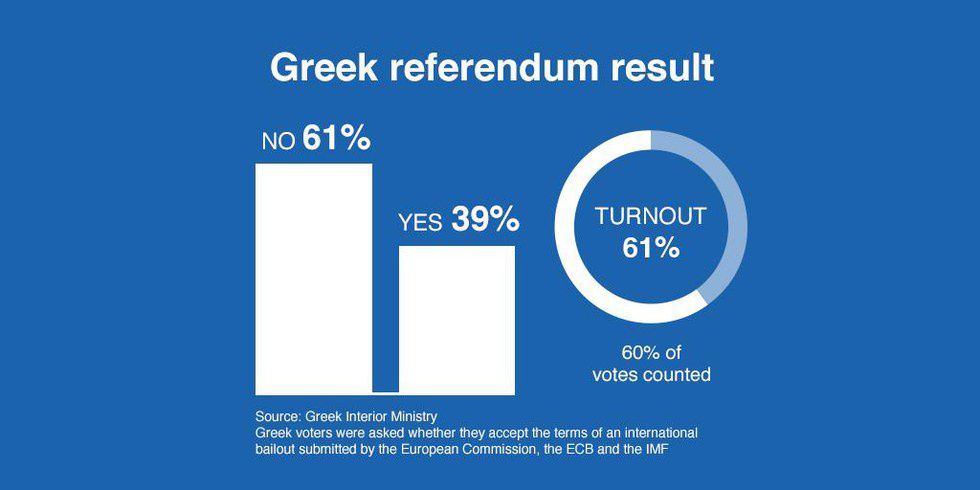
The results of Sunday’s referendum are depicted below.
Initial Reactions After Referendum
Rapid political reactions occurred immediately after the referendum. The Greek Prime Minister Alexis Tsipras hailed the decision of Greek people, while the Finance Minister Yanis Varoufakis supported that Greece sent back the European institutions’ ultimatum and called for an agreement that will benefit Europe in its totality. On the other hand, former Prime Minister and leader of Nea Dimokratia Antonis Samaras decided to resign from leadership.
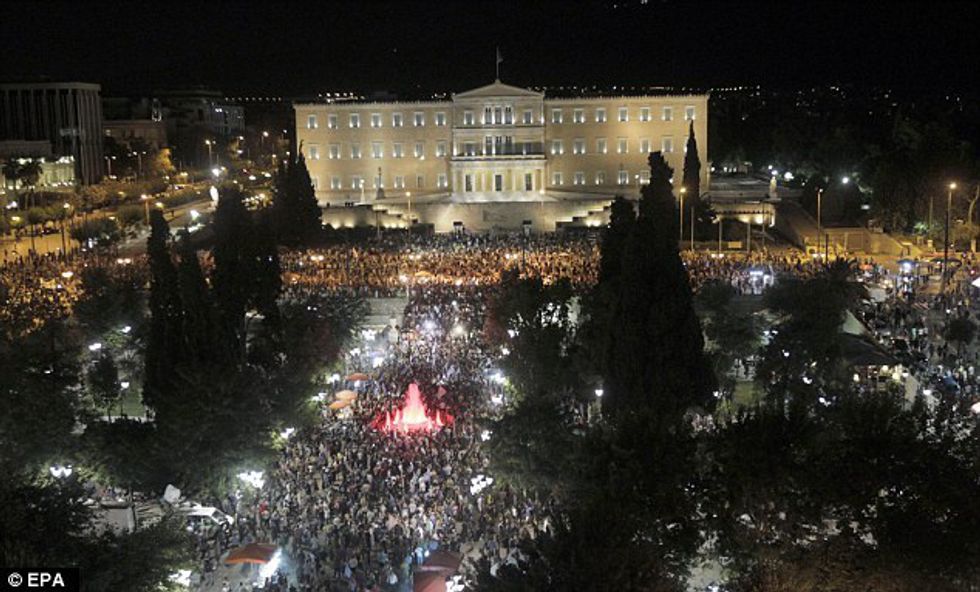
Within the country, people celebrate for the dominance of “NO” and remain optimistic for the future of Greece in Europe.
Outside Greece, Martin Schulz, a German politician and current President of the European Parliament respects the “NO” decision but denounces Greek Prime Minister’s proclamations about negotiations and says that Greece should respect the opinion of the other countries in the Eurogroup as well.
In addition, the Eurogroup President Jeroen Dijsselbloem does not seem content with the decision of Greek voters. In his statement, he supports,
“I take note of the outcome of the Greek referendum. This result is very regrettable for the future of Greece. For recovery of the Greek economy, difficult measures and reforms are inevitable. We will now wait for the initiatives of the Greek authorities. The Eurogroup will discuss the state of play on Tuesday 7 July.”
Future
Global community has supported Greece with protests throughout the whole crisis, but it seems that national European governments do not share the same views with their people. Consequently, the future of Greece is uncertain at this point. A combination of mutual retreat in the negotiations and fierce political will from both ends could be the proper recipe for a successful cooperation between Greece and Europe. The lack of these could prove catastrophic for both sides and could negatively affect the rest of the world.
In any case, the “NO” decision could give the Greek government an additional bargaining chip in the negotiations and boost Greek hopes for a better future.
As Stiglitz supported before the referendum.
“A no vote would at least open the possibility that Greece, with its strong democratic tradition, might grasp its destiny in its own hands. Greeks might gain the opportunity to shape a future that, though perhaps not as prosperous as the past, is far more hopeful than the unconscionable torture of the present.”