

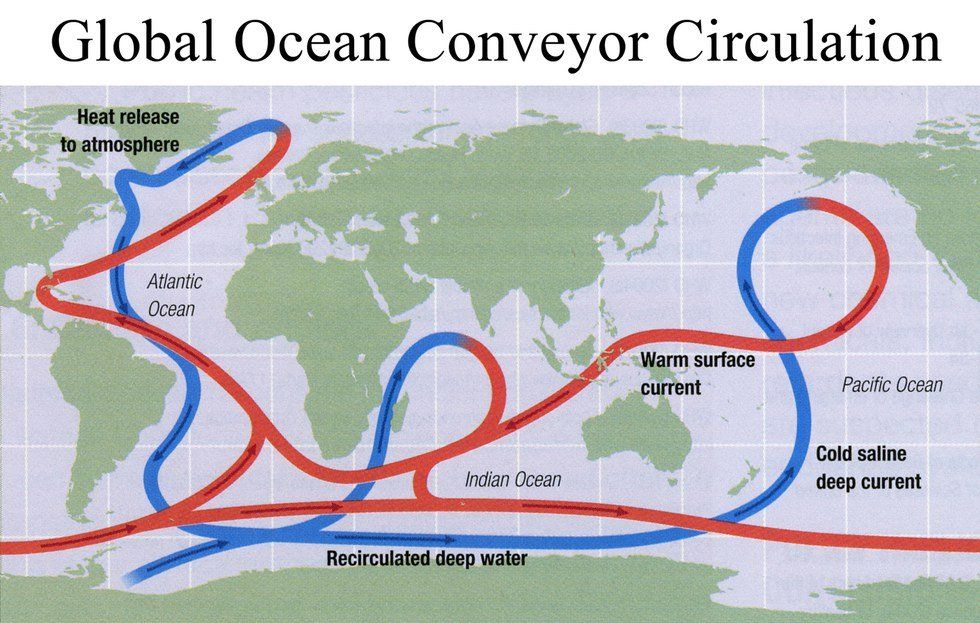
There are many different things being affected by global warming and climate change today, and one of the most important things that is changing is the thermohaline circulation. This is a major component of the Earth's climate, and if the cycle that it is in is broken, than it has huge implications for the Earth's temperatures, as well as ocean salinity and density. This has effects not just on climate, but on many animals and ecosystems in the world. It would cause many species on Earth to go extinct because places where they lived before would become places that are uninhabitable to them. Clearly, it is a very important part of the world that needs to be saved.
The thermohaline circulation is the connection between the major surface and deep water currents in the Atlantic, Indian, Pacific and Southern Oceans. There are multiple things that contribute to how the water is able to continue on in the circulation. Cold water, in general, is denser than warm water. Likewise, water with a high salinity is denser than water that contains less salt. Surface ocean currents are primarily driven by winds, also known as the Ekman Transport Layer. Deep ocean currents, on the other hand, are mainly a result of density differences.
Cold winds blowing over the oceans chill the waters beneath them. These winds also increase evaporation rates, further removing heat from the water. The increased evaporation also results in higher salinity because there is less water than salt. These chilled waters have increased densities, and thus tend to sink. Formation of sea ice also helps to increase the density of water near Earth's poles. As seawater freezes, salt is forced out of the ice, thus making more salt enter the ocean as the ice becomes fresh water. The exuded salt increases the salinity of the cold water immediately below the ice, making it denser still. The salty, cold water near the poles sinks toward the ocean floor. This increasingly cold and salty water is denser than the water that is below it, so it continually pushes it away from the sinking, creating the currents.
Essentially, this is a big convection cycle that is working deep beneath the ocean’s surface. The thermohaline circulation thus carries heat from tropical areas into higher latitude climates, such as the East Coast of the United States and the West Coast of Europe. This in turn keeps those areas temperate and warm compared to other locations at those latitudes, such as Canada, which is typically much colder and harsher than Western Europe in the winter.