As the news cycles stories about the hostages in Iran and the Olympics in Rio, one thing has been a constant since late last year: The Election. The race has been going on for an excessively long time, and, like many other Americans, I look at our two front runners and think Is this really all we've got? From Donald J. Trump, with his loud, off-the-cuff speeches and a knack for controversy, to Hillary Rodham Clinton, who was calmly and casually under FBI investigation, myself and a lot of other Americans feel like we have to choose the lesser of two evils. But does it have to be that way?
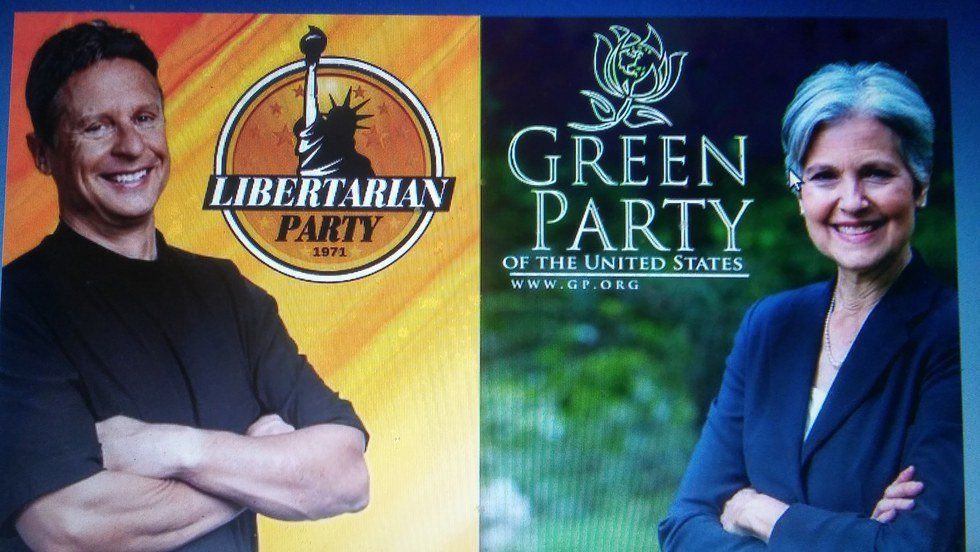
No, it doesn't, and there have been small parties struggling to answer that call for decades. Our two third-party runners this year are Jill Stein of the Green Party, and Gary Johnson of the Libertarian Party. These two have a lot to say, but they don't seem to get much coverage. Gary Johnson was really only talked about when he was chosen at the Libertarian Convention, and Jill Stein only seemed to get much notice when she made waves in support of the Never Hillary group at the DNC. The question I pose then, is why in an election when so many Americans are seeking an alternative to the Republicans and Democrats, do these third party candidates stay mostly unnoticed, with negligible poll numbers? One place to look is how we start our election cycle: debates.
The complaint of many who try to run on a Third-Party ballot is that in order to participate in debates, you would have to at least have 15 percent of the popular vote on Five run-up polls prior to the debate. That's a tough order to fill, and that often leaves many Third-Party voices unheard. Stein and Johnson last July filed a lawsuit against the Federal Election Commission, and the Commission on Presidential Debates, in an attempt to lower these standards. On Friday, August 5th, after sitting on the case for months Judge Rosemary Collyer made her decision, and quashed the candidates' chances of reform. Here is her official opinion.
"The Libertarian and Green Parties and their political candidates sought, and failed to receive, invitations to privately-sponsored presidential debates in 2012. They now seek invitations to this year’s presidential debates, claiming that the rules that bar their participation violate antitrust law. However, because Plaintiffs have no standing and because antitrust laws govern commercial markets and not political activity, those claims fail as a matter of well-established law. Plaintiffs also allege violations of the First Amendment, but those claims must be dismissed because the First Amendment guarantees freedom from government infringement and Defendants here are private parties. Finally, plaintiffs fail to allege facts that could support a claim for intentional interference with prospective business advantage. Defendants motions to dismiss will be granted."
I'll let you read the facts of the case here, but I think this is a sad day for our electoral system. Both parties and private donors spend millions on debates, yet the judge here claims that the Plaintiff's claims on antitrust laws are invalid because it governs only markets? The debate system is most definitely a market of it's own, as is the rest of the political sphere. We've ran with this two party system for 150 years, and if people are dissatisfied, shouldn't we allow other voices, and other options to be heard?
I believe that we've strayed from what the office of president was intended to be. Shouldn't it be that any American with vision, commitment, and ambition can run? Instead we have a rather gamed system, where influence and wealth are the requirements to participate in the race, along with constitutional ones.
My point is this. Letting these third party candidates into the debates, whether they have fifteen, two, or four percent, will allow new ideas and perspectives into the political landscape. It can let those low-polling candidates start to get a following that could take them somewhere. Besides I think we all know, we need more than two parties, a red and a blue, to represent our diverse nation, and it's equally diverse ideas. Realistically, we can't make third party and independent candidates viable overnight, but we can take steps, like the civil case ruled on Friday. But, while Stein and Johnson may have failed in the legal world, there is one voice they can't ignore: The American people. If we raise our voices and our concerns we can to break this duopoly, and hopefully take a step to a better represented America.