
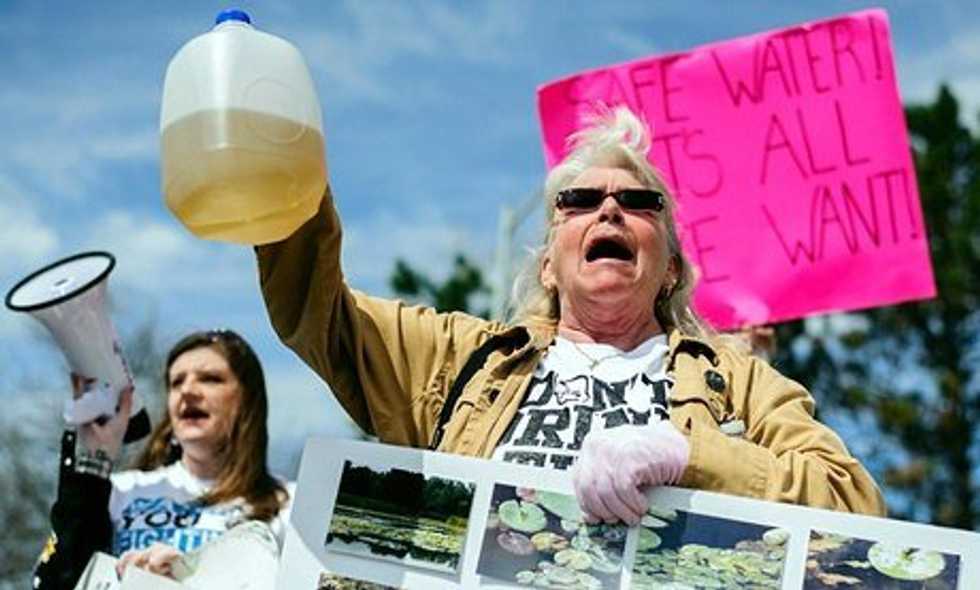
For the past couple of months, there has been a lot of news involving Flint, Michigan, and the injustices committed by the government against the people of the impoverished town. Lead poisoning is now a serious issue affecting hundreds of children, and Legionnaires disease is now sprouting out of the pre-existing turmoil. So, how corrupt is the Michigan government? Are they to blame for all of the problems these innocent citizens are now experiencing?
Absolutely.
Flint has had issues regarding their water supply for over five years, and it all finally culminated into the atrocities that have played out in recent months. It all started in 2011: Flint used to be a town at the heart of the automotive manufacturing world, employing hundreds of thousands of people in manufacturing plants. But as the automotive industry tanked, thousand upon thousands of people in Flint lost their jobs. With so many unemployed citizens, the bottom fell out of Flint’s economy. Crime rates spiked, and Flint quickly became one of the most detestable cities in America. The town completely deteriorated within a decade. Flint quickly went from being a perfect American town to a dump. In 2011, the government finally decided to get involved, and they did just about everything wrong.
In early 2011, the state of Michigan declared a financial state of emergency in Flint and took over budgetary control. Michigan Governor, Rick Snyder, hired a financial manager to handle Flint’s financial crisis. State Congressman Dan Kildee states that his only job was to “cut the budget— at any cost.” Many ideas were proposed, including to cease paying for water from the city of Detroit, which sourced its water from Lake Huron, and instead, start the Flint River as the primary water source for the town. Realizing how much money they could save, the state and local governments enthusiastically embraced the water supply switch—there was no turning back.
Later in 2011, a study found that the Flint River water was much different from Lake Huron water. A study found that in order for the water be considered drinkable, it would have to be treated with an anti-corrosion agent. This agent would cost the state about $100 a day, and experts say, would prevent about 90 percent of Flint’s water struggles. The state, however, thought differently and opted not to treat the water. This decision is the reason everything went awry.
Soon thereafter, the Flint River became the new source of water flowing into the homes of thousands. The source was meant to be temporary until a state-run line was connected to Lake Huron, which was estimated to take about two years, but because of the government’s irresponsibility and total disregard, the water immediately began to come out brown and smelly. It even tasted strange; but the local and state governments insisted that the water was perfectly fine.
Realizing the dissatisfaction of Flint residents with their drinking water, Detroit offered to help. On Jan. 12, 2015, the Detroit Water and Sewage plant offered to reconnect Flint to Lake Huron and waive the $4 million connection fee... but a Flint official declined, claiming the city could not afford the month cost to maintain the connection.
The news was getting out about the high levels of lead found in Flint's water. in July, an internal EPA memo was leaked by the American Civil Liberties Union. It documented high levels of lead in one woman's house—so high, that her son got lead poisoning. Government officials rebutted claiming that there was not enough evidence to support that Flint's water was undrinkable, so a group of researchers from Virginia Tech launched their own study, and also found extremely elevated levels of lead and other toxins. Their research also suggested pipe corrosion, and significant lead leaching. The Department of Environmental Quality still continued to disregard the legitimacy of the findings.
In September 2015, a Flint pediatrician found high levels of lead in many of her patients' blood, but once again the government disputed her findings.
The next month, it was announced that the Flint River would no longer be the water supply, and they would be switching back to Lake Huron. However, because the government failed to add the anti-corrosion agent to the water, the lead pipes had already corroded, and lead continued to leach into the water. Not until mid October did any official admit that they had failed in their duties to protect the people of Flint.
It is a slow road to recovery. The water is still not drinkable and FEMA has been aiding the people of Flint for months. Lawsuits have been filed and officials have stepped down, but it could be years until Flint is back to normal, and some of the children who were poisoned by their own town may never fully recover.
This is Flint's greatest fear—that soon, the cameras will turn off, the reporters will stop coming and telling the world what is happening there. CNN, FOX, MSNBC, ABC... they'll all be gone. And Flint won't know what to do. The world won't know that they're still suffering, and it will be forgotten that the government, for over a year, poisoned it's own people.