
“Even if you know what’s coming, you’re never prepared for how it feels.” — Unknown
I read this quote about 15 minutes before leaving to go to a funeral for a young girl, who I knew was dying months in advance. Even though I knew her time was coming to an end, I was not at all prepared for how I would feel when I got the news.
At the beginning of this summer, I began an internship with Brian Moorman’s P.U.N.T. Foundation, an organization Moorman started in 2004 to help children battling cancer. I was told repeatedly that I would be emotionally shaken when I met and worked with the families, and that I needed to be prepared to hear their stories.
I felt confident that I was ready.
The first patient I met was 16-year-old Shahadah Johnson. I went to her house to sit in on an interview she had with the Buffalo News just as a precursor to my internship, giving me an opportunity to see the kind of work I was walking into.
Shahadah greeted us at the door wearing a mint green dress and silver necklace. Her warm brown eyes and welcoming smile lit up the room. In the interview, she matter-of-factly told us that in 2012 she was diagnosed with cancer that started in her leg and later spread to her lungs. Last March, the doctors told her she had six months to live.
Seeing her sitting there seemingly healthy and full of life, I can honestly say I didn’t believe it for a second. She talked about everything from nail polish and Snapchat to school and cooking. A beautiful young girl with such a positive outlook on life, who brings joy to everyone she meets, doesn’t just get sick and die. I believe in miracles, and I believed Shahadah would get one.
I kept in touch with her over the summer, and she seemed to be doing well. In her interview, she said she liked a challenge and thought she could make it longer than six months. I thought so too.
This past Monday, I thought my life was pretty terrible because I had to wake up at 6:15 a.m. for weight room, sit through four classes, then run a tempo workout. That perspective changed pretty quickly when I got out of my last class to a text saying Shahadah had died that morning.
I went to the bathroom and sobbed. I then stared at my bedroom ceiling until practice started. I thought my summer internship would give me a sense of purpose, but in that moment, I felt completely helpless. I didn’t know how I would pick up my legs for the 7 miles I had to complete on the 90-degree evening, and even if I did, so what? My day's obligiations were feeling pretty pointless.
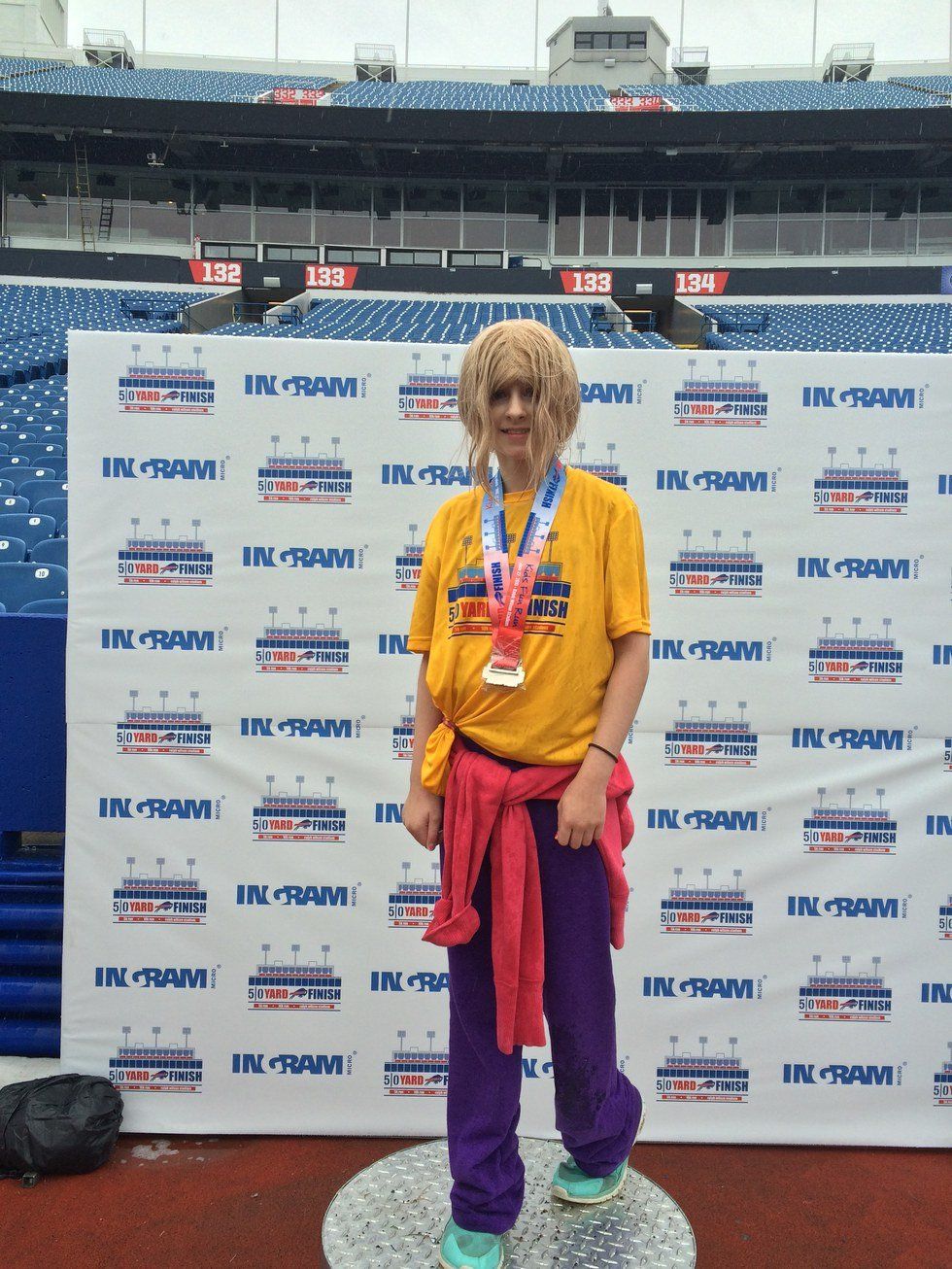
When I got to practice I was lined up to start my tempo on the track, and a girl named Julia Birmingham came to mind. I don’t know much about her or her story, but I do know she is a cancer patient around the age of 12, who is now in remission. I met her at a 5K the P.U.N.T. Foundation hosted at Ralph Wilson Stadium this summer.
Julia was there to be an ambassador for the foundation, but when the kids’ race went off, she jumped on the starting line without warning and said, “I’m running.” My boss, Executive Director Gwen Mysiak, was thrown into a panic.
Julia had only finished her chemotherapy treatments a couple months prior and has some paralyzation in her legs that forces her to always walk on her tip toes. Her parents hadn’t told us whether it was OK for her to run the race, so I jumped in and ran beside her.
Every couple hundred meters, she had to stop and gasp for air because chemo weakens the heart and lungs. With her wig flying in all different directions, she’d lunge right on forward as soon as her breath steadied. She finished the race with a strong kick, as she powered through the tunnel where the Buffalo Bills enter the field at the beginning of every game.
No one would believe she was weak or partially paralyzed because that’s not how she saw herself. She didn’t rush to tell anyone about the race or flaunt her medal. She simply walked away after she had completed the race because she was content with the fact that she had proven to herself she could do it.
At practice, I realized I had not only been taking my ability to run for granted, but so many other everyday things these patients weren’t capable of doing. It made me feel guilty for ever putting less than 100 percent into anything I do.
I thought helping these kids was making my life purposeful, but instead they taught me to live with purpose by putting everything I have into even the simplest of tasks.