
I want to raise some questions about every evangelical Christian's favorite topic: sexuality.
Some say that our culture has rendered the Church’s voice irrelevant when it comes to sexuality, that people no longer care what we have to say. I’m not convinced. A quick Google search suggests that with “hot topics” like same-sex marriage, people are at least curious about how faith and sexuality interact:
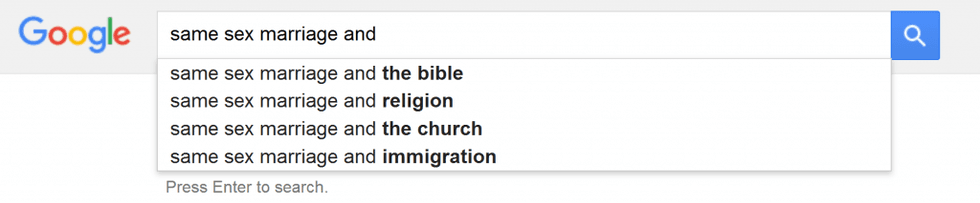
People are still listening. If our only goal is to be heard, we've already accomplished that. But I'm more concerned about what it is we're saying.
Debates about faith and sexuality have become as common as they are heated. I've heard plenty of messages branded the "Christian perspective" on homosexuality and related issues. This is rather confusing, since Christians from various traditions have a wide variety of unique perspectives. There is certainly not consensus, but on the whole, we've responded quite poorly to issues of sexuality.
The intersection between faith and sexuality is, and always has been, complicated. Christians hold as many different perspectives on LGBT issues as on dating, sex, and marriage in general. At one extreme, there is a push for reparative therapy (the "ex-gay" movement), with Christians insisting that LGBT people can become heterosexual with help. At the other extreme, there is an almost flippant attitude towards sex, with Christians hardly batting an eye at premarital or non-monogamous sexual activity.
Once again, Christianity is anything but unified in its sexual values, especially in the U.S. So how can we improve the faith-sexuality dialogue? How can Christians learn to listen to each other and the LGBT community without shouting at and ostracizing one other?
I think one of the best ways to handle controversial topics is to be intentional with our language. The words and phrases we use communicate attitude, tone, and respect as much as they do our beliefs. Here are 3 words/phrases that are often used (and misused) to cause confusion in the faith-sexuality discussion:
1. Gay Lifestyle
I still hear this one a lot. To me, it makes absolutely no sense, because it seems to imply that all gay people have the same lifestyle. However, some context helped me understand why people still use this phrase and why it causes so much backlash.
The word gay has long been used to describe same-sex behavior. Until the gay rights movement started (not even 50 years ago), there wasn't a public conception of homosexuality as an orientation. When people use the phrase gay lifestyle, they may still be operating under the assumption that gay means you have sex with people of the same sex, rather than simply a pattern of attraction to the same sex.
This distinction is especially important for Christians, as there is a difference between who you are attracted to and what you do with those attractions. In order to improve our dialogue, we need to realize that not everyone is using the word gay the same way.
2. LGBTQIA/LGBT
I’m a fan of acronyms, but I also emphasize with those that look at the acronym LGBTQIA and think “huh?” LGBTQIA stands for lesbian, gay, bisexual, transgender, queer, intersex, and asexual. The shorter acronym LGBT is often used instead.
To some, this is just an attempt at political correctness. Instead, think of it as a way for the LGBT community to embrace their own diversity. These acronyms send the message that sexuality isn’t just about being hetero- or homosexual, but that there are a lot of people who are outside of "normal."
This makes the Christian response much more challenging, as nuance and diversity always do. Nevertheless, it’s important for us to realize that the LGBT community is one of very diverse people, each expressing themselves in a unique way. Our response must be to sexual diversity, not just homosexuality.
3. Sexuality
Finally, the term sexuality itself. This is the most misused term of the three. So often, sexuality is reduced to refer only to orientation. We talk about sexuality as it pertains to LGBT people, but we need to talk about sexuality as something that applies to everyone.
Why are some people attracted to blondes and others attracted to brunettes? Why do some artists marry other artists, while others marry logicians? Without using any sexual examples, it’s clear that everyone is attracted to (and lives out those attractions) in different ways.
We could drastically improve our faith-sexuality dialogue if we realized that sexuality refers to more than just sexual orientation. Everyone has a sexuality, because God made all of us sexual beings. Starting from that mutual acknowledgement may help us treat the LGBT community as humans loved by God rather than “those people” that we have no way of understanding.