Violence hung over all of southeast Los Angeles. Buildings were aflame. Tensions between law enforcement and civilians ran dangerously high. Thousands of National Guardsmen were called in as back up to help tame the wild mobs. In the end, the 1965 Los Angeles Riots claimed 34 lives, with an additional count of 1,000 injuries and $230 million in material damage.
50 years have passed, and ghosts of the infamous rampage still linger throughout the streets of southeast Los Angeles. However, there are some good memories too. This is a story about reinvention.
In the summer of 2001, Canyon Creek Summer Camp opened for business. Nestled in the Angeles National Forest, the 81-acre complex is the ideal setting for children to escape the distractions of city life, according to the camp owners. Parents purchase these $3,000 camp experiences for their children with the belief that their child will develop lasting friendships, self-confidence, character, self-reliance, and more.
Once Canyon Creek had been up and running for nine summers, it was time to tackle the next dream--how to share this opportunity with children who didn't have the financial means themselves to attend camp. In 2011, David Moss, the camp's Operations Manager, and Jeff and Joyce Robinson, the camp's co-owners, made that dream a reality by launching the non-profit organization known as the Harold Robinson Foundation. It was named in memory of Jeff’s late father. The foundation brings elementary and middle school students from southern Los Angeles--primarily from Watts, California--up to camp for three-day retreats throughout the school year.
"Three days at camp may seem a small thing to gain. For these children, however, it marks the beginning of a new way of thinking," Moss explained.
People wouldn't come to camp and suddenly forget about the rivalries, trauma, and violence that, up to this point, played a defining role in their lives, but Moss says its a start. Removing these children from the only surroundings they’ve ever known widens their worldview beyond the streets of their hometowns.
The city of Watts is only two-square miles and it is packed tightly with over 20 gangs, making it one of the most dangerous areas west of the Mississippi, according to the Los Angeles Police Department. When they first began running the Grassroots Foundation, Moss and the Robinsons had no greater goal than to simply bring undeserving children to camp. However, as the organization has matured, they now hope they can contribute to a better narrative for the Watts community.
The foundation differs from other causes in that, to Moss’s knowledge, “there are few to no other organizations in Watts using a holistic approach." He continued, "We take not only children but community members, parents, teachers and former gang members up to camp to build community and unity."
Including parents and teachers in this experience allows the lessons and tools to go back into Watts to be implemented in the classrooms and homes. “If you don’t change the home environment, how much of a service are you really doing?” LAPD Sergeant Tingirides said.
While Moss and the Robinsons both serve the foundation with loyalty and vigor, they recognize that, because they are white and from affluent neighborhoods, they can never truly understand the realities of life in the inner city. “I didn’t walk in their shoes,” Moss said. “But we hire counselors that have been there, lived it, survived it."
Omar Castaneda, one of the camp’s counselors, is now reinventing himself after spending 15 years in prison. Employing formerly incarcerated men and women--who are successfully living free of gangs, drugs, and crime--fosters an environment for the campers and counselors to build genuine and organic relationships.
“If you’ve never seen anything other than your supposed role models joining gangs, how are you supposed to know to do anything else?” Moss said. With this idea in mind, the foundation hires these former gangmembers in hopes that their positive influence will help bring an end to gang culture in Watts.
The camp has served Castaneda, and the other formerly incarcerated staff members, as the platform upon which they have been able to build their lives anew. Castaneda is just one of the many former felons who are now not only having a chance at employment, but are also helping kids who grew up in similar circumstances. These changes won’t be detectable overnight, Castaneda explained, because “we’re working to change the whole belief system that has been taught and handed down." He continued, "I know this because it was part of my own belief system."
Still fighting to overcome the trauma of his own childhood, Castenada isn't a stranger to the anger and pain these children live with on a daily basis. “I hate using the word 'abuse' but if you’re beating on a nine-year-old with a stick, that’s what it is,” Castaneda admitted of his youth. “I think that abuse fueled my anger, eventually leading me to prison."
Before connecting with camp, Castaneda allowed his zipcode and skin color to define him and his potential. His light brown skin, painted with gang tattoos, tells a story before he is even given a chance to speak for himself. Unknowing eyes see Castaneda and immediately make assumptions about the type of person he must be. “Someone who looks like me, looks like they’re involved with something criminal,” Castaneda said.
Now, however, working as a camp counselor, Castaneda realized he is in a position to “empower people to learn how to recognize the power they have to shape and choose their own identities." Rather than being ashamed of his appearance, he is using it to help erase the negative stigmas that are readily attached to residents of the inner city.
Through camp, Castaneda now knows that although he has been damaged he hasn’t been defeated. Thus, he wakes up each morning free and grateful that he is in a position to help children find that same resilience within themselves.
Whatever their stories may be, whether it was enduring physical or emotional abuse, the temptations of the streets or exposure to drugs and alcohol, growing up in the inner city robbed these children of a carefree childhood, Sergeant Tingirides explained. But at camp, the children are able to reclaim their stolen power and rise above their damaged pasts. Giving children the chance to step out of Watts and into this novel setting puts a hold on their fast track to gang membership. Going to camp is so much more than simply hiking, acting silly by a campfire, and playing games. According to Moss, it’s as if they’re on autopilot, and granting them the rare opportunity to interact with each other in an environment free of gang lines or rivalries turns that mindlessness off.
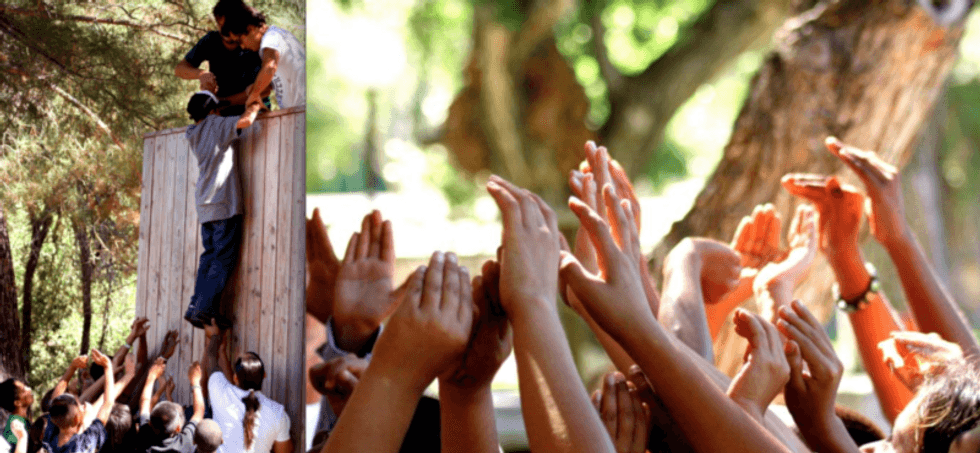
Away at camp, the kids’ schedules overflow with activities drastically different from their idleness and lack of afterschool programs they are offered at home. Just one of the many activities campers participate in during a retreat is the “dream wall.” In the middle of camp stands a flat 12-foot wall that campers are challenged to somehow climb over. Alone, the wall is impassable. Together, however, it becomes an achievable task. As the campers lift each other one by one over the wall, they realize that in order to overcome life’s hardships they must have a solid support system behind them, Moss explained. The goal of the dream wall is in accordance to the goal of the retreat as a whole: "To teach the children conflict resolution and coping skills they can take home with them,” Moss said.
The Harold Robinson Foundation staff doesn’t deny that three days at camp is short in respect to the remaining 362 days of the year they spend in the same broken communities. However, “it’s like planting a seed, watering it, and watching it grow. Not all the seeds make it but some do, and watching that growth is remarkable,” Moss said.
There is still so much work to be done, but, in a world often filled with overbearing amounts of negativity, it is important to celebrate the little victories as they come. Some stories don’t have happy endings. Sometimes the pain of the past is too much. But the Harold Robinson Foundation is empowering Watts, giving them the tools to write their own happy endings, one camper at a time.