

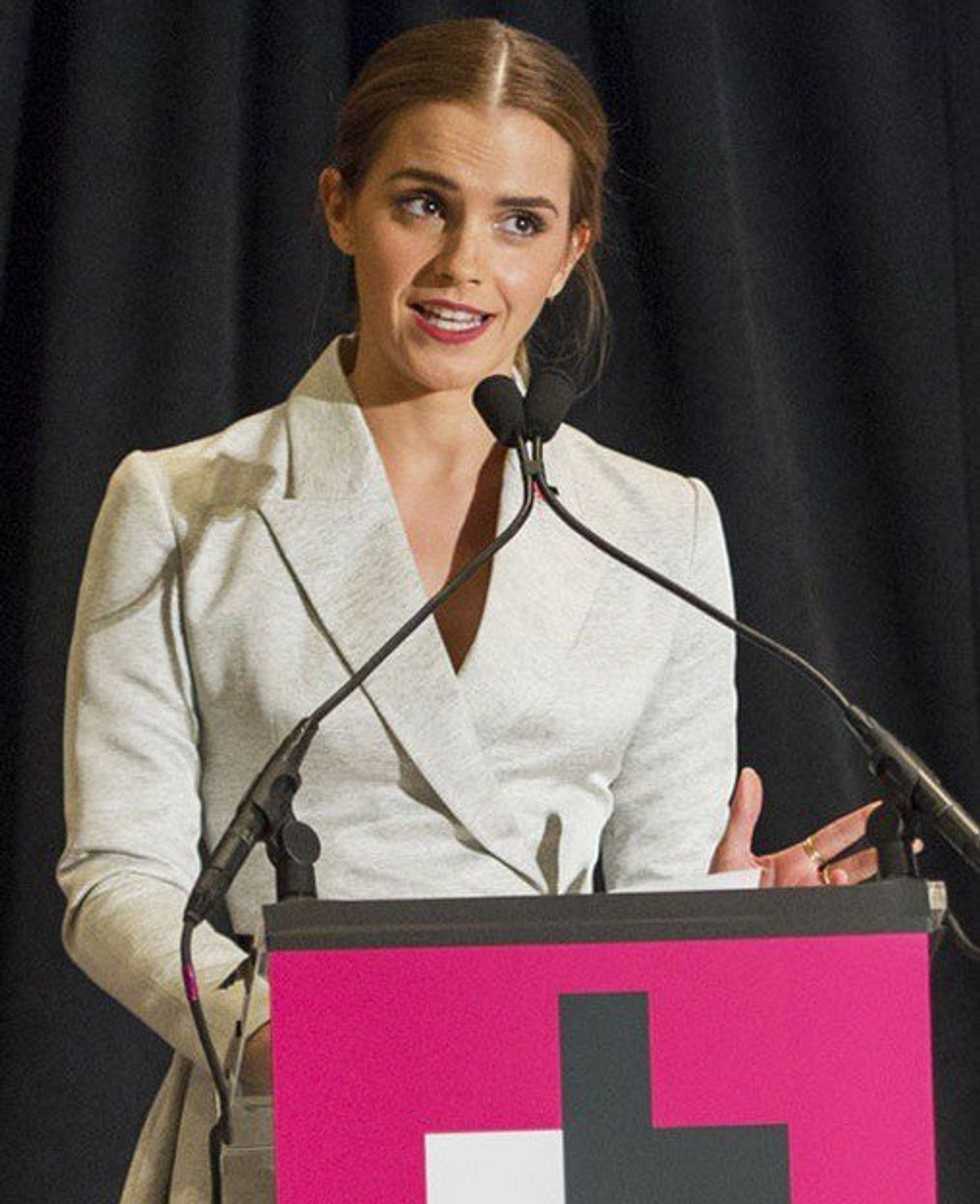
Recently, it has become common practice to decry celebrities who are active in the feminist movement; think of all the backlash that famous women such as Emma Watson, Amy Poehler, Tina Fey, Taylor Swift and Lena Dunham have faced. Critics claim that these so-called "white feminists" are only concerned with feminism when it is about them, i.e. when it is about white women. These women are ridiculed as "not real feminists" who are ignorant of the struggles faced by women of different races, classes, sexualities and abilities.
In my opinion, the practice of patronizing these women is appallingly anti-feminist. First, it is anti-feminist to exclude and discount the efforts of women who have dedicated so much hard work to the fight for women's equality. This is anti-feminist because the practice of alienating these women, who are relevant and important in the feminist canon (because they are women), is an example of tearing women down. Second, "ranking" feminisms is anti-feminist in itself — just because one's feminism is more inclined to the struggles of minority/LGBT/poor/disabled women does not mean that they are a "better feminist" than a woman who is less intersectional in her feminism. Ultimately, all feminists are working toward achieving equality for women in some way; although concerns for women's equality differ greatly across the spectra of race, class, gender, sexuality and ability — for example, white middle class feminists are more commonly concerned with equality, while feminists of color are more often concerned with battling injustice (bustle.com) — ultimately all feminists and their fights are worthy and relevant in the battle against systematic oppressions, injustices and inequalities.
Furthermore, just because a woman's feminism is not explicitly intersectional does not mean that she does not support women of other races, classes, sexualities or abilities. It also does not mean that she is ignorant of the vast differences in lived experience of a black LGBT woman vs. a disabled Hispanic woman vs. a poor white woman. This also does not mean that she believes all women's lived experiences can be reduced to one spokesperson or to one archetype, such as "the black LGBT woman," "the disabled Hispanic woman," or "the poor white woman."
Most likely, a lack of intersectionality in a woman's feminism can be attributed to the fact that people know what they have experienced. It does not mean that this woman is ignorant; it does not mean that she is bigoted; it does not mean that she is self-righteous or self-absorbed. It simply means that this woman has not been enlightened to the necessity and importance of intersectionality in feminism.
In all honesty, I used to be a "white feminist." When I thought of feminism growing up, I thought of the struggles of white, upper middle class cisgender women because that is who I am. That is my lived experience. My mother and grandmother were active in the women's liberation movement; they went on marches in New York City in the '70s at the height of the movement. I learned my feminism from them. When I thought about women's struggles, I thought of my own struggles, because those were the only struggles I knew in my predominantly white, upper middle class neighborhood on Long Island. I thought of how I felt a conflict between portraying intelligence and portraying femininity in school, because those two factors of my identity seemed to be at odds with one another in the classroom. This internal battle felt like a double-edged sword: I could be outspoken in class and own my intelligence, but then I would have to worry that others viewed me as "un-feminine." I could dress overtly feminine and carry myself with a flighty air and make my voice just a little bit higher, but then I knew I would be sacrificing people taking me seriously as an intelligent person. I bonded with both women students as well as teachers over this conflict. Even though I have always been more interested in pursuing a career in the humanities, I knew all too well the familiar isolation of being one of few girls in advanced math and science classes.
It was only when I got to college that I learned about intersectional feminism, which explicitly considers the struggles of women of all different races, classes, sexualities and abilities, and recognizes and analyzes how these identity factors intersect with one another and with gender to create complex and vastly different lived experiences for every woman. I had never even heard of intersectionality before I got to college. Before I came to college, I will admit that the struggles of LGBT women and disabled women were not prominent in my mind, because I could only imagine the struggles of myself and the women I was surrounded by in my predominantly white suburban neighborhood. Nor were the struggles of disabled LGBT women on my mind, because I was not aware of the way that identity factors are not merely additive in creating a lived experience, but that they intersect in their multiplicity. Now that I have learned about intersectional feminism — and I still have a lot of learning to do — I actively consider the struggles of minority/LGBT/poor/disabled women in my feminist considerations. Now, I find myself not only considering how inequalities affect me and women with similar lived experiences to me, but I find myself asking, “Where is the racism in this? Where is the classicism in this? Where is the heteronormativity, the ableism, the ageism?”
I am incredibly thankful to the professors and fellow students who have played a role in educating me about intersectionality and about intersectional feminism. It is so important to alert others to their single-mindedness in their considerations of the world around them, especially with regard to feminism. We are all responsible for alerting others to where and how they could have a more intersectional, and therefore more inclusive, analysis of the world around them. So I still find it shocking and appalling when people choose to berate "white feminists," when they could be educating them and helping to create a more aware, prepared and therefore more effective group of empowered women ready to fight for all women's rights — for all people's rights, really. It seems to have become a game of "we're better than you, so you can't sit with us," where instead of educating and providing constructive criticism, people sit on their high horse and complain about white feminists' "ignorance," declaring themselves better than white feminists and accusing white feminists of not being "actual" feminists. Yet how can one call oneself a feminist if one is contributing to this practice of tearing other women down?
Intersectionality is crucial to an inclusive and therefore optimally effective feminism. It is also important for us to come to terms with our own privileges and how they have affected our own lives, and to work toward understanding how a person's lived experience is created by the intersection of their race, class, gender, sexuality and ability. It is also important for us to recognize our own faults, as well as the faults of those who have come before us; we would be remiss if we failed to recognize that many of the "feminist heroes" of the Seneca Falls Convention were actually racists who advocated for slavery, and that their efforts were preceded by feminist efforts of behalf of women of color, which went unrecognized. But this is a battle we must all fight together. We must educate one another and work with each other to dismantle the societal barriers that have kept women of all races, sexualities, classes and abilities down for centuries. Education, not alienation, is the key to winning this fight.