Over the summer, I worked a little bit of time on the Conway campaign for governor down in Frankfort. This was during the time when fundraising was crucial and so naturally we spent a great deal of our time on the phones asking people for money, or if they want to volunteer and things like that. We’d all make phone calls for some time, and we’d get lunch together every day and just talk politics. I always made my positions very clear with strong support for Senator Bernie Sanders (this was about right when he announced) while they would all take stances for Hillary Clinton or Martin O’Malley saying they were the most viable, realistic candidates. But should any of us be concerned about who has the best chance of being elected?
What about the person who has great ideas?
Even through the course of the campaign, Mr. Conway reiterated over and over again that he was not in support of Obama and that as Attorney General he had sued the federal government. He also took a strong opposition to environmental safety, and declined to comment on his support for same sex marriage. Why was he pretending to be a Republican? We can only guess why, but my guess is that the polls dictated his response. In a political age when the polls decide what comes out of a candidate’s mouth and when money can buy elections, many have very little trust that their vote matters, let alone their voice. But this instance is only one example out of many.
But where is the party at in general? Let’s examine this a little more. Jacob S. Hacker and Paul Pierson in their famed, "Winner Takes All Politics," describe an era of transition during the '80s that essentially handed power over to the wealthy while making social mobility nearly impossible. The Republican Party, under Reagan, become indisputably the party of business always routinely supporting deregulation (or what is called free trade), cutting social programs, busting unions and also expanding American Imperialism. Eisenhower himself, a championed Republican, even declared that being against the New Deal is being against all of American politics. And today, this is not at all the attitude amongst Republicans. But these issues became less widely known where new issues, moral issues, became the main focus after the Republicans mobilized formerly non-mobilized voters. These included the Christian voters, gun owners and heavily xenophobic groups, and this persists even into the present day (just look at the Republicans seeking the nomination).
But what did the Democrats do? Well they followed. What is called the “establishment Democrat” is essentially what a Republican was once. The “New Left” movement, while enjoying a huge amount of success addressing social issues and becoming the movement of equality, forgot its focus on economic issues. What’s more, big money donors flooded the Democrats' campaigns as well, and of course they were happy to oblige so they could actually compete against this new breed of Republican. Essentially, they sold out. A perfectly clear example of this is the bipartisan TPP that had a nearly complete media blackout, and has incredibly harmful policies in its text such as raising the prices of pharmaceuticals, internet restrictions, and creating international tribunals of private firms to challenge sovereign nation’s public interests.
But after this (in the same week), gay marriage was made legal under the Supreme Court’s decision in Obergefell v. Hodges and the TPP was hardly reported on. This follows largely in the model of NAFTA that spurred huge U.S. trade deficits, job loss, continuing inequality and stagnating wages, and left virtually every Mexican farmer unemployed.
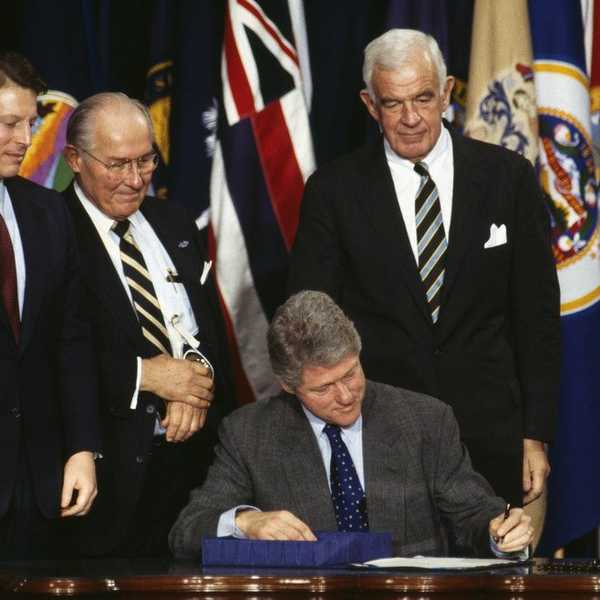
Similarly, NAFTA was put through during the election season between Clinton and Bush which received all of the media attention at the time. On top of this, it virtually bypassed the Labor Advisory Council. There are a host of other trade agreements that had bipartisan support such as CAFTA and the non-renewal of the International Coffee Agreement that kept coffee-producing countries safe in the international market. This stability was supported largely to make sure the Latin American states did not adopt Communist or Fascist sympathies. In Yves Engler’s, "Canada in Africa," Engler describes how the 1989 non-renewal was carried out because America no longer feared any more Communist movements in the Americas. This was of course after Reagan and Bush’s terror campaign through proxy groups such as the Coordinaros and the Salvadoran army, to name a few, and during the decline of the Soviet Union. You can read more about this in Greg Grandin’s "Empire’s Workshop."
But Clinton, despite his budget surplus and all of his achievements, was still not exempt from any wrongdoings. While Clinton did try to make advances in limiting CEO pay to be proportional with a firm’s prosperity, these translated only into higher stock options for CEOs which essentially remained an even higher income as the dividends would later pay out from these shares. This was a largely symbolic move by Clinton. And while the expected failures of NAFTA came to fruition during his tenure, he did not address it whatsoever. His biggest blunder in international trade came when he broke a sanction on China imposed by congress to sell super computers to China, which was sanctioned at the time because our intelligence said in high confidence that they would then turn and sell this technology to radical states such as North Korea. This move allowed North Korea to advance its nuclear program. Follow the money and you’ll find that IBM and Apple were huge donors to the Clinton campaign.
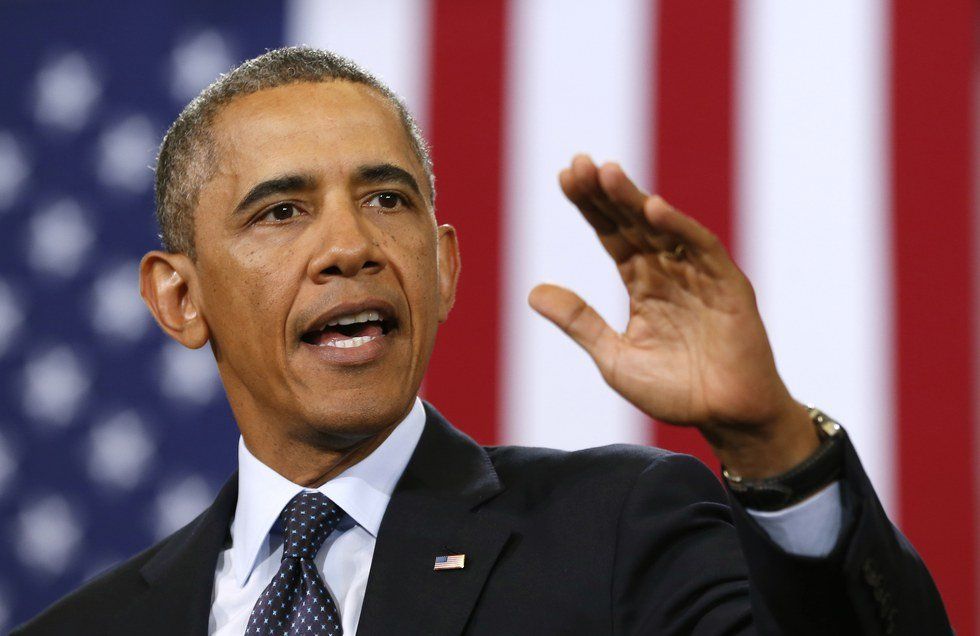
Jim Webb, then Navy Secretary under Regan and Bush stated that their foreign policies were marked by swift overthrowing of governments to avoid any media attention. This was a policy reflected by Clinton in which it was declared that not only did the United States have the right to defend itself, but it also had the right to defend its interests abroad. To the present day, we can see this in the Obama administration that is currently carrying out a huge drone terror campaign, even creating a 40 hour work week for drone operators to eliminate targets.
During Obama’s current tenure we saw a huge escalation in the war in Afghanistan, but most notably we are now seeing a drone campaign in Pakistan that is continuing to destabilize the region. With the Taliban continuing assaults on military depots (many of which they have successfully overthrown) it may not be a far stretch for them to make an advance on their facilities containing nuclear arms. Drone strikes may eventually make this possible as it thins out their military’s resources. Again, this situation is having a complete media blackout. One such example that happened very recently was the bombing of a hospital in Afghanistan under the Obama administration that blatantly broke international law, but was defended on the premise that the Taliban had units stationed in it. Professor Noam Chomsky, in a recent interview, drew a comparison to this and the Battle of Fallujah in Iraq where the marines had raided a hospital, killed civilians, and throwing patients out of their beds. They cited that this hospital was a propaganda center. But how? Because they were displaying casualty figures. Let’s examine other terror groups supported by the Obama administration:
Israel, a state that continues to defend itself despite only ever engaging in wars that it has been the aggressor, continues a massive terror campaign in the West Bank and Gaza. Having 45 resolutions passed against them from the United Nations, they have routinely violated international law most notably in mass murders, using human shields, raping women, and compelling people to admit to crimes they never committed, on top of the illegal occupations of the Palestinian territories. There are many articles on the subject and all of these resolutions can be read on the UN website. Obama has supported this (along with every President, both Republican and Democratic) and unilaterally blocked a motion to declare Israeli settlements in the Palestinian regions illegal; this is of course as continuing financial support along with military equipment is granted. If you also look at the list of key military installations that the U.S. regards in high value — several of these positions are within Israel. In fact, Israeli foreign ministers don’t even have to register as foreign ministers when coming to the U.S., further showing us how intertwined the two countries are. But this position is held by both Republicans and Democrats, and this premise has never been refuted in any debate between Presidential hopefuls.
Another example that happened over the Halloween weekend was that Obama authorized 50 Special Forces troops to go to Syria and train/arm the Free Syrian Army to combat ISIS. This was of course a breaking of his own word in which he declared that there would not be ground troops in Syria. It is probably likely that, since the FSA has routinely engaged with the Syrian Government, that the United States will support this which should not be a surprise to anyone as the U.S. had a failed coup against the Syrian government in 1949 when they attempted to use the Muslim Brotherhood as a proxy. Our other allies, Turkey and Israel, continue their engagements where in some instances Israel’s air units have supported Al-Qaeda’s Syrian front. Turkey is allowing the Free Syrian Army to station a headquarters in their backyard. But, if you actually look at the twitter accounts associated with the FSA you will see disturbing pictures very much reminiscent of the things that ISIS posts. This is also on top of the pictures of these insurgents using chemicals weapons during combat, which was a claim brought against the Assad regime but has had no conclusion as the two reports (both heavily biased) have had conflicting results.
But even then, how do our Presidential hopefuls on the Democratic ticket stand on these issues? Well, Hillary Clinton voted for the war in Iraq (which was a huge issue in the debate) and has said that a war in Iran would be considered given the right circumstance and she supports aggression in Syria. Even the progressive Bernie Sanders supports continuing airstrikes in Syria.
But why do the Democrats and Republicans share this same premise? We can only speculate on this matter, but it seems that in foreign policy there is little room for positions counter to popular opinion. Sanders even ignored the question of his support for the Sandinistas, which were a Soviet propped group in Nicaragua. As Mayor of Burlington, he did speak out against these atrocities. The Reagan administration launched a huge terror campaign against the people during the Sandinistas control of the government, and did everything it could to block social reforms. They even tried to make the elections at the time appear skewed to the international community by compelling organizations to drop out of the election, as LASA studies have confirmed. But why does Sanders not stand by this decision?
Though, the position of trade and the candidate’s disagreement with the TPP is looking hopeful, it is unclear whether Clinton means what she says in her opposition to it. Initially, she supported it but went back on this statement. Even so, she has gone on record saying that she supports the direction of Presidents such as Barack Obama and her husband, Bill Clinton. With of all of this history, we can see that the Democratic Party has shifted from the party that supports the less fortunate to the part that is just another sect of the business party. It is frightening that both parties support such heinous acts, and that no alternative position is accepted. For example, an examination of our foreign relations, our trade agreements, and the role of big money in government, these are all things not spoken about in the mainstream. While Sanders does call out big business in a very blunt way, there are many areas in which he falls in.
I leave it up to you, the reader, to decide what you think about the arguments that I have presented, and I encourage you to get involved in transforming the political culture here in America. As the next generation of professionals, public servants, business people, and maybe elected officials, we have a responsibility to recognize the failures of the past and make better decisions moving forward. Too often we say, “That’s just the way it is,” or “I can’t do anything about this” but understanding that there is no predetermined way of structuring society and that we have a full choice in deciding our present is an incredibly liberating ideal to hold.