
Environmentalism is a morally just cause. Ask the largest environmental group, Greenpeace, why they exist, and their response will be “because this fragile earth deserves a voice.” Greenpeace sprung into life in 1971 when a group of activists chartered a boat into an Alaskan nuclear bomb testing ground. Their motive was to represent the animals that would be affected by blast – which included the revered and patriotic bald eagle. Greenpeace failed – they were removed by the U.S government and the detonation occurred. However, their story caught international attention. Greenpeace continues today much with the same tactics – they are the brave people who oftentimes flirt with arrest and danger to let their point be heard, and with 2.8 million sustainers, they will feel their brushes with the law are vindicated. Greenpeace proves that environmental activism requires a bold approach with questionable legality. When preforming their early ‘stunts’ (today they have the power to do much more) they relied on media coverage to spread a positive message about protection of habitats and species. However, there are other entities that have a shadier approach to the pressing issues of climate change and habitat destruction.
Let me introduce Les Knight, a Vietnam War veteran and substitute teacher from Portland Oregon. In 1991 he founded the Voluntary Human Extinction Movement, simply known as VHEMT. The foundation, while gaining some support, drew more gawking and ire than anything else. This culminated in 2005, when Les was interviewed by Tucker Carlson on MSNBC. In the interview, available on YouTube, Les does well to parry Carlson’s questioning, and actually makes some salient points.
Tucker: Don’t you see beauty in the creation of human life?
Les: I see beauty in the creation of almost all lives. There’s a tradeoff here: the more of us the fewer of them. Baby humans are cute, but so are baby pandas.
Tucker: What about baby maggots?
Les: They may not be as cute, but their existence is far more essential to the earth’s biosphere than Homo sapiens.
Mr. Knight’s idea that we are accelerating the extinction of other species is founded in science; the World Wildlife Fund states that we lose 10,000 species a year and that is around 5,000 times the world’s natural extinction rate. The idea that this is being caused by a single species is a harrowing one. Not many people are proud that we are currently causing the biggest mass extinction since the dinosaurs. After a little research Les Knight isn’t the laced Kool-Aid offering, baby killer he initially appears to be. He is an antinatilist, yes, but he poses a pertinent question: why do a single species have dominion to drive extinct so many? His solution differs from that of a traditional environmentalist only slightly – while many of us agree on sustainable initiatives and mindfulness about the environment, his priority is the preservation of Gaia, and the biosphere. Whereas most people put human interests first, he values his planet more than he values our perpetuation as a species. It is an important reminder that he does not advocate genocide, as his website says, “we should voluntarily phase ourselves out for the good of humanity and the planet.” Les Knight’s movement has lost momentum in recent years, but his response to the destruction of our planet is a more valid one than it first appears to be. It is borne of selflessness and care for our planet, not malice for the people which already populate it. The Human Extinction Movement is effectively done – but it is a memory of a sociological attempt to curb the disproportionate effect a single species has on a richly biodiverse planet.
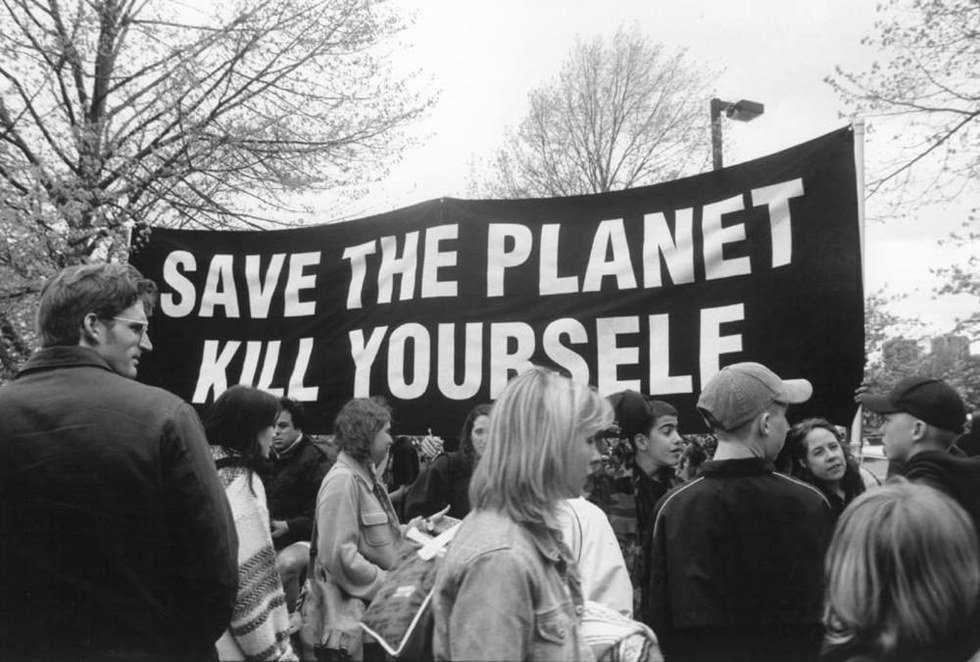
It must be clear now, but it is not Les Knight’s VHEMT which carries the iconic, distasteful banner donning the words ‘save the planet, kill yourself.’ That honor belongs to Reverend Chris Korda, a techno DJ, Software developer, and head of The Church of Euthanasia. Embedded below is one of her songs. Absurd and insulting are two superlatives that come to mind when I personally listen to this song.
A gander around the Church of Euthanasia website followed the same anthem as the song and banner which heads this article. It appears that like Knight, Korda is an antinatalist, but her church goes one step further. In contrast with VHEMT’s “Live Long and Die Out” motto, she and her congregation believe that people should take matters into their own hands, and kill themselves. Anathema to the remainder of human society’s views as a whole, this ugly viewpoint landed Korda and her followers an interview on the television show known for its bizarre guests, Jerry Springer. In a 35 minute shouting match with the controversial environmental group, Jerry did what he does best, and picked apart the arguments of a group of people who have lost the plot. It is easy to cast aside Korda as mental, but when interviewed in “Thank You For Not Breeding,” a documentary by Nina Paley, she says something quite surprising. “[Les Knight] actually has an agenda that could actually work. The Church gave up that agenda a long time ago. I don’t think anyone actually takes us seriously … All we’re doing is expressing something. In that sense we have more of a connection to Dadaism than anything else.” Dadaism – a term alien to me prior to research – is a type of art that critiques social, political and social values. Chris Korda’s response wasn’t what I expected: she thinks of her church as more of an expression of art than anything else.
Let me give an example – in her tumultuous show on Springer, Korda insists that the viewership try a challenge: cook a piece of pork and human flesh, blindfold yourself, and then see if you can tell which is which. Obviously diabolical, the notion of cannibalism drew jeers from the crowd. But the purpose of the ‘blindfold’ challenge isn’t to encourage people to cook each other - that is ridiculous. The point is make an absurd comparison that encourages a thought: if a pig is nearly as conscious as a human, why are they fated to be farmed, tortured and killed, and we aren’t?
Wacky, insulting, insane. Korda uses the most absurd methods to convey her environmental viewpoints. It is easy to dismiss her at face value; her methods are repugnant. However, a closer inspection reveals that she doesn’t mean what she says and does literally – her goal is to provoke a reaction – one that disagrees with her vulgarity, but considers an environmental dilemma. Her devices are strange, but in strategy, she differs little from Greenpeace. Both gain the media’s attention to get their point across. However, consider which of the two is more successful, and pleasant. At first, Les Knight’s VHEMT and the Church of Euthanasia appeared, to be antinatalist kin – but that isn’t quite so. Korda is an ‘artist’ and Les is serious. I don’t agree with either of them, but my purpose was to understand why they came to such conclusions and started their respective movements. It would be easy to say that their proposals are so shocking that they are not worth considering. However, an inkling of research reveals that their outlandish claims and views are not completely unworthy of our time. Movements and groups are oftentimes not what they appear to be on the outside. What’s underneath could still be ugly, granted, but to only glean what is on the surface would be to miss their point entirely - and therefore any argument against such groups without proper understanding is merely a jeer, best fit for Jerry Springer.