


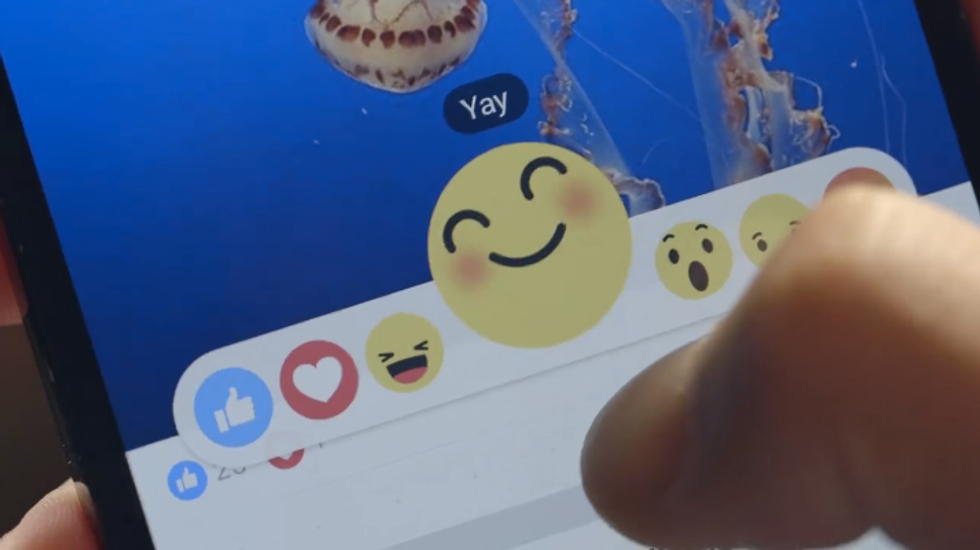
Forget about just liking a picture or post on Facebook; now you can react with emojis representing “love,” “haha,” “wow,” “sad,” and “angry.” Just last week, Facebook released the reactions feature globally and people have gone wild about it ... or have they? I decided to ask some of my fellow sophomore friends about their responses to the new Facebook reactions, and the results were profound.
To most I posed the same generic question: “So what do you think about the new Facebook reactions feature?” Below are reactions from seven of my friends.
Sherry
“It’s cute and allows for a better expression of how you think about a post.”
Michael
“I like it!! I just wish the layout was a little easier to see who reacted in which way. Also there is still no dislike feature.”
Speaking of the lack of dislike feature — Zuckerberg discussed this during a live Q&A session last year, according to USA Today. Zuckerberg predicted that a hypothetical dislike button could spread more negativity among people because of reasons similar to what another one of my friends, Sam, discusses when asked about the new Facebook reactions:
Sam
“I personally am pretty indifferent. It’s better than having a dislike option.”
Me: “Oh interesting ... why do you say that? Some people still want the dislike button.”
Sam: “Because we don’t need more negativity on social media. A dislike doesn’t add anything constructive. If you don’t like something it’s more constructive to comment and explain. But a dislike button also gives this sort of passive ability to spread negativity. And I like positive things.”
For reasons similar to what Sam talked about, Zuckerberg — during his Q&A — also acknowledged the importance to choose how to react to certain posts or situations on Facebook with things other than a ‘like” because “Not every moment is a good moment.”
On that note, however, it seemed that people are also becoming aware of the various potential issues associated with using these reactions. Monica, for example said: “the emojis require more effort in choosing an ‘appropriate’ response. I think it may open up more miscommunication.”

Most people seemed to agree that these reactions could lead to not only misunderstandings but to also a lot of unnecessary analysis about why someone chose to react with a certain emoji over another. Amanda extended this sentiment, pointing out that she “question[s] why people are liking and not loving [her] stuff ... like honestly ... why only a ‘like’ now?”
But of course, despite these new reactions, an overwhelming number of people so far still use only the “like” feature. Jake responded by saying that “even with these new things most people are still only ‘liking’ things. It seems a bit useless for the technologically challenged people like me who barely even use Facebook, but I’m sure it’s probably a great thing for people who pretty much live on Facebook.”
And of course there were plenty of people who not only found these reactions as useless but also as an insult to the beauty of language. Daniel explains that, “we have the entirety of our language to comment our feelings or opinions, and instead we resolve everything to an emoji and call it progress.”
All of these responses reminded me about something important: do new features such as the reactions on Facebook enforce our priorities on reactions? Are new features on social media facilitating conversations between people, or are these further complicating relationships? Will social media ever truly satisfy people?
Personally, I do not know the answer to that — after all, we can only formulate opinions. And each person is to his own. Regardless, should these reactions continue to exist on Facebook, or if people like or dislike how to express their opinions online — it is important to remember that nothing trumps the type of connections that can be formed in real time.
If you “love” that profile picture that your best friend posted — do not just click on that “wow” option. Make the effort to physically tell your friend that they look really pretty in that photo.
If you think a friend of yours is hurting do not just write a heartfelt post on Facebook. Talk to that person in real life.
Social media is great. It has facilitated communication in ways unimaginable to our parents, to the people of Generation X. But to the millennials whose lives can revolve around how many likes or loves or wows or comments or shares a person gets — it is easy to forget about a life outside of the screen. It becomes easy to forget that there are other ways to express oneself, other ways to make new friends or tighten bonds with old companions, other ways to demonstrate your care. And despite the number of different options Mark Zuckerberg and his team create to personalize Facebook — nothing is more personal than the intimacy found in face-to-face interactions.
















