


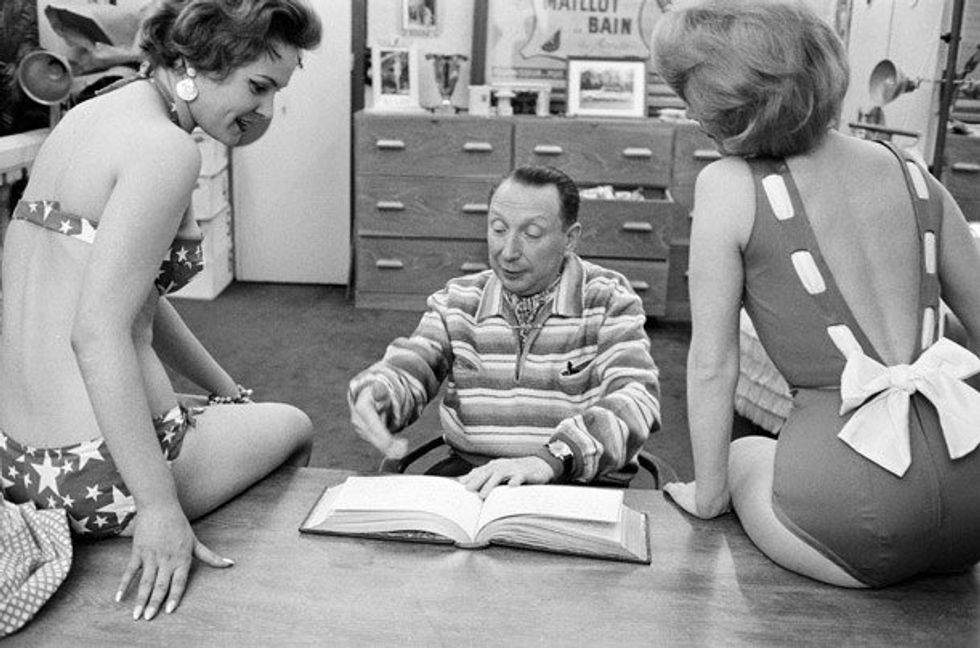
There's some evidence that bikinis were actually invented by the Romans in the fourth century, and possibly even further back around 1400 B.C. when Greek women wore them for athletics. Both of these time periods have mosaics and paintings of women in two-piece outfits, indicating they were popular during these eras.
On the more conservative side, in the 1890's women would actually sew weights into the hems of their loose-fitting one-piece bathing suits to keep them from riding up and exposing their legs -- somewhat like a frumpy, shapeless dress. It wasn't until the early 20th century that women began wearing tighter-fitting one-piece bathing suits that no longer hid their bodily curves.
The bikini, which has been called “The greatest enjoyment-giving invention of the 20th century," was officially invented in 1946 by a French engineer named Louis Reard. Reard's creation was named after Bikini Atoll, the site where the U.S. had been conducting nuclear tests earlier that week (the style came out with a “bang!"). Two-piece bathing suits had been popular in the early 1940's before the invention of the bikini due to fabric rationing during World War II, but the two-piece suits still covered much of the midsection, with the bottom piece coming up to a woman's rib cage.
When Reard created his prototype after the war ended, he advertised it as “smaller than the world's smallest bathing suit," made out of a mere 30 inches of fabric. Reard had difficulty finding a woman to model his new scandalous outfit, but eventually found Micheline Bernardini, a French exotic dancer who had no problem putting herself on display in such a tiny outfit. In one of her first photographs in the bikini, she holds a matchbox, displaying that her swimsuit is so small it could fit into it. After the first modeling of the bikini on July 5, 1946, Reard received over 50,000 fan letters, mostly from men. A few countries such as Spain, Belgium and Italy prohibited bikinis, and they were even declared sinful by the Vatican. However, once they became so popular in Europe in the 1950's, bikinis were legalized.
Reard's business boomed, much in thanks to his promiscuous advertising, saying that a two-piece suit wasn't a true bikini unless it could be pulled through a wedding ring. Additionally, Brigitte Bardot, a young French actress, widely popularized the bikini around the world and is said to have done more for France's international trade balance than the entire French car industry.
The bikini didn't become socially “in" in the U.S. until the 1960's when it became very popular with youth. Brian Hyland came out with his hit single “Itsy Bitsy Teenie Weenie Yellow Polka-Dot Bikini," and celebrity endorsements surged through pop culture. Additionally, Sports Illustrated came out with its first ever swimsuit edition in 1964, only because the editor felt he couldn't come up with enough sports stories during the winter months. So he stuck a model in a bikini on the cover, and the rest is history.

















