
I formed my political opinions over the backdrop of many historic years. My childhood was marked by the Bush Administration, the Iraq War and the reign of the neoconservatives. My adolescence was marked by the Obama Administration, the fight for healthcare and the rise and fall of the Tea Party. Simply by virtue of living in the United States, I was forced to understand where I land on divisive national issues. I learned where I stood on the spectrum. Most importantly, I discovered that I overwhelmingly sided with the Democratic Party.
In the heat of this contentious election year however, I began doubting this personal conviction. I noticed prominent Democrats sacrificing core liberal and progressive principles in favor of watered-down center-right policies. I noticed party loyalists refusing to critique Democrats for taking stances antithesis to their core beliefs, stances which they would not hesitate to criticize Republicans for.
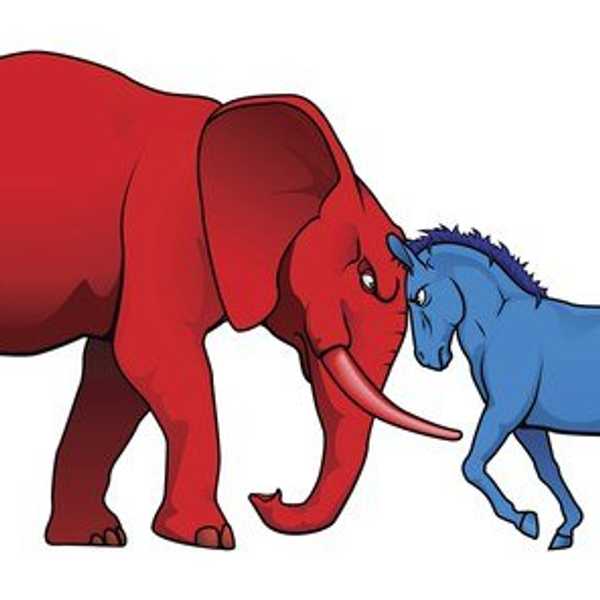
This change in the Democratic Party dangerously disenfranchises the left wing. Since the two-party system does not allow for much thought and discussion of ideas outside of the Overton window, Americans choose between one of two parties, under threat of helping the opposing side if they dare to support a third party. This shift in the Democratic Party has been assisted by supposedly liberal media outlets like Vox and The Daily Show. Instead of challenging those in power, they have instead opted to wag their finger and talk down to those who are too enthusiastic or too far left. This gives otherwise undesirable policies carte blanche to thrive within the Democratic Party.
This election cycle, the Democratic Party has given up fighting a number of progressive fights. The party seems to no longer believe that monied interests influence policy, standing in opposition to our own president. Democratic Party icon Barney Frank, who once believed donations would inevitably influence politics, now insists that accepting donations from Wall Street banks made him a better regulator. Holding this belief would have once made him a minority in his own party, however he is now overseeing the Democratic Party platform, granting him significant influence over the entire party's position on the subject.
Democrats have also conceded foreign policy to the neoconservatives, those who dominated the Bush administration's cabinet and who were fiercely criticized during the height of their influence. Presidential candidate and likely leader of the Democratic Party Hillary Clinton, whose time served as Secretary of State was marked by regime change and assisting in a push to keep Haiti's minimum wage inhumanely low is on the same page as those who advocated for the invasion of Iraq in the early 2000s. She is a fan of the right wing Israeli government and her campaign brags about her viewing the world as a "chessboard", as if to say war is a game and the world ought to belong to the West.
These stances weaken the Democrats' attacks on Republicans. How can they criticize Republicans for their policies on gun control and climate change being swayed by the NRA and oil lobby when they have stated that large donations and contributions don't affect policies? How can Democrats condemn the Bush administration's foreign policy when the likely leader of the Democratic Party is a believer in it? How can Democrats fight right wing policies when they embrace right wing policies?
As I type this, I can already hear the #UniteBlue party loyalists exclaim "If you want to make change you should do it within the Democratic Party!" I cannot make change within a party which take stances contrary to my beliefs. I can also no longer withhold my criticism. The Democratic Party is not a home for liberal ideas and hasn't been since the era of New Democrats and triangulation. In fact, it is now actively creating space for conservatives. I have no arbitrary loyalty to any one political party, only to my values and my principles.
This does not mean that I do not support any Democrats at all, it means I support them only when they are correct. I support Senator Elizabeth Warren for her years in the Senate and for actively challenging the absurdity of Donald Trump. I support California State Senatorial candidate Henry Stern for fighting the oil and gas industry in order to protect an environmentally devastated area. I support them because their beliefs are in line with my own, not because of their party affiliation.
Currently, 42 percent of the United States identify themselves as Independent, neither Democrat nor Republican. I am proud to join their ranks. The two-party system in the United States has given us the two most unpopular likely nominees in decades. This is not characteristic of a functioning democracy. It is time to escape partisan politics in order to have an honest discussion on issues and move toward a system which does not disenfranchise a plurality of Americans.