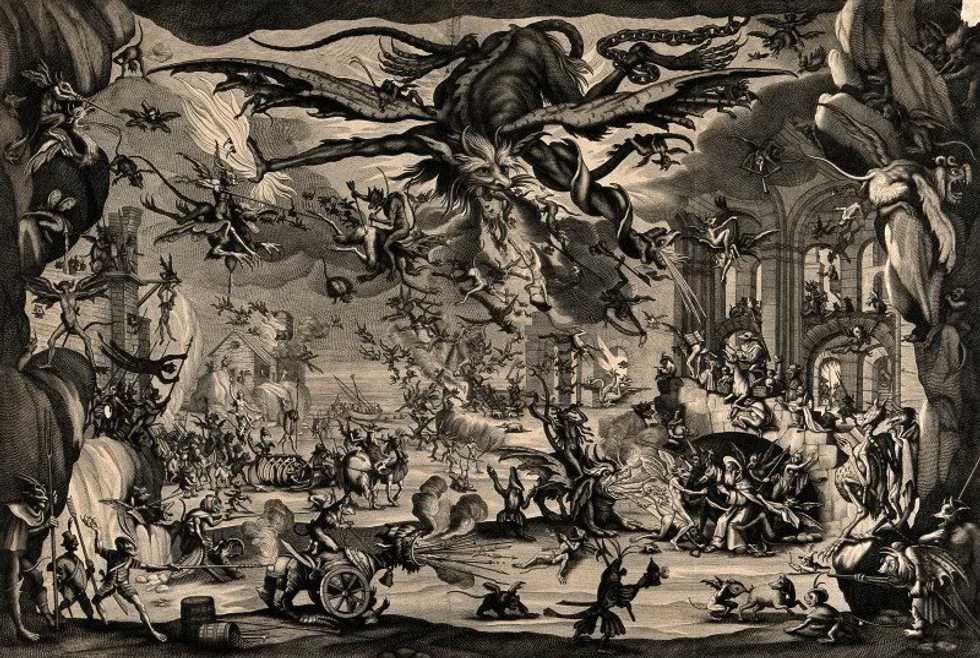
Arguably one of the most famed poems in western literature, William Butler Yeats’ "The Second Coming" was published around 1920, one year after the end of World War I. Be it looked at for its political meaning or biblical symbolism, you’ll be bound to stumble across a quote or two (at least) while studying literature. Woody Allen, for example, titled a book "Mere Anarchy," quoting the line, “Mere anarchy is loosed upon the world,” and Congressman Jim McDermott delivered a speech in 2006, "The Center Cannot Hold," urging President Bush to lay out a plan for Iraq. The New York Times’ Adam Cohen noted that "The Second Coming" was “becoming the official poem of the Iraq War.”
It’s fitting that politicians would often quote his works, considering politics was a major influence across Yeats’ career as a poet. The writer often used his pieces to showcase his political beliefs, as was (obviously) the case with "The Second Coming." This theme is very prevalent from the get-go of the poem, as the first stanza opens:
Turning and turning in the widening gyre
The falcon cannot hear the falconer;
Things fall apart; the center cannot hold;
Mere anarchy is loosed upon the world.
The first line by itself summarizes the entire poem. The gyre (which means “spiral”) draws parallels to the Chinese Yin and Yang, as it symbolizes the historical cycle alternating between order and chaos. Across the entirety of this poem lies this theme, of one continuous cycle; how society will always descend into anarchy and re-emerge orderly, before delving back into chaos once again.
Continuing on from line two, “The falcon cannot hear the falconer,” we’re introduced to the medieval era practice of falconry. This is the practice of a hunter sending a trained bird (usually a falcon or hawk) to track animals. In this case the falcon has strayed too far from its master, and cannot hear him. The situation then can devolve, as “Things fall apart” resulting in “the center” (the order of society) being unable to hold--we fall back into the ongoing cycle of anarchy and chaos.
This first half of the stanza can be compared to the historical demise of Europe, as it descends into the chaos of “The Great War” (World War I). This could also represent the rise of modernism, and the collapse of the traditional social arrangements in Europe. With the rise of modernism post World War I, came the fall of enlightenment age thinking, which the general public began to believe was outdated and unable to keep up with the new economic, social, and political environment of the industrialized early 20th century.
The second half of the first stanza further paints this anarchical picture.
The blood-dimmed tide is loosed, and everywhere
The ceremony of innocence is drowned;
The best lack all conviction, while the worst
Are full of passionate intensity.
Violence. Blood is spilt, “the ceremony of innocence is drowned”. While these lines create vivid imagery, it’s very clear that Yeats is referring to the chaos during and after World War I. What isn’t very clear is the nearly vague biblical reference being made. Words such as “tide,” and “drowned” is reminiscent of the story of Noah’s Ark and the flood. The word “loosed” is synonymous with “let free,” as if the hands of God released the tide himself; a tide that would wipe out every human or animal not on the ark--blood-dimmed indeed.
The second stanza is where we get the title "The Second Coming" from. We have been introduced to horrible conditions of anarchy, the current state of Europe during and post-WWI. Now we read that from these conditions will birth a new Christ; but this time it would be one that would lead the people astray. A false-shepherd, an Anti-Christ if you will. It is a bold prediction that Yeats had made, one that was proven true. In a time of calamity post World War I, in Germany, a leader would rise and appear to all as a savior who would right the ship and steer the nation towards a brighter future. This was Adolf Hitler.
Hitler was a man full of “passionate intensity”, whose fiery speeches would lead him and the Nazi party to power in 1933. This would only further lead the continent, then the world, into more anarchy; a six-year tragedy known as World War II. This is arguably the biggest reason above all, why this poem stood the test of time. Published in 1920, William Butler Yeats would predict the rise of the most famed villain in world history.
The stanza begins “Surely some revelation is at hand; surely the second coming is at hand.” Yeats tells us of its inevitability, the arrival of a divine savior, the return of Christ. It is good to mention that the second stanza is a lot more biblical, as the parallel is drawn between Hitler and the second coming of the messiah.
The second coming! Hardly are those words out
When a vast image out of Spiritus Mundi
Troubles my sight: somewhere in sands of the desert
A shape with lion body and the head of a man,
A gaze blank and pitiless as the sun,
Is moving its slow thighs, while all about it
Reel shadows of the indignant desert birds.
Yeats recalls an image out of Spiritus Mundi, a spirit world of sorts that he refers to as having “a universal memory and a 'muse' of sorts that provides inspiration to the poet or writer.” A lion with the head of a man, an Egyptian sphinx, arises and moves. Biblically speaking, Egypt is where the Jews were enslaved before being freed by Moses. The desert is also reminiscent of the story of Christ, as he faced the temptation of Satan, the devil, in the desert. The sphinx, a symbol of the enslavers, has awoken and has begun to traverse the devil’s land.
The darkness drops again; but now I know
That twenty centuries of stony sleep
Were vexed to nightmare by a rocking cradle,
And what rough beast, its hour come round at last,
Slouches towards Bethlehem to be born?
The concluding half-stanza of the poem is where Yeats settles himself within realization. He believes that he is witnessing the end of order, and the descent into chaos, into the next stage of the cycle (gyre). The sphinx is moving towards Bethlehem to be born as the new messiah, but who could it be? Who might this beast be, that slouches toward the holy land to be born?
Yeats utilized a blank verse technique of sorts, with iambic pentameter but no rhyme, to help convey his biblical, apocalyptic styled prophecy. Just two stanzas, twenty-two lines long, he weaved together vivid imagery with his own political mind to create a truly epic piece that accurately predicted the rise of a false-shepherd through the chaos created after World War I, Adolf Hitler. It’s the kind of prediction that makes most any person stop and marvel at the beautifully worded genius of William Butler Yeats.