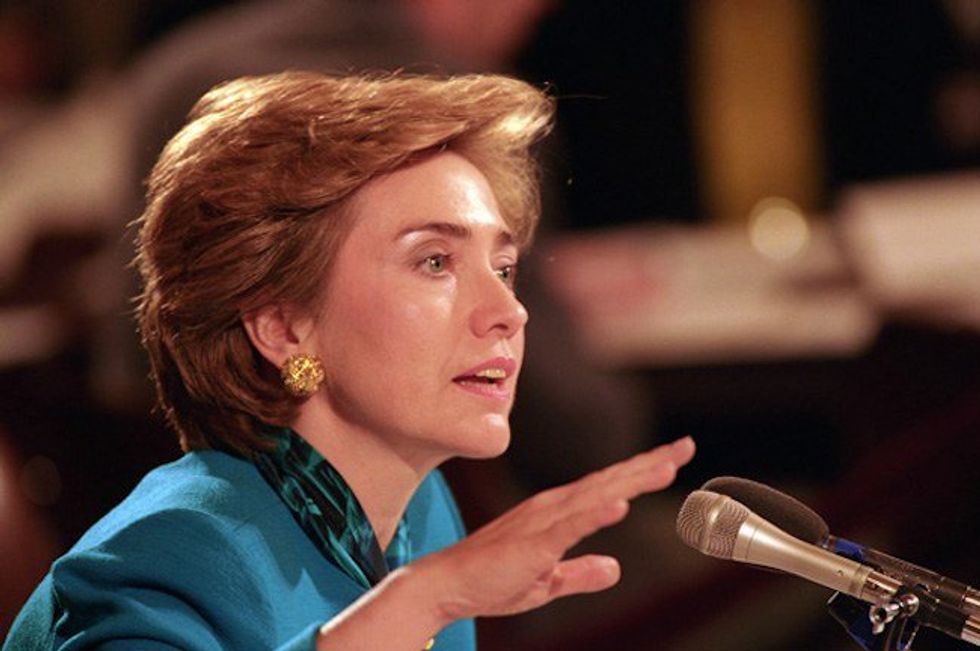
Back in March, Hillary Clinton, Democratic candidate, declared, "I don't know where [Bernie Sanders] was when I was trying to get health care in '93 and '94." One of her biggest talking points throughout the election has been her efforts on Universal Health Care back in the 1990’s. As she puts it, “Obamacare was called Hillarycare.”
But in typically sarcastic fashion, the Internet had an answer. The response? He was “literally right behind you.” There are several pieces of evidence linking Sanders to the fight in the 90’s, including a photo of them at a Clinton speech on C-Span and a signed photo addressed to Bernie.
Fair enough, Hillary tried to make a political jab and savvy Bernie supporters were able to catch her with her hand in the cookie jar. However, Jennifer Palmieri, Clinton’s communications director, tried to argue the point in a less literal sense by saying Clinton “was out in front. Sen. Sanders was in the background. She was the one who took the slings and arrows.”
Bernie has gotten a reputation for having a devoted fan base among millennials, a generation born too late to have any memories of the original health care battles, or the Presidency of Bill and Hillary Clinton. We grew up in the earth-shaking aftermath of 9/11 and the Bush Administration, which largely overshadowed the massive cultural shifts that occurred in the less iconic 90's. And more importantly to our discussion, not being aware of this era robs us valuable context for this current election, and the perks and privileges that have allowed Bernie to take America by storm.
To begin, it is important to understand that when I say the Presidency of Bill and Hillary Clinton, I mean Bill and Hillary Clinton. The famous line during the election of 1992 was that with the Clinton’s, you got “two for the price of one.” Hillary was believed to have saved Bill in the wake of scandals by getting out on the campaign trail. She would be the first presidential wife with a post-graduate degree. She even received criticism for mocking the notion of being a doting house wife. The duo were a mini-revolution for the White House. He was the charismatic, pot-smoking charmer who “felt your pain.” She was the career woman who would get her own office in the West Wing. They were changing the game, with Hillary becoming the face of new generation of women.
That brings us to the health care battle. In 1993, the early years of the presidency, Hillary was in charge of a task force to create a proposal for Universal Health Care. The mere thought of a First Lady taking on such a mammoth project was deemed outrageous. Sure, Barbra Bush was committed to literacy efforts, and Lady Bird Johnson had her high way beautification project, but completely remaking America’s health care? The result was Hillary being caught in the center of a revolt from Conservatives, Libertarians, health insurance lobbyists.
Her bus tour advocating the policy led to hostile protests—including catcalls and knife threats—as Newt Gingrich led a campaign to paint the Clintons as anti-moral fiends, destroying the American way of life. By August 1994, health care reform in America was dead. While Clinton herself takes blame for the overlong, impenetrable proposal, she also suffered the harshest consequences.
While Bill’s popularity took a hit, Gallup polls show Hillary’s went even further down. This tied hand-and-hand with the so-called “Republican Revolution” in 1994, with Republicans taking the House and Senate from Democratic control by capitalizing on the failure. The result was Hillary playing a far less vocal role in both the reelection campaign in 1996, but also the second term in general. Bill got to keep his same slick, man-of-the-people personality, but Hillary had to effectively bite the bullet and change her personality for the bigger picture (and yet, she will still able to help pass the 1997 Children’s Health Insurance Program).
And yet the 'Revolution' would not let it go. Hillary became the first First Lady to ever be subpoenaed in the wake of the Whitewater Investigations, which was just the first of the Clinton-centric investigations including Travelgate and Filegate. And this doesn’t include the accusations that Clinton had Vince Foster, who committed suicide in 1993, killed (I'd personally rather not link any conspiracy theories). Sufficed to say Hillary has had to face near constant questions of her validity. And these constant cases had to do with the Clintons’ personal lives being scoured for every detail, leading to, the pinnacle of it all, the Monica Lewinsky trails and the Impeachment of Bill Clinton.
It is undeniable that Bill Clinton lied, but in the wake of Kevin McCarthy openly admitting that they “put together a Benghazi special committee” to try and hurt Hillary’s chances at the presidency, it is hard to see the millions wasted on hearings as more than politically charged attacks. And on a slightly pettier note, the Lewinsky trials feel especially small when you realize that Newt Gingrich, Rob Livingston, and Dennis Hastert—three of the leaders in an effort to prove that Bill Clinton lied about an affair—have since revealed themselves to be a serial adulterer, a serial adulterer, and an (alleged) pedophile, respectfully.
This historical context provides what I feel the modern Democratic movement often forgets: Hillary was on the front lines of one of the most vicious, politically divided movements since the New Deal. She face a level of scrutiny almost no First Lady has ever faced. Her career—and occasionally life—were threatened. And when even after it was over, she was faced with a barrage of accusations and controversies from critics who should probably have moved on by now.
That—finally—leads us to Bernie Sanders. There is no denying this point that he was involved in the efforts to make health care reform a reality in the 1990’s. But what were the political costs on his end? He faced a close race for his seat as a representative, winning by about 3 percent. But two years later, he was once again winning by landslides. As far as can be seen that was the biggest injury, slight difficulty winning reelection. But many Democrats struggled in the wake of the Republican Revolution, he was one of the better ones off.
Yes, Bernie was right behind her. But while Hillary faced a torrent of attacks, accusations, and labels that follow her around to this day, Bernie was able to continue his political efforts in peace.
This election is an interesting study in the benefits of keeping a low profile in American politics. Pundits call the rise of Bernie, Cruz and Trump as an Anti-Establishment revolution, but in Bernie’s case, his biggest selling point is that he has found a perfect balance between speaking up and always having more recognizable, targetable voices around him.
The result is being able to create an image of being an inspiring advocate without the baggage and danger that comes with trying push these efforts through on the national stage/ Perhaps the best example of this is his efforts with the civil rights movement. He frequently cites that he was arrested protesting against segregation in 1963. But he faced a $25 fine. Other people in the fight for Civil Rights- the people who signed laws, led those marches and had to be on the front lines- faced much steeper costs.
He often cites that he voted against Iraq War, the Wall Street Bailout and the Patriot Act, but given his steady standing in Vermont, a state that has consistently voted blue since he became a Representative in 1990, he hasn’t had to face any blowback for his decisions. Unfortunately, a lot of politicians don’t have that luxury, having to ensure certain policies and fights by compromising on others.
On the national level, this is the “Pragmatism vs Idealism” argument that has frequently cropped up when discussing Hillary's and Bernie’s attitudes, and it is the wall a lot of presidents find themselves at when facing policy decisions. Could the Clintons continue to push health care past ’94. Sure, but public opinion had swung so far away in the other direction that it could have jeopardized reelection. And without reelection, welfare reform would have never occurred, the infantile Brady Bill could have been endangered, or the State Child’s Health Insurance Plan. People have criticized Obama for not quiet living up to his campaign promises, but can you imagine the amount of distress he must be under to ensure his healthcare reform is safe? Much better writers than me have been able to explain this dilemma: once on the national stage, you have a moral responsibility to help as many people as humanly possible. There is very little time or space for finding the perfect solution, just the one that will ensure the majority of Americans are helped. Bernie has criticized policies like Obamacare for notable flaws and compromises, but given how difficult the fight was, getting the uninsured rate down bellow 10% was worth those compromises. But Bernie's persona is built on the concept of ideological purity, that he never settles for less than perfect policies in his mind. There are millions of words to be had at the dangers of that attitude, but when Bernie's career is put under the magnifying glass, it doesn't hold up.
Possibly the most glaring effect of is that unlike Hillary, Bernie’s weak points aren’t public knowledge. While there are plenty ready to take Bill and Hillary to task for the Violent Crime Control and Law Enforcement Act—not unjustly—but forget that Sanders voted in favor of the bill (albeit with several complaints). See also that he vote against The Brady Bill—vital gun regulation legislation. Even recently, after taking a particularly strong stance in favor of Palestine, fired Simone Zimmerman as a coordinator for negative remarks toward Benjamin Netanyahu. The point is that despite his supports championing his progressiveness, he has had his share of mistakes. He's had his share of policy reversals and flip-flops and compromises. So has Hillary. The difference between the two is that Hillary has been fighting in the spotlight for years, as detractors scour for anything to use as a weapon against her, whereas Bernie has been able to step on to the spotlight seemingly flawless, anything negative about him conveniently left off stage. They are both human, first and foremost. But where as the American people have had first hand experience of Hillary's humanity for over 20 years, mainstream audiences are meeting Bernie for the first time.
Make no mistake, we need fighting in the background on all progressive battles. Change doesn’t happen with the small army of politicians, allies, activists and citizens working to make a difference. Every person matters. But we aren’t talking about just one person in a bigger fight. We are talking about the most powerful office in the United States. Is Bernie right for such a position?
That’s for you decide, though personally I tend to lean on the ‘no’ side. However, I have found this election cycle particularly disheartening due to how quickly decades of accomplishment by Hillary Clinton have been forgotten. American politics are immense frustrating in that sense that between Hillary and Bernie—who are both wiry political veterans at this point—the one can be called “unqualified” and “too ambitious” for fighting for change in the national spotlight while the other is praised as a revolutionary for staying as a quiet, consistent presence (I think to a certain extent gender is a factor, but that is an entirely different piece about America's complicated attitudes toward women in authority).
Many will argue that Bernie is preferable because he hasn’t being seeking power throughout his career, but I’ve always thought it is strange that, while we champion people who spend their whole lives training to be the best they can be in their respected fields, presidents are the one person we want an “outsider” for. While there is an argument to be had about politicians over staying their welcome, what should be an impressive up the political world for years has become the subject of ridicule because Americans are tired of seeing her.
I do want to stress that this isn’t intended to be an attack on Bernie Sanders, but a critic of how we have demonized Hillary Clinton in favor of a candidate who has had the privilege to fight for progress without facing nearly the amount of consequence that comes with being in the national spotlight. The consequence of facing choices that affect millions and trying to find the option that helps as many as possible. The consequence of having every decision you make scrutinized by an entire nation. It is distressing how quickly the Democratic Party and Progressives are willing to throw one of their biggest voices under the bus for the mere sin of being around too long.
Ask yourself this: before Bernie Sanders became a sensation, did you care about Hillary’s email scandal? Or the Benghazi Hearings? Or Super Pacs? Or Super Delegates? Or would you merely have shrugged them off as Republican attempts to discredit her campaign? Yes, Bernie was right behind her, but he picked an awfully convenient time to try and step in front of her.
This piece was a massive research effort that included information from countless sources. If your interested on information regarding the Clinton Presidency, I would recommend "A Woman In Charge" by Charles Bernstein.