The perspective of the third generation immigrant is not often examined. Of course, as there continues to be pressing racial tensions and injustice in the United States, the racism and discrimination that certain people groups face should be the forefront of our focus until resolved. However, because I had never been victim of great injustice, I never gave myself permission to reflect on my own identity. It wasn't until I attended a seminar on cultural diversity that I thought about my own perspective and biracial identity.
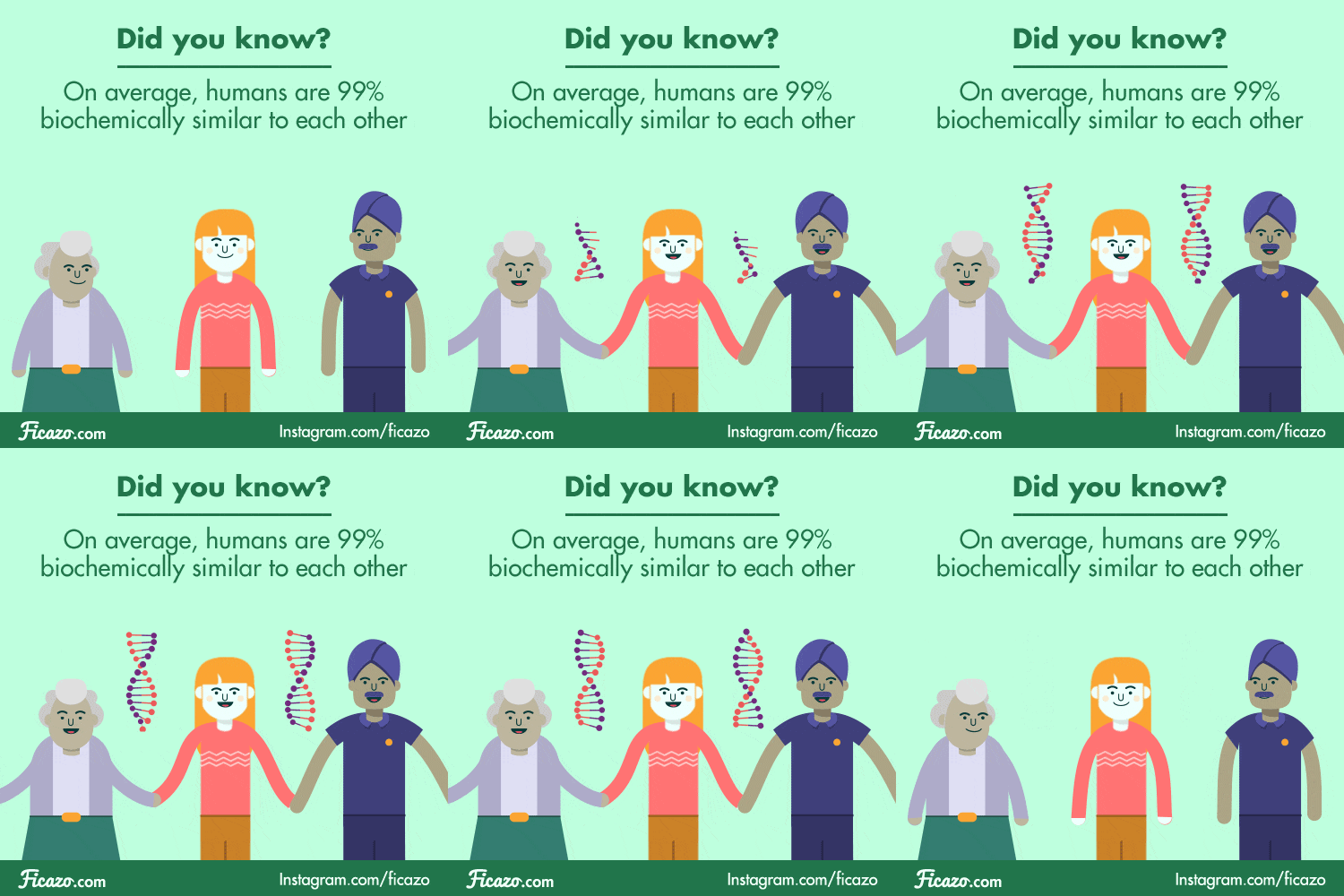
There is no firm definition of "race". Many times the word race is used to make distinctions between different people groups. But how do we go about defining what a "people group" is? Current research discredits the former idea of biological race. This means that your "super white genes" from your "super white ancestors" could be more similar to someone who traces their immediate family and ancestry to Nigeria than to someone who traces their lineage back to the same village in Europe your family originates from. I use the word race in this article simply because there is no better term or description available.
Below are some common experiences or questions that have popped up for me in my own life. I hope the following reflection inspires you to reflect upon how your race has shaped your life experience.
1. What the heck do I fill out on forms?
I'm not quite sure why on forms there's sometimes a limit of selecting only one race. That leaves the people (like me) who are half one race and half another very confused and it turns into a "Sophie's choice" type situation.
Just as a fun fact, back to the construct of "biological race", if you go to the doctor's and mark yourself as being one race you may be given a different course of treatment than if you had marked another race. Somehow the American medical system, which was born out of racist ideals to begin with, hasn't caught up to modern research on race.
2. Did I get into ____ because of some diversity quota?

Although I am pretty confident in my academic ability and other skill sets, there's always that question of whether or not at least some of your accomplishments were due to a diversity quota. Honestly, if my 1/2 Asian-ness helped me get one of the 112 seats in my nursing program out of the 4,000+ people who applied into the program, I wouldn't be mad. But it begs the question, what of my accomplishments are solely mine and how much attributes to me being biracial? This doesn't keep me up at night and it shouldn't for you either, but a girl's gotta wonder.
3. Watching people struggle to ask about your race.

People can tend to be uncomfortable when it comes to talking to people of different ethnicities. White people from white suburbs tend to be SUPER uncomfortable when it comes to talking to people of different ethnicities. Sometimes people try to be so politically correct it's plain awkward and uncomfortable for both parties involved. When people wonder about my ethnicity, sometimes they start to ask and realize halfway through that they don't know a "polite" way to do so. There's a lot of stuttering and rewording involved for something that is so simple to answer. To answer the question you'll never ask, no, I am not offended by you asking about my race.
4. "Say something in ____."

In elementary school, a lot of my peers assumed that since I looked Chinese, I could speak Chinese. I was asked a countless number of times to speak the language by classmates, and my second grade self wondered if I was somehow supposed to be able to because of that half Chinese part of me. Although my mother grew up speaking Chinese, I never learned and my high school never offered it as a class so I settled for French (that's close right?). I come in handy at bakeries in Montreal, but would be completely useless in China.
5. Missing certain foods while away at school.
While college hunting in high school, I visited a school who bragged about their extensive food offerings on campus. A representative from the school approached me and in our short conversation she was sure to mention that the food selection was so vast that she was sure it "even included the food my mother makes at home." Although the comment was laughable and Burlington offers so much good food it's mind boggling, sometimes I miss the food I grew up eating. I would be lying if I told you I've never ordered plain white rice from a local takeout Chinese joint for a snack.
6. Not being white but also not being completely (insert race here) either.

It was a little strange growing up because I wasn't completely like my white peers but also wasn't straight from China. As a third generation immigrant, there are some aspects of Chinese culture that I have in my life but otherwise I am predominantly culturally American. I'm completely fine with this now, but as a little kid I learned that I was biracial from kids in kindergarten stretching the outside of their eyes into a squint and exclaiming, "look, I look like you!" Before that I was just me- no race at all, just a human being. Living in the tension of not being 100% white and also not being "very good" at being Chinese (or in other words, not connecting with the Chinese culture) was interesting and eye opening. People my age are more accepting and don't give much thought to what I am, but it's interesting to think that a five year old can learn how to think of or treat people of different races from such a young age. Given a child that young probably is just repeating what they've seen and heard others do and say, it's in some ways the most unfiltered view of existing racism and stereotypes in our country.
7. Being the token friend.
I have been lovingly deemed the "token Asian friend" of certain friend groups. But can someone tell me what this means? I'm happy that you're happy to have a token friend but I'm not quite sure how I ended up in this role.
8. Enjoying embracing two (or more!) different cultures.

Good news: you don't have to pick one ethnicity to identify with. You can embrace all facets of your ethnicity, and one is not "better" than another. As long as you aren't using your heritage to belittle or disrespect someone else's, embracing your ethnic identity can be a positive and freeing experience.