


With Memorial Day right around the corner, families throughout the country will celebrate with barbecues and flower planting, but along the way, some may forget the true purpose of the holiday and the sacrifices made for such celebrations. Here are some of the stories of the more forgotten, behind the scene heroes to be honored this holiday.
Bing
Bing, the dog of war, parachuted into France with his sniper handler to become a D-Day hero. Bing was one of the first dogs to be parachuted and dropped behind enemy lines alongside British paratroopers. The Alsatian-Collie cross landed on Normandy soil with the purpose of sniffing out trouble before troops entered, even after being wounded with mortar fire. When something didn't seem right, Bing would stop in his tracks and point. When the troops moved, he pioneered the advance into potentially dangerous areas. It is estimated that Bing saved hundreds of servicemen from ambush during his time at war. After his service, he was awarded the PDSA's Dickin Medal, which is the animal equivalent to the Victoria Cross.
Traveller
Traveller, one of the most famous horses of the civil war, was purchased by General Robert E. Lee in 1862. The horse, whose name was originally "Jeff Davis" served as General Lee's mount through the majority of the war, to places such as Gettysburg, Manassas and Fredericksburg. After the war, Traveller later participated in the General's funeral procession. In 1971, Traveller's remains were reburied next to the Lee Chapel on the Washington & Lee Campus, just a few feet from Lee's burial site. Traveller is the namesake of the University's Safe Ride Program where students say "Call Traveller and you will get home safely." There is a book written by Richard Adams which recalls the war from Traveller's point of view.
Old Baldy
Old Baldy was one of the most prominent of the war mounts belonging to General George G. Meade. General David Hunter was riding Old Baldy during the first Battle of Bull Run on July 21, 1861. When shrapnel wounded his nose, Old Baldy was sent to recover in Washington D.C. before returning back to serve. On the Second Bull Run in August 1862, Baldy was wounded through the right leg. At Antietam in September 1862, he was shot through the neck and left for dead. But die he did not. He returned to work and in July 1863, he was shot through the body and found the strength to survive. He retired in Pennsylvania with a man named John Davis, until his death on December 16th, 1882. He survived General Meade by greater than ten years.
Sergeant Stubby
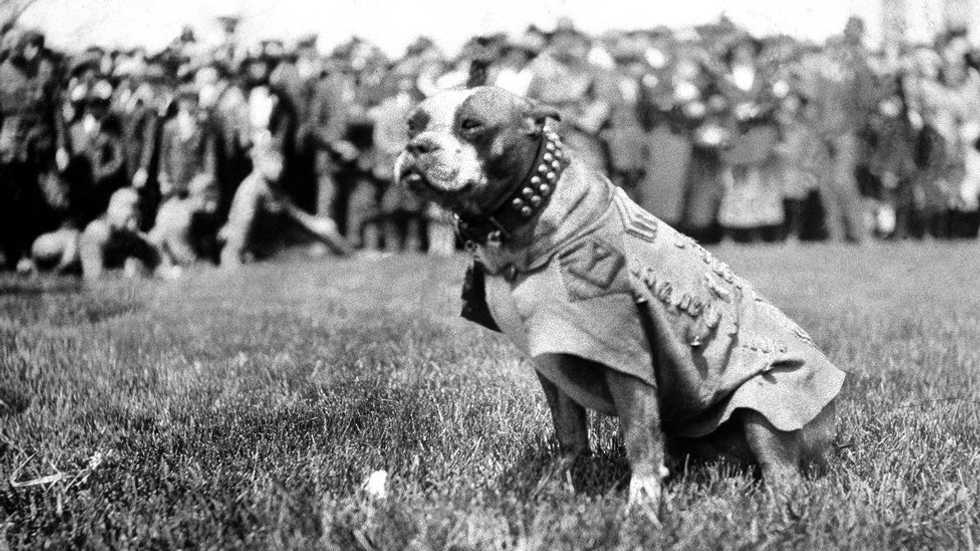
Over 200,000 dogs were sent to their deaths within just the first two months of WWI. When it was heard that Germany was mass training dogs for their use in the war, the training of 7000 army dogs was set to begin. Sergeant Stubby became the most decorated war dog of WWI, and the only dog to be nominated for rank and then promoted through combat. He was the official mascot of the 102nd Infantry Regiment of the United States and assigned to the 26th Yankee Division. He served for 18 months and fought in 17 battles on the Western Front. Sergeant Stubby saved his regiment from surprise mustard gas attacks, found and comforted the wounded, and even caught a German soldier by his rear and held him down until American soldiers found him.
I hope you all have a wonderful holiday, but in between the barbecue chicken and potato salad, I encourage you all to take a moment and thank the men, women and animals which have served and made the ultimate sacrifice for our country and for our freedom. Happy Memorial Day.

















