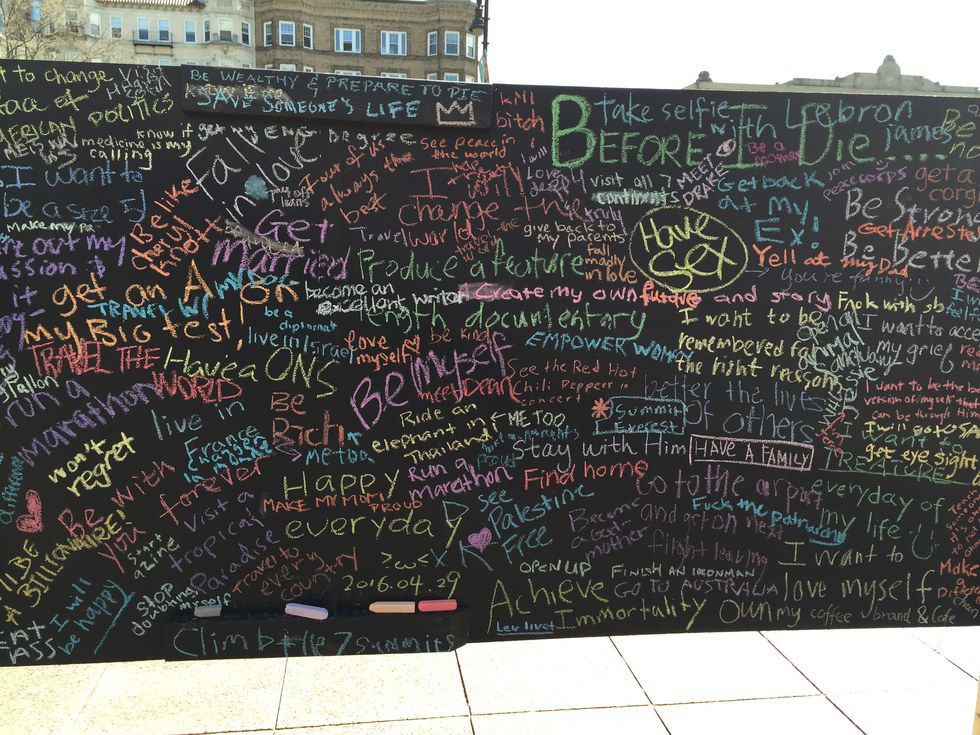

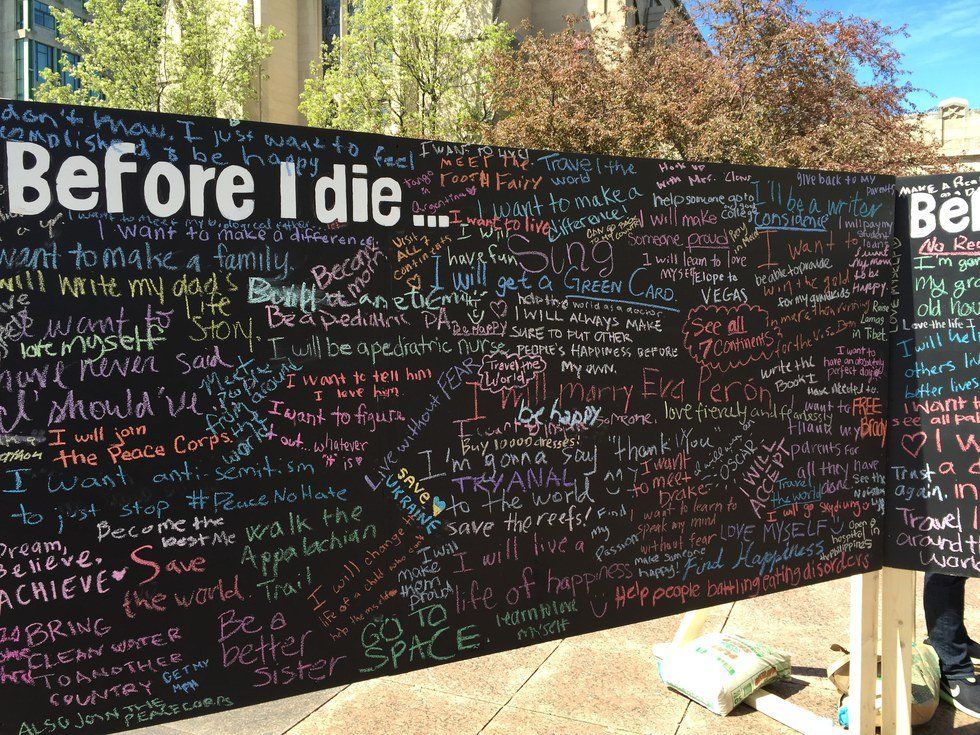
Where is a place in which secrets can be shared and dreams can be solidified? A place where ambition, desire, acceptance and hope can all come together and combine? Where is a place in which creativity can bloom out of death? The “Before I Die” wall proposes just that.
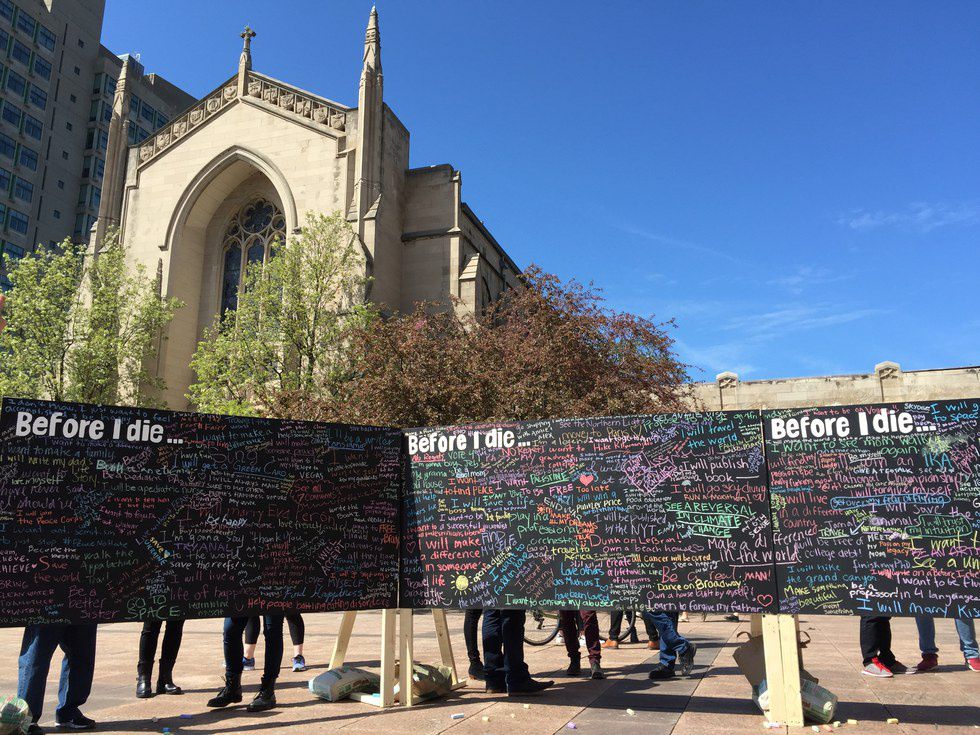
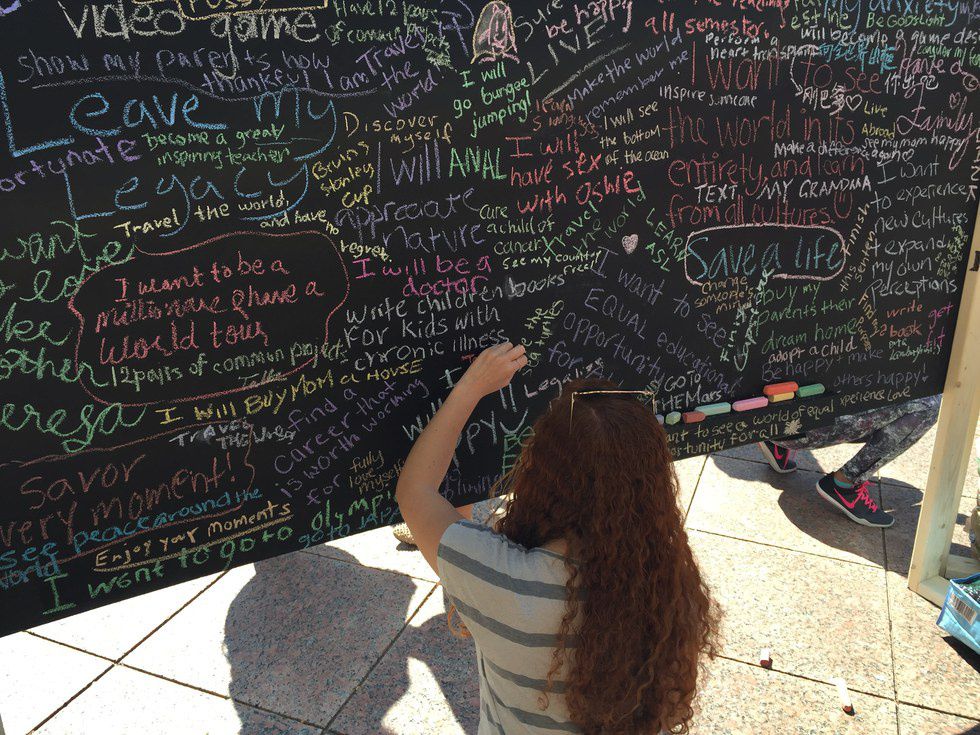
Students gathered and stood back from the 8-foot wall that stretched across Boston University's Marsh Plaza on Friday. Out of respect, they kept their distance from those who were writing and gazed at, photographed and absorbed the mass collection of secrets, dreams and private thoughts that were anonymously written with colored chalk on the wall.
"Before I Die..." was written with bold white chalk in the top left hand corner of each wall section. Here was a place where free thought was more than encouraged. Looking at the creation for myself, I wondered, why don't we have this up here every day?
Perhaps the idea of a bucket list or dreams in general have, at this point, been too romanticized. People reblog, pin, share and post about things they want to have and accomplish during their lives on social media, but they hardly ever get around to actually doing them. This doesn't mean that we should relinquish dreams altogether; they are absolutely necessary for inspiration, motivation and purely fueling passion. They exist as goals for so, so many. But there comes a point where we must ask ourselves: are we talking too much and doing too little?
With the term "goals" being practically overused nowadays by millennials, and with so many Pinterest ideas, dream vacation home photos and trip reports circulating on the internet via countless social media sources, it is a wonder how people get anything done. It's as if a new addiction has sprouted: the "goals" addiction. People have become obsessed with the ideas and dreams of achievements and have fallen from the actual ladder of creating and finishing. They sit at the bottom of the ladder and gaze at the top contently, giving themselves a false sense of productivity by simply placing one hand on the bottom rung.
It's as if clicking that "share" button or "pin" button on an idea or goal means you're already halfway there. And in a way, that's not totally incorrect -- where do achievements begin without the original inspiration and idea? But the problem comes when social media addiction takes over. People can't look beyond the screen. "The sky's the limit" becomes "The screen's the limit." People no longer look up for their dreams; they look down at their phones. And they repeat the cycle of sharing, pinning and staring at the dream vacation photos instead of booking the plane ticket or hitting the gym for that body.
In the 1992 film "Glengarry Glen Ross," character Blake confronts the employees of a Chicago real-estate office. He teaches them the ABC's again, but this time in an adult way and with a more valuable lesson: "Always be closing." Blake's speech teaches the workers that if they want to get anything done, they had better complete it. His lesson preaches not to start a sale or project and then walk away unfinished to go and do another one. "You close, or you hit the bricks." It's a relatable lesson and a renowned speech that is valued by many people, so if you haven't heard of it, I highly suggest watching the scene and taking Blake's words to heart.
This article is not meant to put you down and say your dreams have pretty much died if you use the Internet. Simply put, awareness is the key of this generation. When I look at the wall in Marsh Plaza that asks every passersby to share their goals and wishes, I see an overwhelming number of responses. Some are humorous, some are touching and some are shocking. "Pray in Mecca," "Buy mom a house," "See the Northern Lights" and then "Forgive my rapist," just to name a few.
There was something different about this wall, though: it would not be here forever. It was physical: you lifted the chalk, you drew on the board and then you walked away. It would be erased by the end of the day. You could take a photo of it, but it wouldn't be the same -- just like everything you see online. You can't grab those dreams; you can only share them and then keep scrolling, likely to forget about them.
With the wall, however, there was something about writing your sacred wishes on a board with your own two hands that made it feel real: the one dream that people chose to share clearly means something to them. And to make it mean even more, they have to get it done so that it will not mean nothing when it is erased at the end of the day. So it will not simply live through pixels on a screen, but through their beating hearts. That is what makes it the human experience, and that is what makes it truly real. Always be closing, always be dreaming and always be achieving.