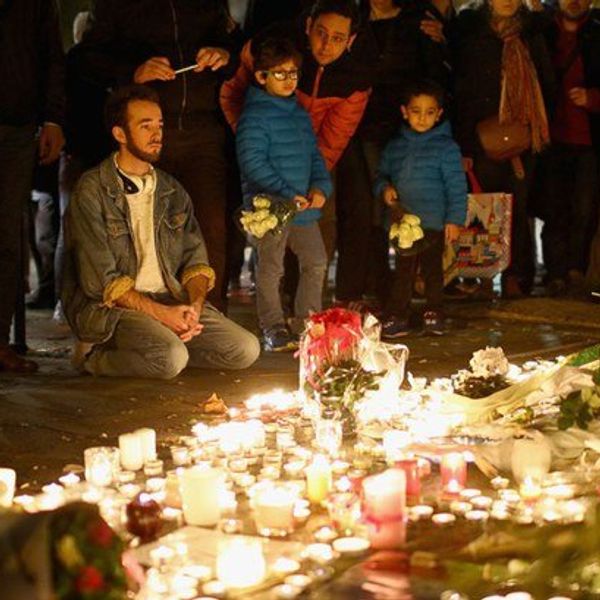

It's no mystery that the very world we live in has come to a crossroads within the past week. Friday, November 13, 2015 was a day on which one of the world's greatest evils (if not the world's greatest evil) came to the forefront of the mind of each and every man and woman. It was a day in which we realized there is a force to be reckoned with: a force that is driven by insatiable, fanatic passion, and will not stop until their own perceived victory is achieved or they die striving to achieve it. That force is what we know as the Islamic State, or, better, ISIS.
However, what many do not understand is that ISIS is far, far more than the "bad guy" in a Cowboys vs. Indians show, like the kind that used to be normal television programming. This is the completely wrong image. Not only is the essence of ISIS far more sinister, it is far more deep-seated. ISIS is the very image of the events that occur when religion and militaristic agenda are combined. ISIS is not an army of soldiers. It is an army of idealists. ISIS not only wages warfare militarily, it wages war in the psychological sense.
What do I mean by psychological? I mean that ISIS soldiers have been taught from the day they could speak that their Islamic "faith" was to be spread by means of the sword in a sinful, unholy world. These are people of the Islamic tradition that have taken the Quran (the Muslim holy text) very literally regarding the use of violence against people of other faiths: that is, "unbelievers" or "infidels." The particular passage they cite has often been referred to as "The Verse of the Sword," which states: "But when the forbidden months are past, then fight and slay the Pagans wherever ye find them, and seize them, beleaguer them, and lie in wait for them in every stratagem (of war); but if they repent, and establish regular prayers and practise regular charity, then open the way for them: for Allah is Oft-forgiving, Most Merciful." (Quaran 9:5). Extremist, jihadist terrorist groups have taken this passage of Islamic scripture to the utmost. They have adopted a sort of "convert or die" mentality.
But why are these groups so intent on such a waging of warfare? The truth is that there are many, many reasons. But, to gain a basis of understanding for their mentality, we should look at their sense of ethics. ISIS is a Sunni (as opposed to Shi'ite Muslim extremist group. Sunni Muslims is the sect of Islam that holds fast to what is called Sharia La. Sharia La is a rigorous code of ethics to which Sunni Muslims adhere. This is why we might see a practicing Sunni Muslim woman wearing a burka to cover her head in public. This is why Sunni Muslims will never drink alcohol. This is why Sunni Muslims will never engage in pre-marital sex. To do such a thing would be to violate Sharia La, which is a very serious matter in the Sunni Muslim faith.
However, the ideas we see coming from the ISIS think tank can hardly be described as "faith." If moral conviction and religious faith informs action, ISIS is the wrong place to look for an example. Rather, for ISIS, religious faith is used as a crutch for their agenda: their intention to wage warfare upon each and every person who would not hold to such a rigorous code of ethics. Here is where the disconnect comes, and it's not hard for us to see. How could a group proclaiming such rigorous religious ethics senselessly slaughter innocent lives, rape women and sell them into slavery, and pillage and plunder, leaving utter destruction in their path? Your thinking is exactly right. This is no sort of "faith." This is politicized faith. This is militarized faith. This is not authentic Muslim faith. This is faith with an agenda behind it. Religion is, for ISIS, being used as a support for their war machine.
Now that we have a sort of understanding of why ISIS does what they do, and an understanding of their (mistaken) motivations, let us dig a little deeper into why they are the way they are. In an article in The New York Times written by David Brooks, there is a perfect description of the sort of cultural separation and moral high-ground ISIS has claimed in their jihad. Brooks refers to a book entitled "Not In God's Name": Confronting Religious Violence by Rabbi Jonathan Sacks, in which Sacks explains the concept of "pathological dualism." This dualism is a result of taking religion to the utmost extremes, i.e. the attitude of "all who do not hold such faith are worthy of instant death." Brooks writes, "...religion fosters groupishness, and the downside of groupishness is conflict with people outside the group. Religion can lead to thick moral communities, but in extreme forms it can also lead to... pathological dualism, a mentality that divides the world into those who are unimpeachably good and those who are irredeemably bad" ("Finding Peace Within the Holy Texts" - www.nytimes.com). This mindset opens the door for jihadists like those in ISIS to embrace a politicized religion, in which they demand that the caliphate (an Islamic government, as there once was in the early Medieval world in the times of Mohammed) be restored.
So, what is the best way to combat this? How do you stop a group whose sole intention is to restore the caliphate: to hang the ISIS flag from the White House, the Reichstag, the Kremlin? In such a time as this, there simply must be some sort of military action taken against ISIS, even though it is an utter tragedy. While war should never be the first instinct, it is a human reality, and it is no mystery that the nations of the world (not just the United States) must unite in purpose against ISIS in some way, shape, or form. There need not be a search for a just cause in doing so either. The just cause the nations of the world have in doing so is the cause of eradicating a group that, as President Barack Obama says, is "the face of evil" in our world today. Raping and killing innocent women is evil. Beheading Christians, Jews, and other Muslims who will not convert to "ISIS Islam" is utterly evil. Killing innocent restaurant patrons on a Friday night in Paris, France, and holding hostages to torture in a theater afterwards is unmistakably, unequivocally evil. The nations of the world have the means to fight such evil with military force, and will seek to do so.
But, it doesn't stop there. Military force is not the only way we should combat ISIS. In fact, it is not even the most effective way. We must combat ISIS with ideals. We must combat ISIS by shifting our own frame of reference, in some senses. This is much of what Rabbi Sacks talks about. If we were only to fight ISIS with bombs and missiles, we could very well win. But, how long would peace last? Would we really attain true victory? Peace can only last through the changing of twisted mindsets. This is something that, up until now, has not had the chance to take hold in the wake of such conflicts. Our first reaction is retaliation through arms. Our first instinct as people who desire hard, fast victory is to launch airstrikes and put troops on the ground in the Middle East. But, what if there was a better way to lasting peace and victory?
What does this look like? Let's take a look at Rabbi Sacks' argument. He first reminds us that the great religions of the world (Christianity, Judaism, Islam, and others) are based off the premise of loving one another. However, Sacks states that the ideal of love by itself can be problematic. In fact, this ideal by itself is exactly that thing which would drive ISIS to commit such terrible acts as they do. As Brooks paraphrases, "...love is problematic. Love is preferential and particular. Love excludes and can create rivalries" ("Finding Peace Within the Holy Texts") Alongside love, there must be something else. That something else is the ideal of justice. Justice is, indeed, what "sanctifies" our love. Brooks writes, "The command is not just to be empathetic towards strangers, which is fragile. The command is to pursue sanctification, which involves struggle and sometimes conquering your selfish instincts."
What a huge claim this is. True victory, true sanctification can only come when we embrace the ideals of love and justice as two sides of the same coin. As Sacks argues, this is the way to end religious violence. Again, Brooks writes, "Sacks's great contribution is to point out that the answer to religious violence is probably going to be found within religion itself, among those who understand that religion gains influence when it renounces power." Religion is not to be used as a platform for power. Religion is not to be used as a crutch for a political agenda. If a religion is to be authentic, if a religion to have any sway whatsoever on a person's moral self, it would require the defiance of earthly power.
As a Christian, I will admit that I struggle mightily in a world of warfare to hear the call of Christ to love my enemies, and pray for those who persecute those around me. I struggle with the desire for victory over evil, and victory that comes quickly. I sometimes catch myself going into dark places concerning my thoughts about the best way to take action against groups like ISIS. But, in the end, I must reexamine where true victory is really found. Victory is found in denying myself, and, as Brooks writes, "conquering [my] selfish instincts." Christ has called me to "take up my cross" and follow him. But, how powerful would Christianity become if we took to this radical idea of love, this radical idea of where true victory is really found? For me, victory is ultimately found in death, because, as Paul says, "For to me, to live is Christ and to die is gain" (Philippians 1:21). Reexamining where victory is truly found in a debate such as this. Victory is not found, in the end, in who has the strongest soldiers. Victory is found in the denial of self, even to the point of death. For the respective religions of the world, it will be important in such a time at this where real victory is found. Victory is found in truth. Victory is found in justice. Victory is found when love lines up and takes the hand of justice: justice that is embodied in a radical, unusual way that will force those who commit injustice to think long and hard about what they are really doing, and why they are doing it. This is influence. This is true power.
Why do we not seek to instill this ideal? What would happen if, alongside, and ultimately instead of, our warfare with weapons, we used the sharp sword of morality, the sharp saber of ideal and truth to combat evil? Because we are opposing such an idealistic, indoctrinated, imprinted group in ISIS, there simply must be a change at the idealistic core. There must be a paradigm shift in the thinking of ISIS jihadists. So, as we seek to combat the Islamic State's presence in the world, let us search for the link between love and justice, and thereby aid in moving the world to a place of right ideals: ideals that lead us to true, lasting peace and victory. Let us show that power is not simply found in who has the biggest guns and bombs, but in those who embrace right ideals, and who shed light into the darkened places of the mind.