

There are lots of girls out there who can rival their male peers when it comes to sports knowledge. Unfortunately, I am not one of them. If you're anything like me, figuring out how much time is left in a sporting event and who has possession of the ball are victories in themselves. When the Super Bowl or another large event happens, you choose a team (probably based on outfit uniform colors) and go with it for the night.
But what happens when the games don't seem to end? When NCAA basketball begins to consume everyone around you, you can either join in the madness or be totally left out. You gotta fake it 'til you make it (or at least until April 6 for the final game). If you aren't sure where to begin, see below for my take on the tournament.
If you're as basic as I am, we need to start with the most basic term. March Madness is the commonly used (and far catchier) name for the "NCAA Men's Division I Basketball Tournament." The tournament itself is single-elimination (read: if you lose once, you're out) and it starts with 64 hopeful teams (and ends up with a single winner). A common misconception is that the madness solely takes place in March; however, the games trickle into the first week of April as well. Confusing, right?
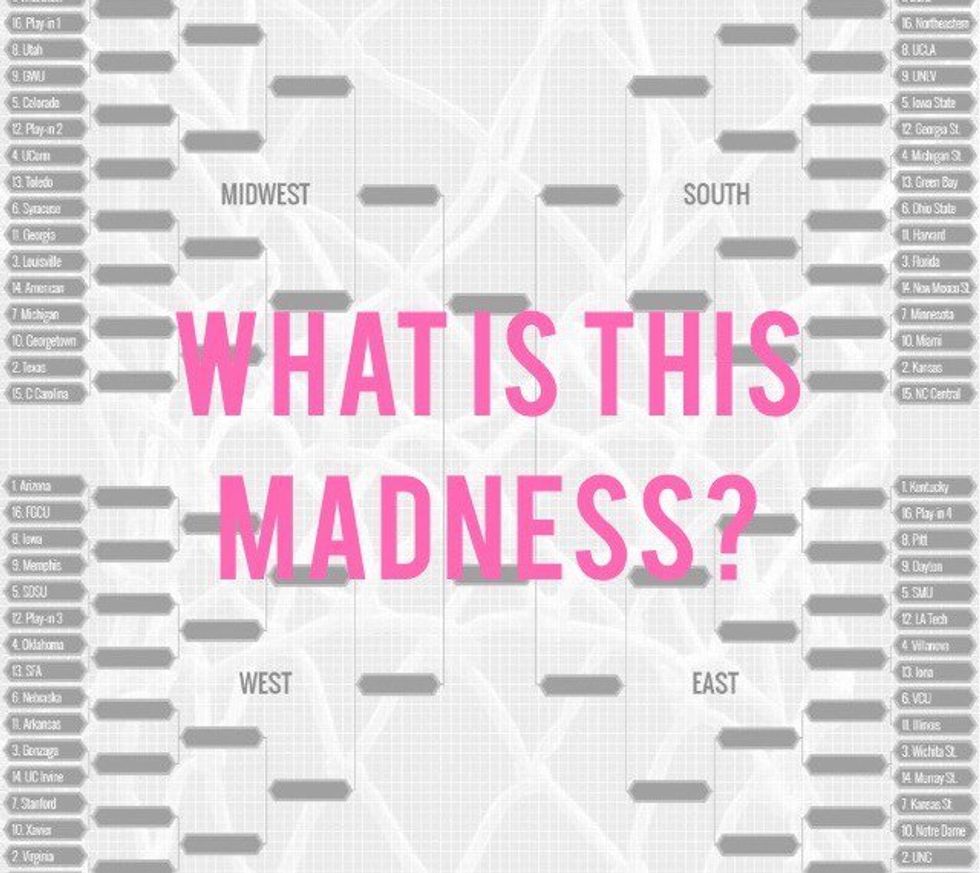
Possibly the most important buzzword of the season, bracket, refers to a chart of sorts that lays out the teams and who they play. To those of us who didn't participate in enough team sports in our youth, this can look like a mashup of confusing lines and boxes. But the key to March Madness is simply following along, because the bracket tells you who's still in the running and who's not. As the tournament plays out, we go from 64 teams to 32 to the Sweet Sixteen, Elite Eight, and Final Four. Basically, if you can just remember a few alliterations, you're well on your way to sounding like a real basketball fan.
One way to feel a little more invested in March Madness is to make your own bracket. You can do this pretty easily online or on your phone. The first games are all listed out for you, and you decide who you think will win. Then, you have to choose who will advance when your winners play each other, and so on, until you have miraculously filled out the entire page. A few quick questions to ask yourself when making your picks: Do you look good wearing their team colors? Did a friend or family member (or maybe you) attend that school? Do you enjoy the city/state that the school is located in? Have you even heard of the school? Does it have a funny name? Is your college football rivals with said school? Having a positive or negative answer to any of those questions can help lead you in your bracket creation. (Note: Unfortunately, the tournament has already begun and you can no longer create a bracket from the beginning at this point, but you can keep those tips in mind for next year).
On a bracket (and pretty much anywhere else where a team is listed), there is a teeny tiny number (1 through 16). This is the team's seed and it is only mildly important if you ask me. This tells you how their season went and whether they won games or lost games, compared to the other teams in their region. A painfully common mistake is not realizing that there are four regions, thus four #1 teams, four #2 teams, and so on. Rankings are not the end-all-be-all. Upsets, or when a lower seeded team beats a higher seeded team, make it extremely difficult to predict a winner for each game. This year, we've already seen several upsets and near-upsets. I would recommend that you enable the "upset alert" feature on your sports app (whether you made a bracket or not), as these are an easy thing to work into a conversation (The correct way to use this information: "Wow, I can't believe that Baylor got knocked out by Georgia State." Tempting yet incorrect: "Who knew Georgia State even had a basketball team?")
Now that we've got the basics down, you are ready for a few advanced concepts that will really impress your dad/male friends/boyfriend/coworkers/more knowledgable girlfriends. Applying our Disney knowledge, a Cinderella team is a really unlikely team doing better than anyone thought they would. This could be a 15th or 16th ranked team upsetting the #1 or #2 team, for example. Another important stat is that Kentucky is the only team that entered the tournament with no losses (we can also refer to this as "undefeated"). From what I've heard, this makes a lot of people excited to see them lose, so be prepared for conflict between die-hard Kentucky fans (as well as people who chose them to win on their brackets) versus basically everyone else.
Hopefully you now know enough to hold your own in the endless madness that is NCAA basketball. When all else fails, remember the alliterations, the upsets and the most importantly, the bracket.