
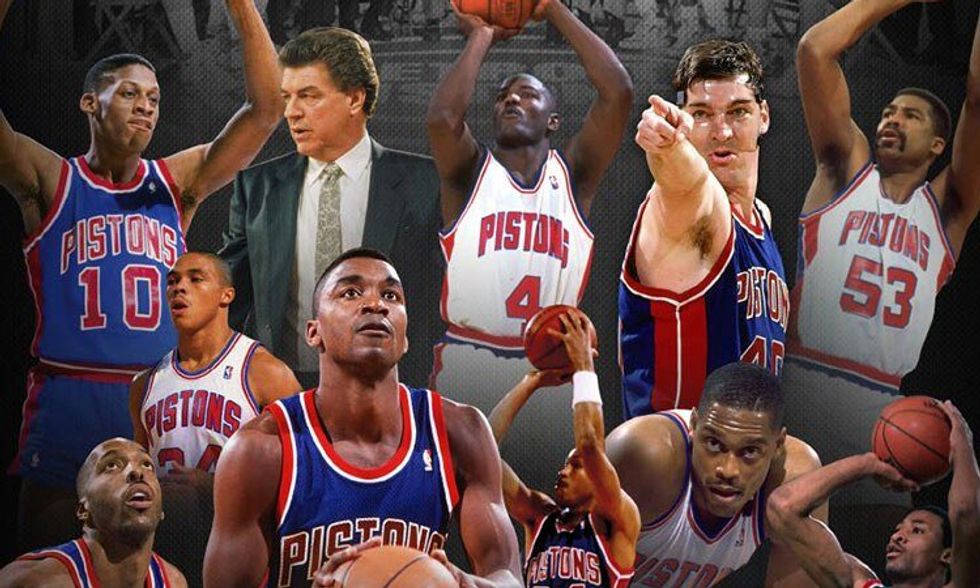
While it is admittedly bold to state that every team played like the Bad Boys, how inaccurate was Isiah Thomas in saying this? I recently read an article in which the author created a custom chart rating the Bad Boy Pistons in badness (Technical Fouls) and goodness (Winning Percentage) between 1982 and the present, and unsurprisingly one notices a strong relationship between technical rate and winning. Not to mention even the baddest Pistons team (the 1989 Bad Boys who won the franchise's first NBA championship) rank 15th most technical fouls since 1982, with each team ranked higher having an equally as good or higher win percentage. A prime example of this curious relationship is the 1995 Seattle SuperSonics, who not only have one of the highest technical rates since 1982, but also one of the highest win percentages, coming within two games of defeating perhaps one of the greatest dynasties of all time in the Chicago Bulls lead by Michael Jordan (who went on to win the 1996, '97, and '98 Finals). I digress, however, that this alone shows that the Pistons were perhaps not anywhere near as "bad" as people make them out to be, but instead were only viewed as such a disgraceful and dirty team because they were among the first teams to use technical fouling and aggressive defensive play in order to contribute to their success. But do you hear Larry Bird, Magic Johnson, or Michael Jordan talking about their immense hatred and disrespect for the 1995 SuperSonics? Absolutely not, although to be fair two of the three mentioned had already retired by this time. The Pistons were hated so greatly simply because they were one of the first teams to realize that by playing aggressively and taking what some might argue tactical technical fouls, they could beat even the most seasoned of teams and players which they obviously proved by dethroning not one, but both of the dominant dynasties in the 1980's.
Of course, it would be naive to state that this is the only reason the Bad Boys were so intensely hated by their opposition, which I have no issue acknowledging. What I do have an issue with however, as stated in the first part of this article, is the extreme bias and hypocrisy surrounding those who were so vocal in their loathing of the Pistons during this time and even now in the present day. My purpose for writing this second part is to address some of these issues simply out of frustration and a desire for fair opinion (as unrealistic as the notion of a "fair opinion" may be). But, being that I am such an avid fan of certain sports, I also want to address my reasoning for my defense of this incredibly infamous and controversial team.
The year is 1987, the location: Boston Gardens. The Eastern Conference Finals between the Boston Celtics and the Detroit Pistons has become nothing short of a war zone, with the primary facilitator being Bill Laimbeer (starting Center for the Pistons, widely regarded as the "baddest" of the Bad Boys). Throughout the series, Laimbeer has jabbed and poked at the previously untouchable Celtics offense lead by Larry Bird and their frustration with him and the entire Pistons team has finally reached its peak during Game 5 following a bloody Game 4 which saw Laimbeer fined $5,000 for illegally clotheslining Larry Bird to keep him from making an easy layup, who subsequently initiated an on court brawl between the two teams and a further fining of $2,000 for Bird for initiating the melee. Laimbeer goes for a rebound, aggressively boxing out the opposing center in Robert Parish with an arm to his chest (an aggressive, but generally completely legal play). Suddenly, fists and forearms are flying, and Laimbeer is struck from behind repeatedly by Parish, who connects with blow after blow to the back of Laimbeer's head and across his face. Laimbeer hits the floor and security guards rush to the court to prevent another on court melee as the dazed Pistons center is checked by team physicians. Boston fans are going wild, cheering and clapping for Parish who has in effect "silenced" the Pistons' most hated player with repeated sucker punches to the back of his head. Of course, these are the same fans who for nearly 5 years have voiced their intense hatred for the Pistons for their aggressive defensive play. But in those 5 years, one could count on one hand how many times the Pistons played so dirty that they resorted to underhandedly sucker punching an opposing player for little more than a slight provocation at the immediate time. Yet here are these same fans cheering and encouraging Robert Parish (who up until this point had been a relatively level-headed and mild mannered player) who had just performed one of the most dastardly things a player can do in any sport by repeatedly striking a player in the head from behind. This is but one example of the hypocrisy and bias surrounding fans when considering the general opinion of the Motor City Bad Boys.
Moving forward to 1988, the Pistons have finally dethroned the Celtics as Eastern Conference Champions and are heading for the 1988 NBA Finals against the "Showtime" Los Angeles Lakers, led by Earvin "Magic" Johnson and Kareem Abdul-Jabbar (who still holds the NBA All-time career scoring record and is widely regarded as one of the 10 greatest players of all time). Prior to the matchup, Magic and Isiah Thomas were reportedly very close friends, with Thomas even going so far as to say "Magic was probably the closest person to me at the time." However, once the Finals began, their relationship changed from a mutual kiss on the cheek prior to tip-off in Game 1 to the aggressive play shared between the Pistons and Celtics in previous years. In Game 3 at the Silverdome in Detroit, Michigan with the series tied at one game apiece, the friendship shared between the two as evidenced only two games prior finally came to a head and visibly crumbled on the court. However, it was not Isiah Thomas who made this choice as many would expect from the proverbial ringleader of the Bad Boys, but rather the widely loved Magic Johnson. Midway through Game 3, Thomas drives towards the basket for a layup when suddenly, Johnson comes across and meets the guard midair with a deliberate elbow to the face. No foul is called, and Thomas rises (and I quote from Thomas) "as if to say 'What the f***?'" but is only met by an aggressive stare from Magic. During the postgame press conference (which the Lakers ended up winning 99-86 to go up 2-1 in the series), when asked about the elbow, Magic replied "if he is going to come in here and I have to put him down like I did, it's just going to be that way now." To reiterate, another of the players who was highly notable in their voiced hatred of the Pistons deliberately threw an illegal elbow into the face of Isiah Thomas with little to no provocation. And yet, while the Lakers fans had no issue joining the Celtics fans in their unanimous loathing of the Bad Boys, they cheered Magic on for his actions. When Magic did it, fans said "We love Magic, look at that. He'll do anything to win!" But when the Pistons did anything even moderately similar, they were branded as "malicious," "disgraceful," and "villains of the game." Why? Why was it that fans could be so deliberately biased and hypocritical when players on their own teams very visibly showed they had the capacity to be equally as bad (and all too often, far worse) than any one player on the Bad Boy Pistons?
It is understandable for fans at the time to have been so completely loyal to their teams (especially these two teams evidenced, as they were considered 'royalty' in the league during the 1980's) to the point of perhaps holding a specific level of bias against the Pistons. But for analysts, fans, and even many of the players in question to talk about their hatred of this team even to this day is absolutely ridiculous. I do feel obligated to state that I have left out some details about the Pistons and their actions (many of which I cannot in good conscience defend, regardless of my love for the team and its players), but at the same time, I can honestly say that none of these details would in any way provide justification for the hypocrisy and bias directed towards the team to this day. In closing, my opinion of the Bad Boys is one of adoration. Why? Because they were unafraid to do anything necessary to win and they thrived on the hostility, bias, and hatred of fans that were exemplified above. They were willing to play physical and aggressive even towards teams and players that many idolized due to their profound dominance of the league during the 1980's. Finally, they embraced the fact that because they had found a way to defeat these teams, they would receive hatred for that fact alone. However, in a sport, one must respect teams based on their accomplishments and abilities, which is why the 1988-1990 Detroit Pistons are widely regarded by professional analysts as one of the greatest basketball teams of all time. Despite having nearly everyone against them, the Pistons found ways to thrive in a league that hated them and branded them 'The Bad Boys'.