Tall, slender and clad in a Comme des Garçons sweater with her hair tied back neatly into a red ribbon, Professor Mears certainly looked the part of model during the first Sociology 101 lecture of the year.
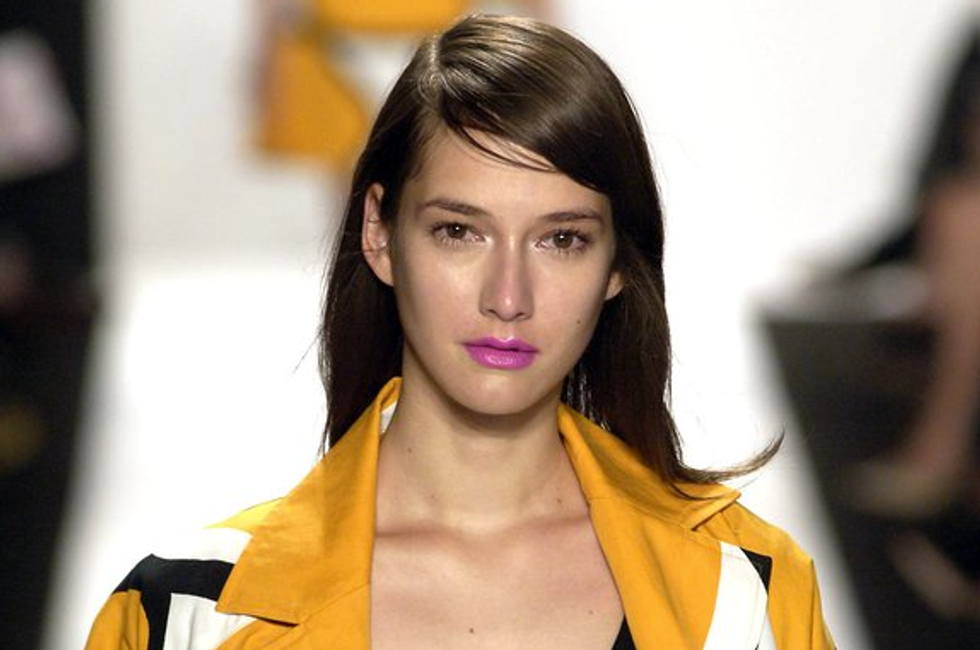
Roughly 10 years ago, Mears walked the runways during the prestigious New York Fashion Week for distinguished designers such as Diane von Furstenberg. Today, she is an Associate Professor of Sociology at Boston University.
So how did Mears make the transition from high-fashion model to BU professor?
Mears was encouraged early on to model—she recalls receiving her first issue of Vogue from her mother at age 13. At 16, she began modeling with agencies in her hometown of Atlanta, and she continued working in the field during her time as a college student at the University of Georgia. While she was a student at UGA, Mears juggled her modeling career—which required her to fly overseas to places such as Milan, Italy and Osaka, Japan—with her sociology courses.
In her classes, Mears had been reading case studies in worlds of work such as McDonald’s and funeral parlors, and from this research supposed that the modeling industry could be analyzed in the same way. While pursuing her BA at UGA, Mears began her first thesis, arguing that “modeling is ultimately another type of service work, where the models manage their own bodies and personalities to appeal to people.” In this study, she found that models get pleasure out of crafting individualized personas because it allows them to exercise control over their appearances, which are constantly being examined and judged.
At 19, Mears was hit with the realization of just how short the shelf life of models is when she was told she needed to lie about her age to appear younger. So by the time she was 23 and a newly-enrolled NYU grad student, Mears had packed up her portfolio and planned to focus her time on her studies in sociology. It was accidental that she fell into the industry a second time, when an agent recruited her in a New York City coffee shop, telling her she had "a great look" and "would make it big," while sharing that his "top girls" earned around $10,000 a day.
Mears was conflicted as to whether she should delve into modeling a second time, but ultimately decided to give it a go in order to perform an ethnographic study from the inside of the modeling world—something she had been "fantasizing" about doing since she left the business. From her previous modeling years, Mears wondered how the industry decides what is "beautiful" or what is "in," and knew that she could find these answers if she accepted the scout’s offer.
So once again, Mears played the role of part-time student, part-time model, dividing her time between studying the gender politics of beauty and the body while going on model castings. This time around, however, Mears found more success within the modeling world. Her calendar began filling up, and she started walking in esteemed designers' shows. Agents were even calling her "the breakout girl of the season." But all the while, Mears was researching, conducting interviews and writing a dissertation based on her experience—and what would later become the subject of her book, “Pricing Beauty: The Making of a Fashion Model.”
In the book, Mears peels away the glossy facade that covers the economic hardships that models face. As Mears explains, the book "examines the production of value in fashion modeling markets." She finds that producing "beauty" is "structured along racial and gendered lines, such that markets in cultural production like fashion ultimately become sites for the reproduction of cultural inequalities." Taking an ethnographic approach, Mears was able to draw on her own experiences as well as interviews from models and prominent people within the industry.
After receiving her PhD from NYU, Mears became an assistant professor of Sociology at Boston University. She is now an associate professor at BU and is currently working on a book "that examines how women produce status distinctions for men in the global VIP leisure and party scene"—a topic she covered last year in an Op Ed for The New York Times.
Mears currently resides in Boston, and is the mother of a 1-year-old girl. She still maintains close ties with some of the models she formerly worked with, and enjoys balancing her time between teaching, researching and writing.
Throughout my time in Professor Mears' Sociology 101 class, she often explains sociological concepts through analyzing real-world situations. Frequently, she points to corporations such as the fast food industry, entertainment business and (of course) the fashion market.
After speaking with Mears, it is clear that she is not a "model turned sociologist." Rather, she has used, and continues to use, her own experiences as a means to study the implications of gender, race and class inequalities on the production and change of culture. Between her first-hand experience and field work, Mears truly is, as The New York Times dubbed her, a "model professor."