
In the words of the beloved Gretchen Weiner, “Oh no, you can’t like Aaron Samuels. That’s Regina George’s ex boyfriend. Ex boyfriends are off limits to friends. That’s just like, the rules of feminism.”
Ah, what a tangled web we weave when we try to define feminism.
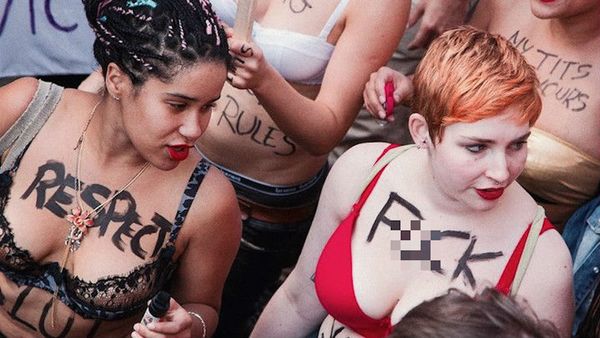
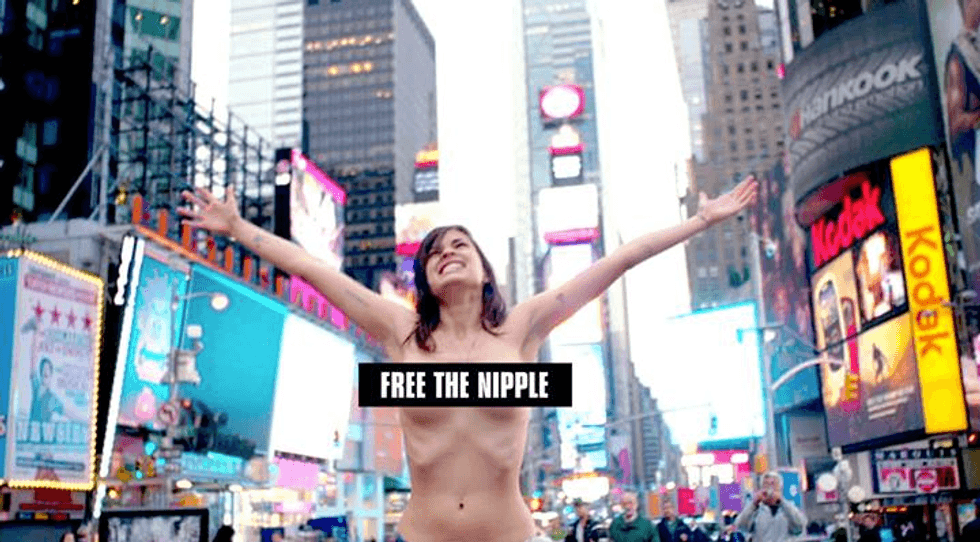
Recently, Lina Esco’s fight for women’s equality has lit a match in the media. Esco started a campaign called Free The Nipple in 2014. She employed her activism and filmmaking to create a documentary that seeks to achieve equality: “inspired by true events, Free The Nipple follows a group of young women who have taken to the streets of New York City topless, to protest the archaic censorship laws in the United States. Activist Liv and With set out to start a movement and change the system through publicity stunts and graffiti installations while armed with First Amendment lawyers. The film explores the contradictions in our media-dominated society, where acts of violence and killing are glorified, while images of a woman’s body are censored by the FCC and the MPAA. What is more obscene: violence or a nipple?”
I remember my friend one time telling me that she didn’t think women were cut out for sales, and that we should instead capitalize on our strengths. I was outraged when she said this and tenaciously argued for a woman being just as capable at anything as a man.
Why then, does Lina Esco’s fight for equality make me feel the same way?
I first heard about the Free the Nipple movement when it came to Hampton Beach this past summer. I was completely against Esco’s campaign-it made me angry: the twitter headlines of the event had men of all ages gawking in the background. Were people really flocking to Hampton Beach to support equality?
The idea of topless women parading in public seemed, at first, counterproductive. Shouldn’t women be focusing on more important things like the infamous wage gap or affirmative action? Isn’t walking around half naked just enabling the objectification of women? It felt like a slap in the face to think that these women were trying to be seen as equals to men by giving them, perhaps, one of the things they enjoy most. How much can society change how biology responds?
As a society, we just keep becoming accustomed to more and more skin showing. In colonial times it was scandalous for a woman to show her ankle. Are boobs the new ankles? What is sacred?
And yet, in an article from Free Keene, that was published this August in regards to the Free the Nipple movement in Hampton, one man commented, “Why is it only fat and unattractive women go around topless? Blech.” Another comment read, “These a-holes just bring this crap upon themselves.”
Additionally, this past summer, South Africa Bic released an advertisement for their pens that read, “Look like a girl, act like a lady, think like a man, work like a boss.” Quite ironically (arguably, even comically), it was released on women’s day and in the corner had a #HappyWomensDay. Thanks for the #empowerment, Bic.
What is a productive way for a man to see a woman’s thoughts before her body and just as equal to their own? Where does this responsibility even lie? Who are women covering up for- themselves to show respect and be conservative; or for men to make sure they’re not distracted? Do we tackle the difference that men don’t have to wear shirts and women do? Or do we accept the fact that men don’t have boobs and women do?
The Free the Nipple campaign ultimately conveys one of the most challenging things about life- we do not know how our actions are going to be perceived. However, we must not let the ambiguity of another’s perceptions hinder our motives. You, my friend, do not have to be the woman clawing your way through corporate America as “the bitch” in order to pave the way for your following ladies. But you have got to go out there with the mindset that nothing is set in stone. What we allow is what will continue. And I am sure ready for some change.
Ah, Lina Esco. No promises that I won’t crush on your ex boyfriend, and I curse you for the grueling debate that just took place in my dorm room. But also, hats off - maybe even shirts off- to you for creating this movement.