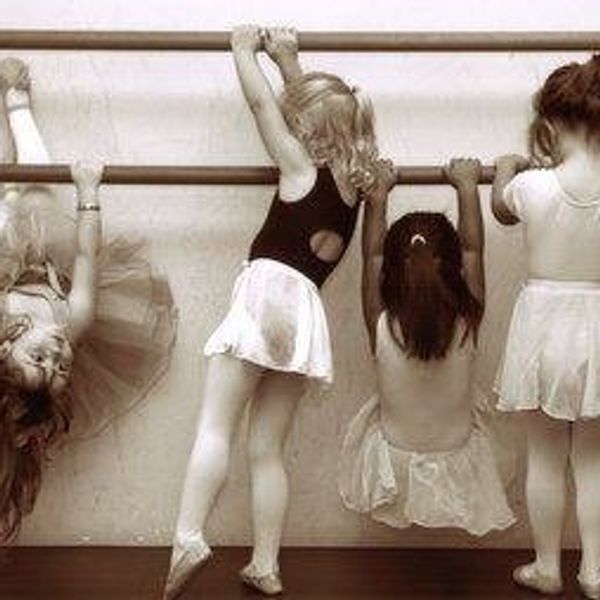
Life is pretty great as a spunky, eight-year-old kid.
Still young and filled with all the hope and confidence of the world under my belt - eight year old Rheanna wanted to try everything and anything, and she wasn’t afraid of failure or ridicule.
As one of the shortest girls in her class, she still dared to play little league basketball- even after being repeatedly pushed around by her taller and more temperamental adversaries. Hardly understanding the mechanics of softball she attempted to play and had a great time "pitching" as she walked the other team’s players around the bases.
As you can see, sports were never my forte, but by the time I turned ten I had stuck to one that I was relatively good at, and that fit in perfectly with my primary interests in the performing arts - dance.
However, despite having a naively fearless attitude in most every endeavor, I did have an insecurity that appeared in this particular one.
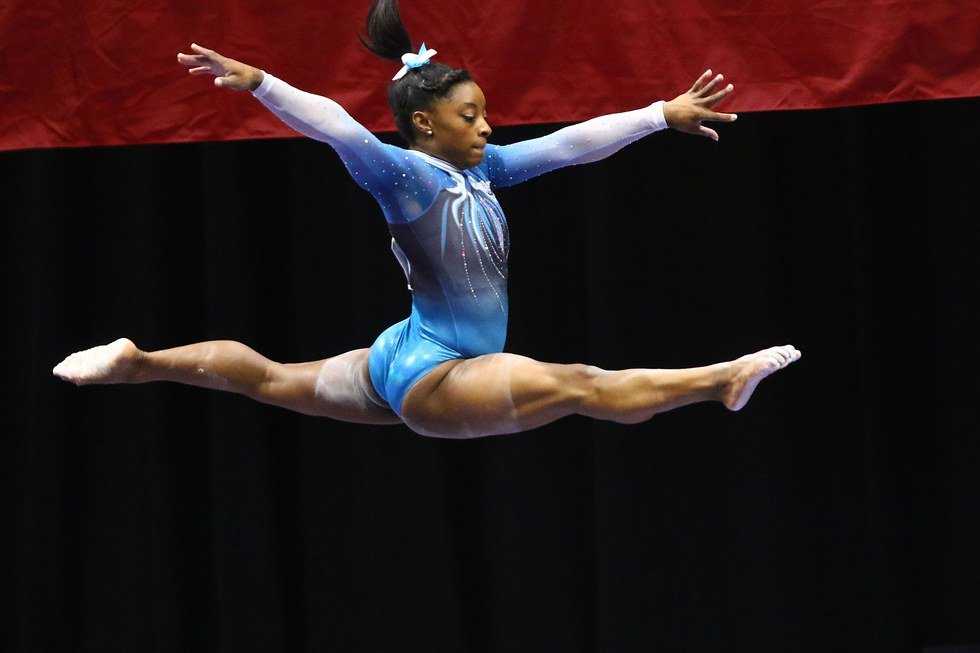
I couldn’t do the splits.
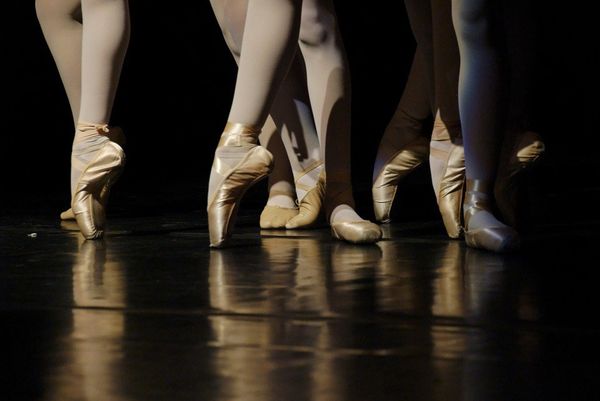
Being the very active kid I was- I spent a lot of time dancing. For a while, I even on a competitive team. I wasn’t exactly a prodigy, but I was certainly able to keep up. I enjoyed it for both fun and exercise for over ten years of my life in total. I could do the basic acrobatics and ballet moves required for competitive dance, all five positions, pirouettes, arabesques, I could even cartwheel and tumble at an impressive proficiency, however, the splits were always the one technical skill that everyone else on my team seemed to effortlessly master, whereas I on the other hand never could seem to get right.
The splits were the thing I always dreaded in every class, the degrading skill that set me apart and defined a major shortcoming of my dancing abilities. Despite the fact that the split was mainly used as a warmup exercise, and that I didn't necessarily have to master it in order to be a well-contributing member of the team or to win approval of my teammates, it always immensely bothered my young mind that I could never figure out how to close the gap between my legs and the floor. I hated the way I floundered around while the other girls fell gracefully into position, but up until my tenth year of life I never really made an effort to change the situation despite my frustrations. Somehow I was subconsciously convinced that my teammates were born more capable, and that there wasn’t really anything I could do to improve my splits since I was not blessed with the skill at birth.
I don’t remember what it was that finally motivated me, but after a decent amount of vexation, I decided I wasn’t going to mentally limit myself anymore, and that’s what truly set me free. I asked my teammates for tips and my teachers for advice, all of them told me the same thing- stretch. I vividly remember opting to do my 4th grade math homework on the floor of the living room as opposed to the table for a month, to force myself to sit in a straddle at an attempt to develop flexibility in my thighs. Although I didn’t fully believe it would work, it made me feel better to be actively working on the skill, and it gave me a purpose and a reason to become a better dancer in other respects even outside of flexibility.
In about three weeks of my daily regimentation, I dropped 4 inches closer to the floor. After a month and a half- I arrived in my lyrical dance class the same way I had every week prior. We did our typical warm ups, arm stretches, lunges, and of course the infamous splits.
This time was different though,
Our teacher yelled “Right split- one minute- go!”
I fell into perfect position, just as gracefully as each and every one of my teammates.
It’s true that predisposition is more than helpful when it comes to learning a new skill or improving an old one. Too many people in the world, however, are stuck with the same belief that my pessimistic pre-splitting ten year old self was - that if something doesn’t come naturally it isn’t worth doing, or it’s impossible to complete. Too many people are imprisoned by the idea that they cannot pursue their interests because they aren’t gifted enough, whether it be at singing, painting, sports, or anything else that supposedly requires a prerequisite of genetic talent. Not enough of these people realize that personal success and accomplishment can be achieved by absolutely anybody if they’re willing to dedicate enough time and effort to it. Keeping in mind that personal accomplishment is about setting goals for yourself and achieving them step by step, no matter how small they may seem to others, all it really takes is drive to turn a one into a reality.
Mastering that split didn’t make me the best dancer in my school, and it certainly did not define a career for me as a professional ballerina. Even at that young age I knew that in other parts of the city, state and country in which I live there were certainly ten year old dancers far better than I, mastering much more complex techniques in half the time it took me to learn that one, but I still hold the first day I sat in a full split as one of the greatest accomplishments of my young life. Children in their naive and untainted world view sometimes appreciate the things that adults tend brush off as a result of jaded life experiences, and ten year old me knew that by accomplishing my goal of doing the splits that I had already overcome an obstacle that many people in the world that were double and triple my age had yet to master : the art of self improvement minus the need for outside validation. It was one of my highest accomplishments not because it was a skill I used everyday, or because it won me a prize or approval, but because it proved to me that the cliche is true; anything is possible, anyone can do the splits.