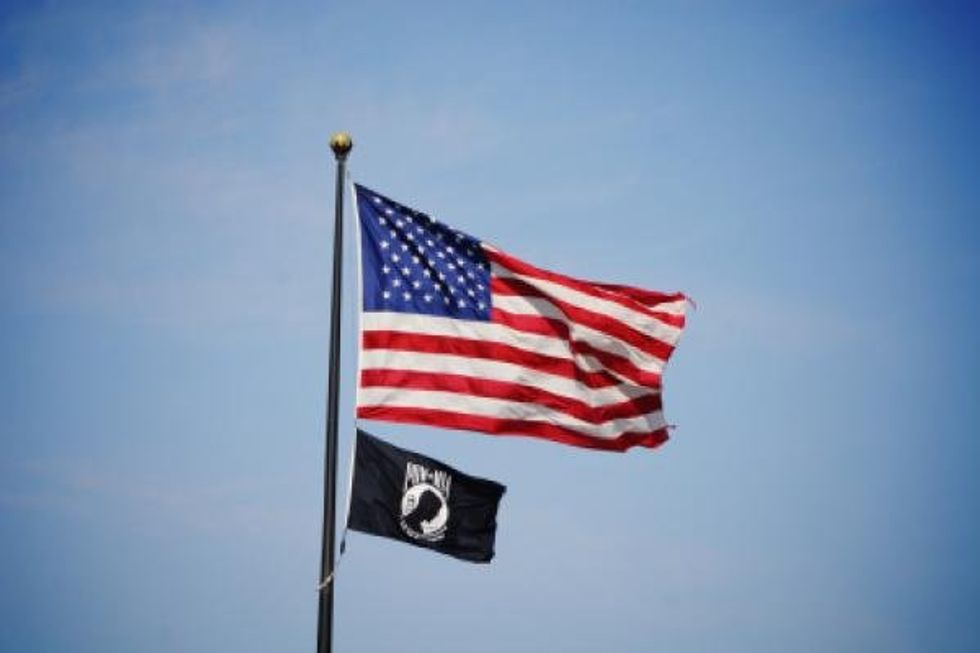
In recent months, there has been a lot of controversy surrounding the Confederate flag. I could go on a whole rant about how both sides of the argument have their valid points, but that would take too long. Now that the flag has been removed from the grounds of the South Carolina Statehouse (which, in this writer's humble opinion, was a great move) and the backlash from the controversy has died down, another symbol has found itself under great scrutiny. When I learned what the next target was, I was astounded and quite disgusted. The new target is the flag for our Prisoners of War and our Missing In Action. This flag could be easily found flying outside government buildings underneath the Stars and Stripes. Now, in 2015, its removal is desired because it has been classified by many activists as a racist flag.
The flag's origin traces its roots back to the 1970s while the war in Vietnam raged on, with much controversy surrounding it. The National League of POW/MIA Families had been formed in 1969 to help spread national awareness for the mistreatment of American prisoners of war in Vietnam. The architects of the group, Sybil Stockdale and Karen Butler, both had husbands who were captured in the war. The idea for a symbol or flag came in 1971 from Mary Hoff whose husband was also a Vietnam POW. The design for the flag came from a graphic artist named Newt Heisley. Heisley used just black and white for the flag, which depicted a silhouette of a man bowing his head in the foreground with barbed wire and a guard tower in the background. On the top, in white letters, was simply written POW and MIA with a star separating the two. On the bottom were the words "You Are Not Forgotten," also in white.
Over the next 20 years, the flag went through some variations. In August 1990, Congress passed Public Law 101-355. The last portion of the joint resolution reads:
"The National League of Families POW/MIA flag is hereby recognized officially and designated as the symbol of our Nation's concern and commitment to resolving as fully as possible the fates of Americans still prisoner, missing and unaccounted for in Southeast Asia, thus ending the uncertainty for their families and the Nation."
It has been 25 years since the bill was passed and since then, veterans from other wars, from World War II to the Persian Gulf Conflicts, have adopted it to remember their fallen unknowns and prisoners who never returned home.
Recently, this flag has come under attack by critics who say that the flag is racist. These claims came from an op-ed piece written in Newsweek by Rick Perlstein. According to his op-ed piece, the flag spreads propaganda and was created by President Nixon to get Americans on board with sending in more troops to stop the North Vietnamese. It's a symbol of racial hatred towards the North Vietnamese, and Perlstein believes, as he puts it: "it's past time we pulled it down." according to Newsweek.
The fact that someone went out of his way to use the word "racist" to describe the flag is appalling, to say the least. The only reason why this got the attention it did was because it came just weeks after the debate over the Confederate flag. This black and white banner that can be seen flying underneath the American flag was not flown in battle and was not implanted over a conquered land. The purpose for this flag is to offer remembrance for those missing and prisoner soldiers who still haven't returned home. There are still over 80,000 unaccounted service men and women since World War II and, as mentioned before, the remaining veterans from every war since World War II have used this flag to remember those who made the ultimate sacrifice.
Veterans from all across the nation have been insulted and disgusted by these claims. One such veteran is Joe Tiralongo, a resident of New York City, who served in both Persian Gulf conflicts.
According to a Pix 11 report, Tiralongo is quoted as saying, "I think it’s completely disgusting, because what happens is people fail to realize that the freedoms that they’re enjoying, that they’re being provided for, is being paid for with the blood of those POW’s and MIA’s" according to Pix 11.
Reaction and debate over the flag has died down in the past weeks, but like the animosity and debate over the Confederate Flag, the possibility of this issue being reopened always exists. The intention of this article is to offer people an informed answer to what that flag means and stands for. It wasn't created by Nixon and it wasn't created to spread hate towards Vietnam. The intent for the flag was drawn up and created by the wives of POWs and MIAs in Vietnam who wished to have a symbol to represent their group. Since then, it has become a symbol of hope and a measure of closure for families who are still unclear as to the fates of their loved ones.