
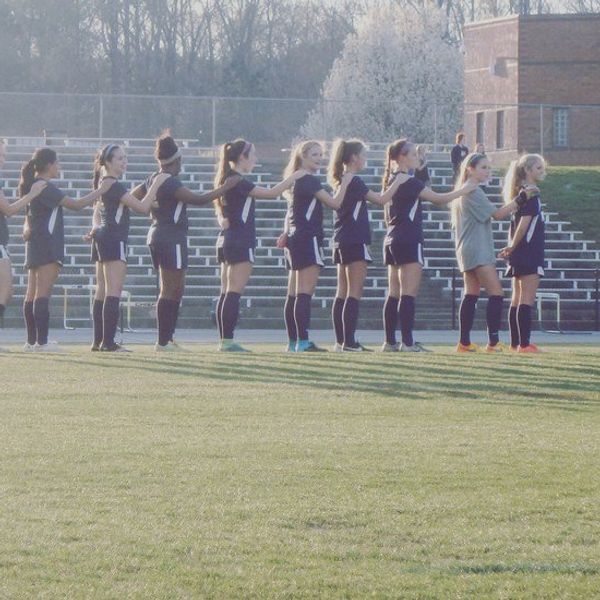

Team sports like soccer are more than just ways to spend your free time. They take up copious amounts of time, they require dedication, competitiveness, and the will to put the group ahead of yourself to accomplish a goal. At times they are exhausting, frustrating, and can leave you feeling defeated. But they also can be the most rewarding experiences of your life if you allow them to be. Team sports like soccer teach you more than just the skills necessary to defeat an opponent. The lessons I've listed below are just a few of the valuable life skills soccer teaches you that you will carry with you long after your days on the field are over.
1. What it means to be part of a team
It’s the 70th minute of what may possibly be the toughest game you’ve played in all season. You’re exhausted, your legs are sore, your throat burns, and you’ve got a headache from the 30-plus head balls you’ve had over the course of the game. You’re down by one and you’re feeling defeated, worn out, and you quite honestly don’t know if you can make it these last 20 minutes. Suddenly you hear the voices of your teammates from the side of the field, urging you on, encouraging you. Your goalie yells out, your defense shouts out who to mark, where to step, serving as your eyes from the back of the field. You turn to the other center mid, a silent acknowledgment passes between you as you step forward together towards your opponent. You win the ball, your forward makes a run as you send a pass without even needing to look to know where she’ll be. She finishes it and the score is tied up. Your team comes together, the players on the sideline cheer, you smile, but you know it’s not over. You huddle up and each of you looks at one another, knowing what all of you are thinking without needing to say anything. This is what being part of a team is. You support one another, back each other up, you know each other inside and out, you spend countless hours together, learning how to play by each other’s sides, you overcome losses with one another, celebrate victories, and bond in a way that anyone who isn’t part of a team will never truly be able to comprehend.
That's what it means to be part of a team, it means being part of something bigger than yourself.2. How to lose
It’s the third game of the season. You’re playing a nationally top ranked team and you’re down by two. The final whistle blows, and your head slumps forwards are you realize you have not come out on top this time. You unenthusiastically shake your smiling opponent’s hands and walk off the field. There’s no energy on the sideline, as Coach tells you to gather in the corner so he can talk to you all before you leave. This is the worst part of the sport, you can’t stand losing, but somewhere in the back of your head, a little voice reminds you that there is a lesson to be learned here. You look up, look at the faces of your teammates and realize that you are not done. You have so much further to go, and this game has only shown you what you need to work on. Loss shows you where your weaknesses lie, it wakes you up, it motivates you. You can see frustration in the eyes of your teammates and you know they too feel the fire that you feel. Only loss can give you that feeling, and you know that if you use it in the right way, the outcome of your next game will be very different. A loss does not have to defeat you if you don’t allow it to.
3. Where to find that extra little bit of motivation you didn't know you had
It's the middle of August, it's over 90 degrees outside, practice has been going on for over two hours now and all you've done the entire time is run sprint after sprint. You hit the line for what you think is the last time, legs shaking, throat burning, heart pumping and you feel relief. Then you hear the worst words to ever exit a coach's mouth, "get back on the line". You don't think you can run another one, you look around and see defeat, exhaustion, and anger on your teammates faces. But what can you do? Call it quits? Sit down and refuse to run anymore? That won't get you anywhere except seated on the bench during your next game. You make eye contact with your teammates, nodding at each other because you understand what you have to do. You step up and swallow the ache you feel in your body. Coach blows the whistle and you run, you sprint, you feel every muscle in your body begging you to stop but you keep going, all the way back to the line. You didn't know you had it in you, but it's finally over; and as you walk over to get your water, you can't help but smile.
4. How to take criticism
It's the middle of the season, you're on your home field playing your biggest rival and all of your friends and family have come to watch you (hopefully) win. You've got the ball, and you take one too many touches; the defender on the other team capitalizes on your mistake. She steals the ball and suddenly you're sprinting as fast as you can back towards your own net. Luckily your teammate behind you cleans up your mess, and you get lucky, your opponent doesn't score -- but that doesn't stop Coach from screaming at you from the bench. You're embarrassed and frustrated, but the way you respond to his criticism will define the role you play in the rest of the game. Let it kill your confidence, make another mistake, and most likely end up watching the game from the bench. Or, listen to it, let it fire you up, remind yourself to do better next time, and pick up your game. Criticism can be catastrophic to the way you play if you let it be, but if you take it for what it is, as a constructive lesson on how to be a better player, it can help you to cut down on the mistakes you make and enhance your game in all the right ways.
5. What it feels like when your work pays off
It's your senior year, you're in the 90th minute of the state final, a game you've only imagined being able to play in before. This is your last season, your last chance to get that state trophy, you've been working toward this game for as long as you can remember. The final whistle blows and you've done it, you've won. Suddenly in that moment, every lift, every suicide, every 8am practice, every late night spent doing drill after drill over and over again, all of it is worth it. Every exhausting minute you spent training suddenly seems like a small toll to pay for the feeling of victory you have now. These moments, these victories, are the reason you work year round, in and out of season, and these moments teach you that if you put in the right amount of work, someday you will be able to reap the benefits of your efforts.