

At the start of 2016, I set out to take a fresh look at the phrase "you learn something new every day." I decided to be intentional about learning something new and writing it down each day and seeing how it affects my everyday life. I'm one month in and it's been amazing. The random bits of knowledge that become available to you, whether you ever express the knowledge or not, is simply satisfying. The cool thing is that many of the things I've learned have branched from experiences.
Here are 15 of the random, interesting, or odd things I learned in January listed chronologically.
1. Jan. 2 - Pulling a shot of espresso with a lever machine.

Travis at Insight Coffee's capitol location in Sacramento showed me how to pull a shot of espresso using a lever machine. Fine grounds have to be pressed evenly to allow for even extraction. Once the bottom is about 60-70 percent bubbled over, pull the lever. The first part of the shot will be under extracted; some at the top will be over extracted (crema). Some over extraction is good, but not too much.
2. Jan. 3 - History of the french press.

The first design of this coffee brew method came from France in 1852. A more modern design was created by Italians in 1929. This model more closely resembles the french press we have today. The most popular design was actually by a Swiss man, made in France in 1958 called the "Chambord" or "La Cafetiére Classic".
3. Jan. 4 - The Golden Gate Bridge.

The idea for the Golden Gate Bridge was first proposed in 1872. Construction for it began in 1933 and finished in 1937 with Joseph Strauss as head engineer. Its cables were made by the same company that built the Brooklyn Bridge 52 years before. It weighs 887,000 tons and stretches over a mile long. It's been closed only three times in history due to weather, it was the longest suspension bridge in the world until 1964 (Japan), and 800,000 people showed up on the 50th anniversary to walk the bridge; only 50,000 were expected.
4. Jan. 5 - How lightning strikes.
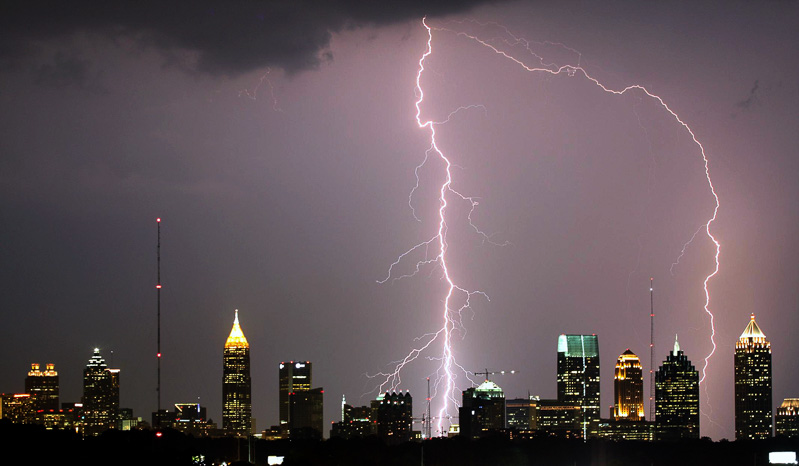
Thunder clouds form when below-freezing temperatures turn moister in the cloud to ice. Lightning can strike within or between clouds or between cloud and ground. It's caused by positively charged particles in the upper part of the cloud (the anvil) and negatively charged particles in the lower part interacting. It strikes toward the ground because of positive charges on the earth's surface.
5. Jan. 7 - Kobe reaches 33,000.

On this day, Kobe Bryant and the L.A. Lakers took on the Kings in Sacramento, CA. As it is Kobe's last seas in the league, this was his last time playing in Sacramento. Despite a two point loss, the Black Mamba became the 3rd player in history to reach the 33,000 point mark, and the youngest to do so at the age of 37. He scored 28 points in the span of the first three quarters alone in that game.
6. Jan. 8 - The city of trees.
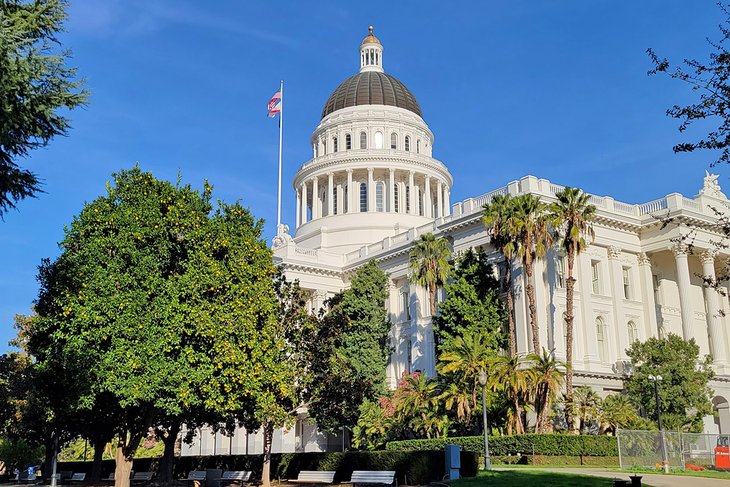 Sacramento, CA is nicknamed the "City of Trees." Having lived there most of my life, I never knew why. Come to find out, this great city supposedly has more trees per capita than any other city in the world. In 2007, the city even set a goal to double the number of trees in SacTown. Paris seems to be the only other city to stir a debate on the matter.
7. Jan. 9 - Cortado/Gibraltar
 A cortado is a Spanish coffee drink consisting of just under two ounces of espresso and just over two ounces of steamed milk. In size, it's between a macchiato and a cappuccino. Nearly the same size as a cortado, Steve Ford of Blue Bottle Coffee in San Francisco created the drink, but called it a Gibraltar after the name of the glass he served it in. The gibraltar has become a popular name for it on the west coast US.
8. Jan. 13 - 2015/2016 Golden State Warriors (36-3).

With a loss on this night, the Warriors are still tied with the 1966/1967 76ers, 1971/1972 Lakers, and the 1995/1996 Bulls for best start in NBA history. The other three teams went on to win the championship in their respective years.
9. Jan. 14 - Phantom ringing in your ear (aka Tinnitus).

The mammalian cochlea has inner and outer hairs. Both vibrate, but only the outer hairs can cause their own vibrations. This increases our hearing by 40-60dB. When one or a few outer hairs act up, they all vibrate, causing us to hear a high pitch sound. The nerves that act against it take about 30 seconds to kick in, and the ringing goes away.
10. Jan. 15 - Chuck Taylor.
 Charles Taylor was born just 10 years after basketball was invented (1901). He was a basketball player who started working as a salesman for Converse in 1922, three years after starting his semi-pro career. He later joined Converse's team. The Converse All Star sneaker came out in 1917, but they put the Chuck Taylor name/tag on it in 1932 and the sneaker is to this day the most sold basketball shoe in history. Chuck Taylor was inducted into the Basketball Hall of Fame for his contributions to the game in 1969, the year in which he later died.
11. Jan. 18 - Devil's Pool.
 The Devil's Pool is found at the top of Victoria Falls in Zambia. Erosion has created a natural ledge and when water levels drop it makes a very dangerous and beautiful natural infinity pool. One side is pure bliss, the other is sure death.
12. Jan. 20 - Why does mint gum make my water taste colder?
 There is a protein called TRPMS that's expressed in the sensory neurons. It's triggered in the presence of menthol which is found in mint gum. The protein accepts NA+ and CA2+ ions that change the electrical charge in the neuron, giving the perception that your mouth is cold when coming in contact with water or cold air.
13. Jan. 24 - "Can't Help Falling In Love"
 Elvis Presley recorded this song to be featured in the movie "Blue Hawaii" in 1961. Elvis supposedly sang this for his grandma for her birthday rather than strictly for the movie. He even gave her a music box that played the song.
14. Jan. 26 - Jellyfish.

These strange creatures are composed of 95% water and have no brain, heart, or blood. Their digestive cavity serves as both stomach and intestine, and they only have one opening for the entry and exit of food.
15. Jan. 27 - Football to soccer.

Surprisingly, the word "soccer" comes from England. People in the 19th century needed a way to distinguish between rugby football and association football. Association football became known as "assoccer" and was later shortened to "soccer," while rugby was called "rugger." Soccer became so popular in England, no distinction was necessary. People knew that football referred to association football only. The term stuck in America amidst the presence of American football.