
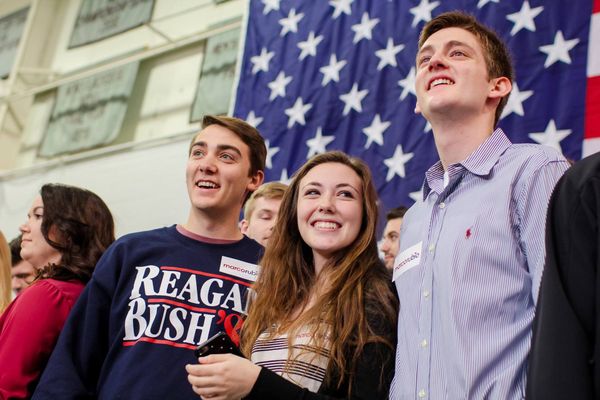


It’s that time again. The flag pins are polished, the sound bites are readied and the Super PACs are popping up by the dozen. Yes, it’s presidential campaign season. It may still be over a year until Americans flock to the polls, but the candidates and campaigns are already in full swing. Here at The Ohio State University, we’re used to politicians. As one of the nation’s largest colleges situated right in the capital of a perennial swing state, politicos of every stripe are sure to stop by. College students are some of the most energetic activists around when an issue interests us, and we range up and down the political spectrum.
With that in mind, I asked ten Ohio State students to name their candidate of choice and what they think the biggest issue facing the nation is. Here’s what I found out.
1. Peter Lyon, a fourth year majoring in music education named Bernie Sanders as his top pick, citing his views on same-sex marriage and saying that he likes “his ideas for taxes on the top .5% of Americans who control so much of the wealth. He’s the only candidate without a Super PAC, he’s relying on average Americans to support his campaign.” When asked what he thought the biggest issue facing the country was, Peter answered “legalizing gay marriage and not having any Jim Crow-like laws impeding two loving humans from getting married. People like Kim Davis and her supporters like Mike Huckabee are people I will never vote for.”
2. Avery Pierson, a second year political science major said, “John Kasich is my man. He really turned Ohio’s economy around, and I have confidence in him doing the same at the federal level… He’s a bit too moderate for most ultra conservatives, but I think that’s what makes him a great candidate, as moderation shows a willingness to hear the other side and actually get things done.” Asked what the biggest issue of the election was, Avery simply answered, “The economy.”
3. Patrick Garrido, a third year studying communications, agreed with Avery’s choice. “Kasich seems pretty bipartisan. He’s not too concerned with courting the far right, but isn’t a soft conservative at all.” In Patrick’s view, the biggest issue in this country right now is partisan polarization. “If you look at the frontrunners in both parties, it’s too extreme. On one hand you have Bernie Sanders going to the far left and then you have Donald Trump on the right. The fact that they’re gaining popularity tells me that people want serious changes made, but how much can you really get done with these fringe extremists?”
4. Stavroula Pabst, a third year majoring in history and Modern Greek, said that her favorite candidate is Bernie Sanders. Saying that she considers herself a socialist and feminist, Stavroula believes that Sanders and his policies best represent what she would like to happen in this country. The most pressing issues in her mind are “income inequality and getting rid of corporate money in elections.”
5. Mohit Varma, an environmental engineering major in his third year, says that he also supports Bernie Sanders “because he’s very progressive and he wants to fight corporate America… He also wants universal healthcare sponsored by the government.” Mohit said that the biggest problem for 2016 is finding “a way to help the middle and lower classes” by ensuring easier access to education, higher wages and more job opportunities.
6. Nicole Huser, a third year majoring in strategic communication and political science said that she wants Hillary Clinton to be the next president because of her “stands on healthcare and social issues such as women’s rights and income inequality.” Nicole did say however, that there are still many issues that she doesn’t agree with Clinton on, and that she wasn’t “strongly supportive of any one candidate in particular” at this point in time. The biggest issue she sees is “the destruction of the middle class.”
7. Adam Hribar, a food, agricultural and biological engineering major in his second year, is a Sanders supporter – bringing that total up to four. Sanders “seems like a breath of fresh air who does what needs to be done” in Adam’s view. He believes that the biggest issue in the country was the fight over Planned Parenthood, because the organization “helps the whole population. It provides medical care to low-income families, prevents the spread of disease and performs mammograms which can help detect cancer early.”
8. Emily Saleme, a second year studying criminology and public affairs, was the third one I spoke to that named John Kasich as their ideal choice. Emily said that “with a Republican majority in the House and Senate, he can do a lot for this country while also having some moderate views to allow for compromise.” Like Patrick, she also said that polarization was the country’s biggest problem, saying that “it makes it harder and harder for the legislative branch of our government to be efficient and do what it is supposed to do.”
9. Jeff Tiedeken, a fourth year middle childhood education major said that Rand Paul is his candidate of choice. Saying, “I’m going into the education field and he’s one of the few conservative candidates that match my ideals – and he’s one of the few conservative candidates that seems to care about education, unlike candidates like Christie and Kasich… I want a candidate that values my field and at least values the students.” For his view on the most important issue, Jeff said that he was “torn between foreign policy and control of information.” Referring both to the NSA surveillance programs and the Clinton email scandal, he said that “there’s not much clarity coming from the government, and it’s causing people to lose faith in their government.” Jeff said that he thinks there is “a large divide between the people and the people representing the people.”
10. Kristen Hegeman, a third year majoring in information systems, was the last student I spoke to. She hadn’t settled on one candidate yet, but said she was leaning towards Kasich, Marco Rubio or Ben Carson. Kasich as a governor, has “experience leading a government” while she believes that Rubio “wants to build up the middle class and has core conservative values.” Carson, as an outsider, “can bring a new perspective and offer new ideas.” The most important issues to Kristen are fixing the economy by “balancing the budget and getting people off government assistance” and foreign policy – particularly the threat posed by ISIS in the Middle East.
Well there you have it. Ten Ohio State students from a variety of different academic backgrounds offering their perspectives on the 2016 race. Like the country at large, their views run the political gamut.
Ohio Governor John Kasich was the most popular Republican – not surprising for Ohio students. On the Democratic side, Independent Vermont Senator Bernie Sanders is far and away the favorite. Sanders’s appeal to the youth vote is an extremely interesting facet of the campaign for 2016, and something that is no doubt giving Hillary Clinton more than a few headaches.
Their views might have been varied, but these students all had one thing in common – an enthusiasm for politics and a desire to make their voices heard. Now it’s time to see if the candidates will listen.

















