
When you ask an American about who their favourite author is, they might say F. Scott Fitzgerald, or William Faulkner, but some might be even more nostalgic and spew out names like Herman Melville or Nathaniel Hawthorne. Since its establishment as a country in 1776, to say America has become a dominant force in the shaping of western culture would be a severe understatement. Whether you grew up in Canada, or somewhere as far as... Timbuktu, one doesn't make it through life without knowing, or having tasted a slice of the pie that is the American Dream.
So how does this country continue to fascinate us? While Hollywood immediately comes to mind, a lot of what we know about America comes from books. No, we're not talking about The Hunger Games or I don't know... 50 Shades of Grey. We're talking about literature, pure authentic literature -- a narrative that not only captures the very heartbeat of a place, but that of each individual pulse which dwells within its inhabitants. Here are 10 American authors that are an absolute MUST READ if America is where you call home.
10. Nathaniel Hawthorne

Born Nathaniel Hawthorne in Salem, Massachussetts, Hawthorne was descended from John Hathorne, one of the sitting judges during the infamous Witch Trials that took place in the acclaimed writer's hometown. To hide this relation, Hathorne added the 'w' to his name, and thus, Nathaniel Hawthorne was born.
Capturing the Puritan sensibility of Colonial America in The Scarlet Letter (1850), his first and most acclaimed novel, Hawthorne became a prominent figure in the Romantacism Movement that defined American Literature until the end of the Civil War in 1865. His works served as a source of inspiration for Herman Melville, who dedicated his masterpiece Moby Dick to Hawethorne, and Henry James, who published a book-length study on his predecessor -- unflatteringly titled Hawthorne (1879).
9. Herman Melville
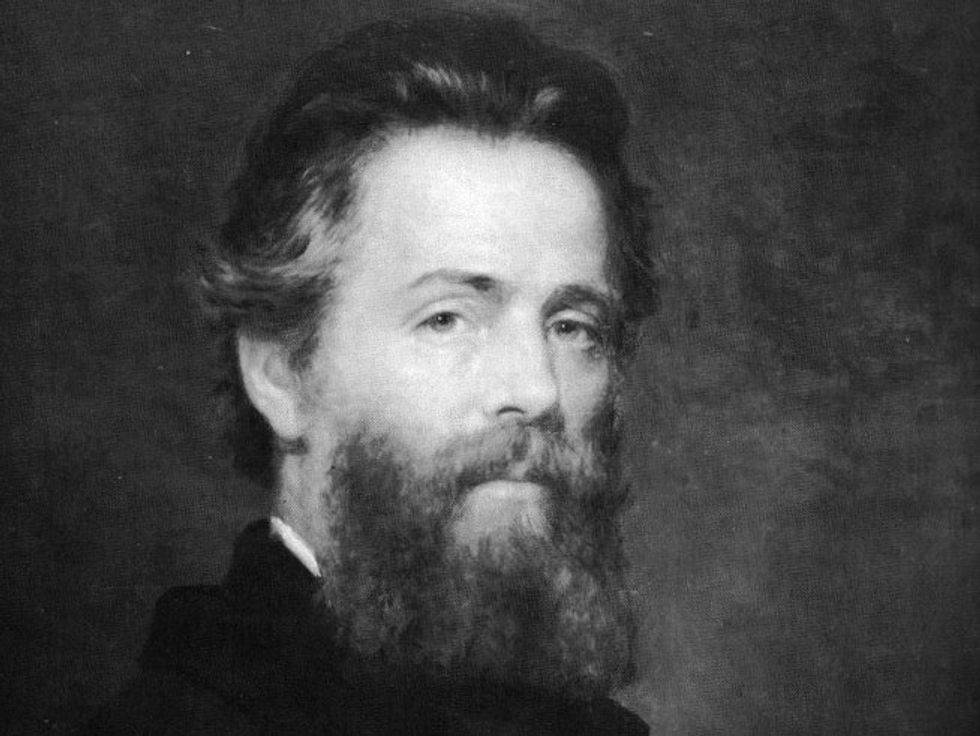
Also a champion of American Romanticism, it should be no surprise to find Herman Melville on this list. Although modern scholars and critics rate him as one of the key figures during the American Renaissance, Hawthorne's pal didn't achieve the same level of success when he was alive. In fact, Moby Dick (1951), followed by a novel named Pierre (1852), caused Melville's career to plummet into such a free fall that he decided not to write another book EVER again.
Before you throw your arms up and go, Wtf? You have to remember that this was the mid-19th century, readers and critics during this period typically didn't respond well to what was perceived as images of homoeroticism (Moby Dick) and incest (Pierre).
Today, however, Moby Dick is considered a tour-de-force, and one of the most innovative masterpieces in American Literature.
8. Henry James
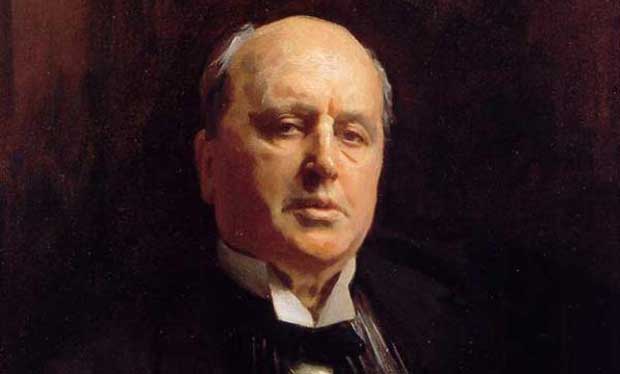
Henry James. Ah, there is lots to say about the great Henry James. Born in the wealthy skirts of Washington Place in New York City in 1843, James comes from a pedigree of success. His brother was prominent psychologist William James who had the pleasure of teaching Gertrude Stein at Harvard, while his sister Alice went on to establish an illustrious career as a diarist.
Rising to prominence for his novella Daisy Miller (1878), Henry James is considered by many to be one of the pioneers of literary realism in the United States. Primarily remembered for incorporating transatlantic themes into his work while examining the relationship between Americans and Europeans, James brought many other innovations through his imaginative use of point-of-view, interior monologue and unreliable narrators that added a new depth, and transformed narrative fiction as it was known at the time. This newfound awareness that James approached his writing with also lead many to consider him as one of the first practitioners of early modernism. A distinction he shares with British novelist Joseph Conrad, who was James's neighbour while he lived in England.
Among his finest works are The Portrait of A Lady (1881), The Wings of the Dove (1902), The Ambassadors (1903), and The Golden Bowl (1904). Of which, The Modern Library counts the latter three to be amongst the 100 best English-language novels of the 20th century.
7. Mark Twain
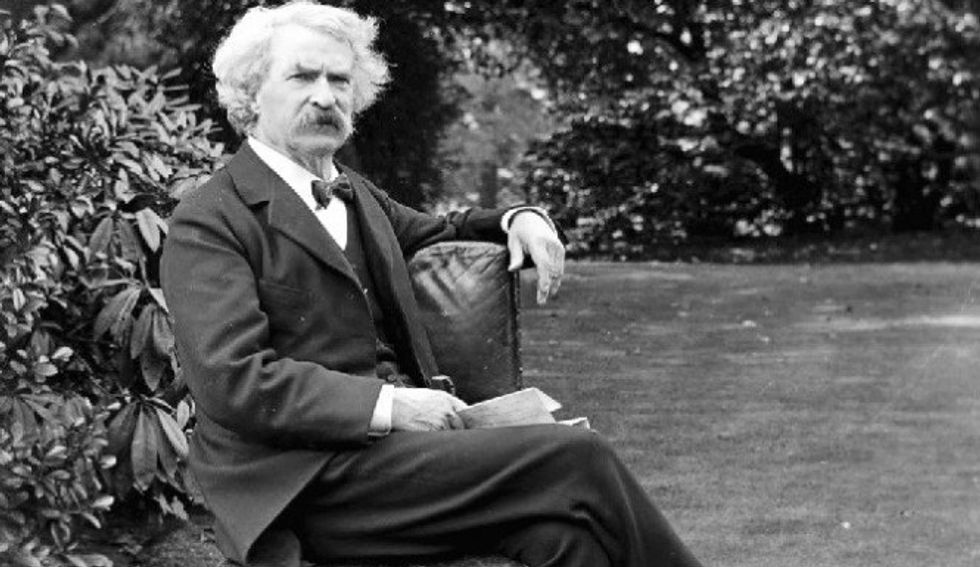
Remembered for his ironic, but forthcoming and relentless wit, Samuel Longhorne Clemens -- forever immortalized by his pen name "Mark Twain" -- is praised by scholars and writers alike as the father of American Literature. His masterpiece The Adventures of Hucklyberry Finn is not only regarded as the 'Great American Novel', but the first of its kind. Huck Finn was however, and continues to remain highly controversial due to Twain's use of racial stereotypes and slurs to incite humour.
As scholars continue to debate whether Twain was indeed being racist, one thing's for sure: As a realist, the inclusion of such language which took the literary world by storm allowed Twain to paint a stunning, but accurate portrait of the American South. His incisive interrogation of the South's continued struggle with racism and old antebellum traditions that carried over into the post-reconstruction era in the form of 'Lost Cause Ideology', paved the way for a young writer who would take the literary world by storm in his own right -- William Faulkner.
6. Edith Wharton

New Yawk! New Yawk! Even today, in the American mindset, the 'City That Never Sleeps' remains the zenith of American Society. But back in the Gilded Age, if you were looking for a tour of Manhattan, there was no better person to ask than Edith Wharton -- especially when it came to acquiring an insider's knowledge of New York's most elite. Yup, Miss Wharton was pretty much the Gossip Girl of the 19nth to the early 20th century. But since they didn't have blogs back then, Wharton translated her experiences of growing up in Old New York into short stories and novels.
Providing a scathing critique of the excessive materialism and strict norms that policed the culture of the New York Aristocracy in The House of Mirth (1905) and The Age of Innocence (1920), her efforts garnered her a Pulitzer Prize for the latter. Oh, and she was the first female writer to ever accomplish such a feat.
5. F. Scott Fitzgerald

Show me a hero, and I'll write you a tragedy. We were going to get to F. Scott Fitzgerald eventually. Like Herman Melville, Fitzgerald never lived to experience the fruits of his success. If Edith Wharton is Gossip Girl, than Fitzgerald's your frat boy. Prohibition, the Jazz Age, or otherwise known as the roaring 20's, Fitzgerald captured the entirety of this glittering era in his epic The Great Gatsby (1925). While the book drew praise from fellow writers T.S. Eliot and surprisingly, Edith Wharton, who wasn't a huge fan of the modernist aesthetic, the book failed to mirror the success of This Side of Paradise (1920), and The Beautiful and Damned (1922), Fitzgerald's first two books. At the time of the author's tragic death at 44, all his books were out of print, and it seemed he was destined to be forgotten.
But it wasn't to be so. Today, modern scholars consistently list The Great Gatsby as a top contender for 'The Great American Novel'. Furthermore, the last novel Fitzgerald completed before his death, Tender Is the Night (1934), is ranked 28th by The Modern Library on the list of 100 best English-language novels of the 20th century. Despite having published just 4 novels over his short life, Fitzgerald was also popular for his short stories. Babylon Revisted (1931) and Crazy Sunday (1932) are worth checking out.
4. Ralph Ellison

There ain't no Jazz Age without the jazz. Whether you like it or not, it is important to acknowledge what African Americans have done for literature in America, and perhaps no one is more important than Ralph Ellison. Praised for his novel Invisible Man (1952) which garnered him a National Book Award, Ellison provides one of the earliest examinations into America's complex relationship with its slavery legacy through the eyes of an African American, something that was utterly scarce during the time before the book's publication.
Seeking to expose the various ways in which racial prejudices in the North and the South continue to persist to disenfranchise African Americans from American Society, Invisible Man actually drew a lot of negative backlash from African American readers who felt Ellison had styled his novel in order to appeal to a Caucasian readership. Nevertheless, race is a controversial issue, no matter how it is discussed.
3. William Faulkner
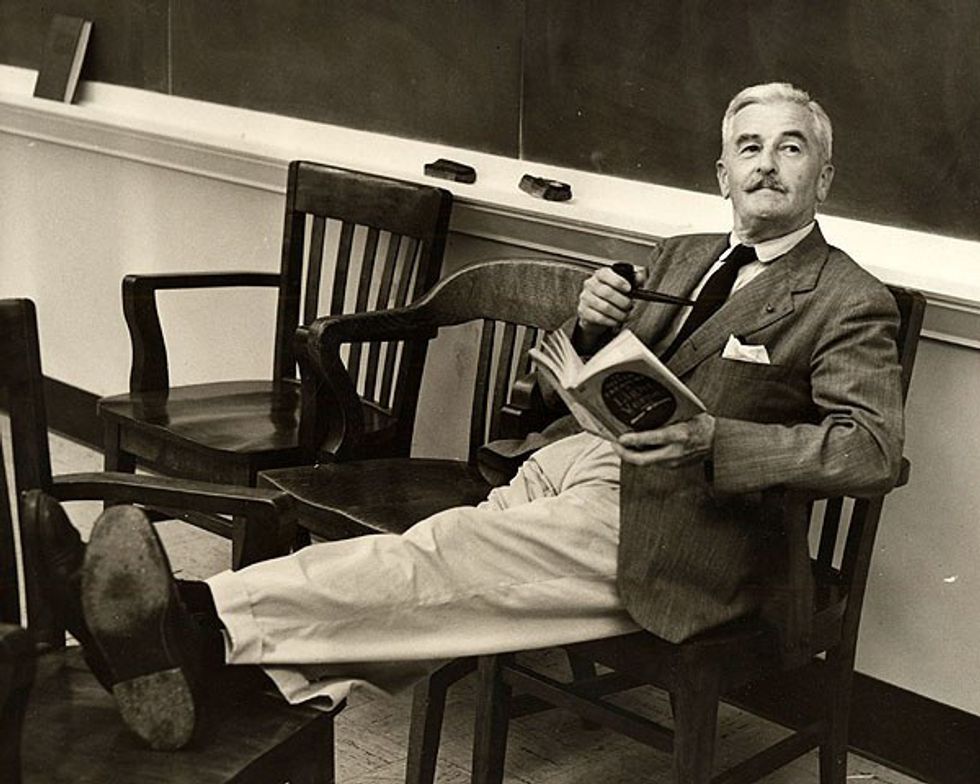
Where do we start with William Faulkner? Well first of all, along with John Updike and Booth Tarkington, he is the only American novelist to have one the Pulitzer Prize more then once; first for A Fable (1954) and then, The Reivers (1962). Yet, these two aforementioned novels are not even considered to be the finest of his works. If you want quintessential Faulkner, look at As I Lay Dying (1930) and The Sound and the Fury (1929). What makes these two novels unique is that they help establish Faulkner in a league far beyond any writer of his generation. Alternating between character point-of-views, Faulkner puts his utmost mastery with the stream-of-consciousness aesthetic to work, displaying a flawless ability to mimic the exact thought processes of people from various walks of life, ranging from a mentally enfeebled Benji Compson to a slowly maddening Darl Bundren.
But Faulkner's achievements don't end there. In 1949, he become just the second American writer to receive the Nobel Prize in Literature and the speech he delivered? Truly a force to behold as the man was.
2. Toni Morrison

An author with a career as decorated as Faulkner's, Toni Morrison has written almost exclusively on race in her novels. Building off the Slave Narrative that has defined the whole of African American Literature, Morrison's initiative as a writer was to examine the lasting trauma of slavery, and the impact it continues to have on those with ancestors who endured such atrocities. A past that still continues to cast a very dark shadow on African American lives.
Her first novel The Bluest Eye (1970) and her Pulitzer Prize winning Beloved (1987) are written with such poetic tenderness and compassion that the issues she discusses -- as disturbing as they may be -- crawl into the deepest caverns of your heart, and never come out. Thats how powerful Morrison is, from out of the memories of injustice, pain and cruelty, she gives her readers a small, but an endearing fraction of what it is like to be an individual who is forced to embody the marred legacy of slavery for life.
1. Ernest Hemingway
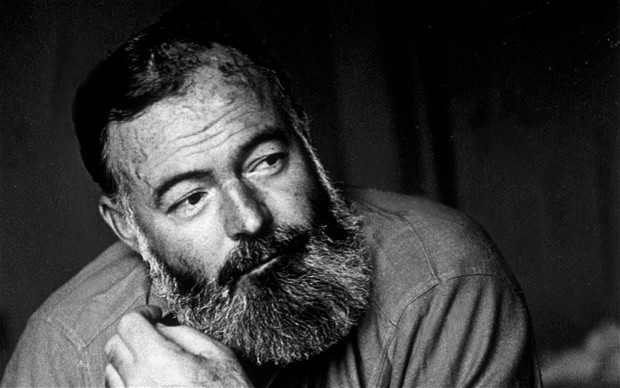
From the streets of Paris, to the safaris of Africa where he was almost killed twice in two separate plane crashes, no American Author was as well traveled as Ernest Hemingway. Along with Gertrude Stain, William Faulkner, and F. Scott Fitzgerald to name a few, he was part of 'The Lost Generation', a group of writers that broke away from traditional molds of writing, championing the modernism sensibility.
Known for his understated and economic style, these traits first manifested and became trademarks in his first novel The Sun Also Rises (1926). Today, it is deemed his finest work, and bears the distinction as the iconic modernist novel. After once again demonstrating prowess in contemporary style through the success of The Old Man and the Sea (1952), he became just the third American writer to become a Nobel laureate in Literature in 1955, with the last having recently been William Faulkner in 1949.