


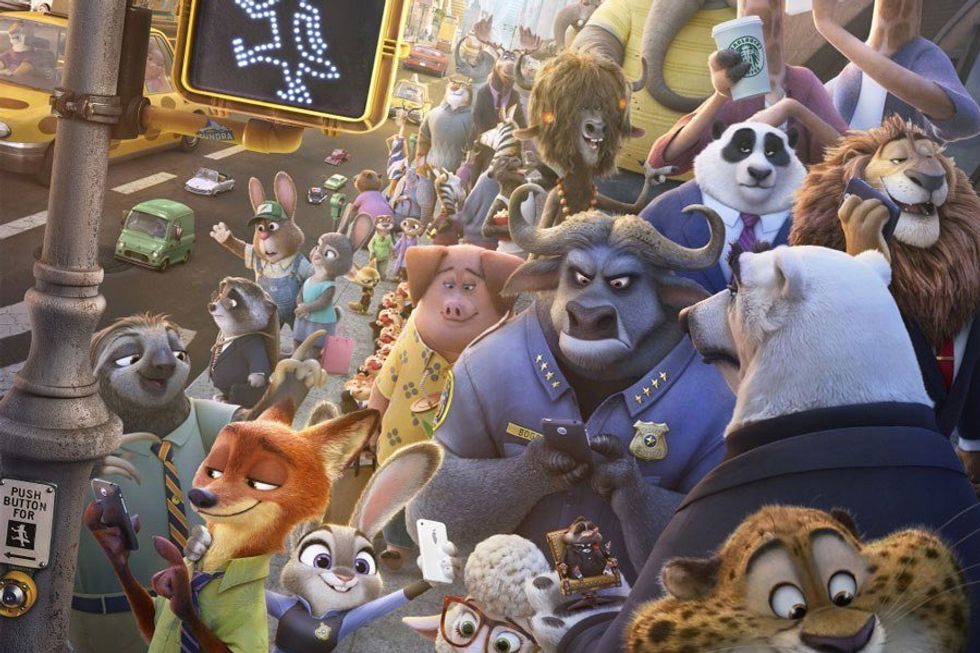
When I sat down to watch “Zootopia” this weekend, my expectations were low. How could an idea so simple and common in children’s movies (anthropomorphic animals in their own world) be the first movie of the year to receive a 100 percent “Fresh” rating from Rotten Tomatoes? What followed was two hours of some of the most original, thoughtful and engaging material from a Disney movie I have ever experienced. “Zootopia” has something for everyone—from hilarious gags like a “nudist colony” for animals to a mafia boss mole with Marlon Brando eyebrows and dialogue directly from “The Godfather,” this movie was fun for both the kids kicking my seat behind me and myself. The movie ventures away from traditional “feel good family movie” tropes and breaks new ground in originality and storytelling for children. But what truly blew my mind was “Zootopia’s” overall message and themes, which were complex, nuanced, and still understandable for its target audience of kids.
WARNING: SPOILERS AHEAD!
“Zootopia” begins with protagonist Judy Hopps becoming the first rabbit police officer of the city of Zootopia, as a part an integration program from the mayor’s office targeted towards small “prey” animals to promote mammal diversity in government. Judy is immediately dismissed by her peers, and at one point even accuses her superiors as keeping her on as a “token bunny.” She observes an elephant telling a fox to purchase goods “in his part of town,” and many other aggressions demonstrating that Zootopia is not the utopia (hah) she imagined. There are suggestions that the police are complacent in the disappearance of predators throughout the city, comments about how species address each other (Judy at one point says that only other bunnies can call each other “cute”) and even a longer scene where fox protagonist Nick Wilde mentions that he was severely bullied as a child and stereotyped due to his species (the “sly” fox). These are obvious analogies to race and ethnicity in society, and the aggressions many people have to live with in their daily lives just because of their race or where they are from. The movie tackles overcoming stereotypes, as many characters write Judy off as a carrot farmer. There is even a point in the film where Nick conveys the extremely complicated feeling of having to live up to your stereotypes because of the lack of opportunities to overcome them in society, which is something I never expected any children’s movie to ever touch. Overall, "Zootopia’s" driving plot complications and underlying societal issues is new territory for Disney, and it is handled extremely well.
But it doesn’t stop there—the major conflict in this films comes from the dominant predators versus the prey, who outnumber the predators in Zootopia. While society has “evolved,” and predators and prey now coexist without hunting and being hunted by each other, there is still significant inequality in Zootopia. One sensitive point in society comes from the “biology” of predators, who prey (including Judy) believe can and will become “savage” at any time. Nick is extremely offended by Judy’s opinions on predators, and at one point directly asks her if she thinks that all predators are savage, and why she carries “fox repellent.” This is an obvious portrayal of continuing racism against minorities in American societies, akin to the racist portrayal of African American’s as “thugs” or inherently violent. Part of the resolution of “Zootopia” comes when Judy runs into an old school bully (who happens to be a fox) who apologizes to Judy and shows his good nature, causing her to overcome her prejudices towards predators and reconcile with Nick.
Even more amazing is the fact that “Zootopia’s” main antagonist is not a predator, but prey. When the villain of the plot being investigated by Judy and Nick is revealed, it is someone who uses fear and separating the Zootopia community to accomplish their goals. This fear leads to large scale protest against predators, and there is even a scene where a protest goes awry with a pig telling the predators to “Go back home!” If Disney wanted to make it more obvious, they could have put a few “Make Zootopia Great Again” signs in the crowd. “Zootopia’s” message is daring: Advocating for the celebration of differences while still treating everyone equally, not allowing fear and mis-education inform our interactions with others, overcoming the prejudices of society—these are fairly controversial subjects in America.
It’s also caused “Zootopia” to be labeled “PC,” a label placed on anything that challenges the status quo of American’s hegemonic, racist underbelly. I however see “Zootopia” as an incredibly well-executed film encouraging children to respect and treat everyone fairly, believe in yourself, support your friends and do the right thing. In summary, “Zootopia’s” message, characters, voice actors (shout out to the hilarious Tommy Chong cameo as a meditative, stoner Yak), expansive universe and beautiful animations makes for a wonderfully fun and refreshing movie-going experience, and has reinforced my belief that Disney is still capable of producing amazing, non-Pixar animated movies. Adding “Zootopia” to Disney’s recent animated resume of films like “Big Hero 6” further demonstrates the diversity and skill in storytelling still possessed by Walt Disney Studios, and I look forward to their next project.

















