
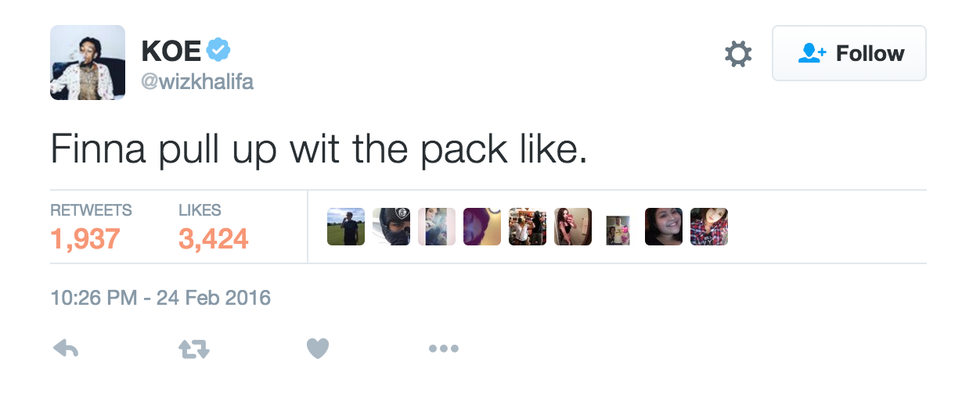
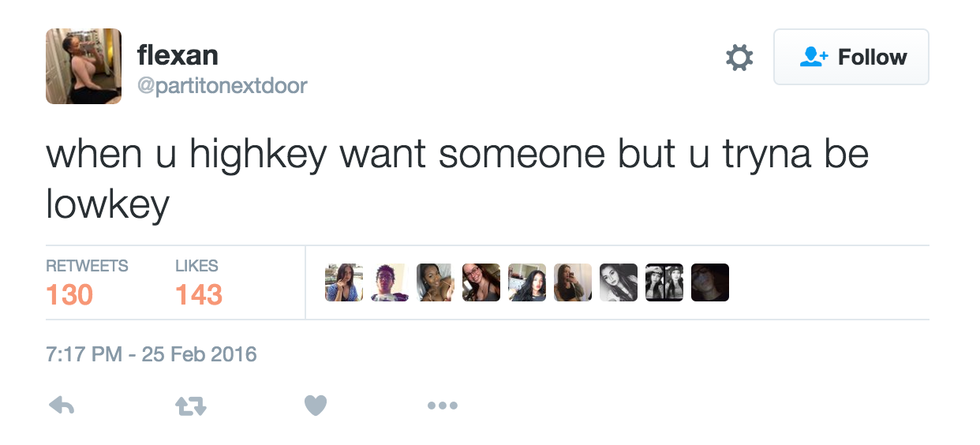
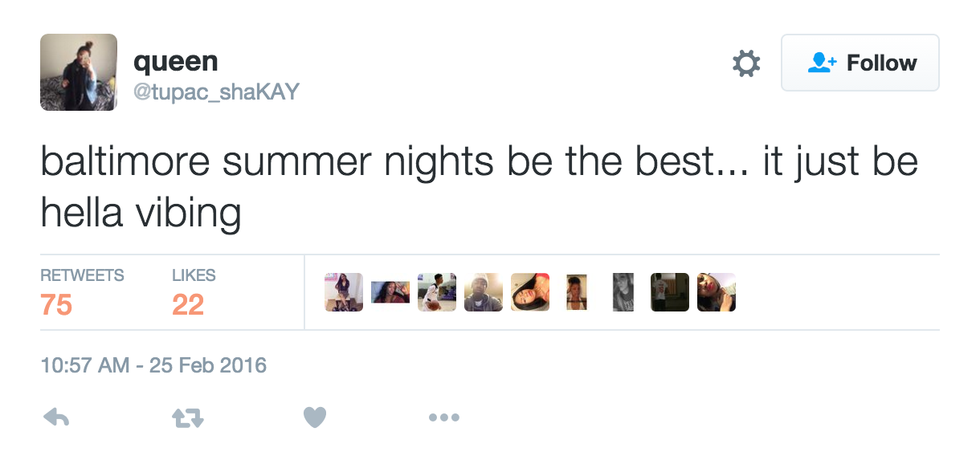
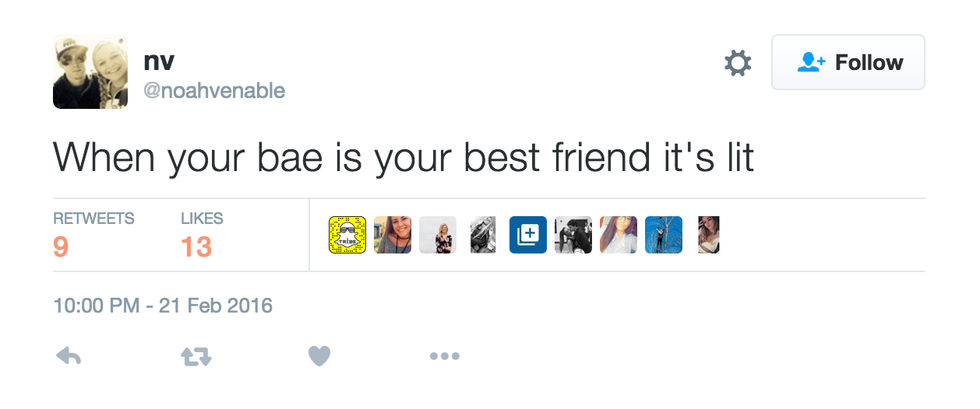
To people foreign to social media: Tweets like these are not uncommon, and are in fact representative of something very peculiar about millennials. Our language is changing at an unprecedented rate, and, in a lot of ways, we are worse off for it.
Obviously, language is not some idée fixe, and it ought not be. We consider many conventions of the English language outdated, which is why people don't casually throw "thine," "thy," and "thou" around in casual conversation anymore. The changes that have been made to our language at this point have been made out of some sort of necessity. As literacy rates rose after the Elizabethan era, people did not find the need to perpetuate a language that was loaded with meaning and interpretation. Writing was able to communicate complicated ideas that no longer had to be expressed in conversation. Later, the advance of the telegraph urged language to be condensed and concise so that people could communicate telegraphic messages to one another.
So language is no stranger to the idea of change, but it is a stranger to the idea of needless change. Can anyone tell me what the purpose is of using 11 different terms ("turnt," "yurnt," "outta my mind," "faded," "twisted," "gone," "hammered," "plastered," "trashed," "smashed," and "crunk") to mean "inebriated"? What's the point in creating so many words for one idea if it weren't to say that our generation likes getting drunk? The changes that have been made to our language are not meaningful, and all they do is paint millennials as a generation characterized by creature comforts and materialism.
When I hear people who use slang profusely and without considering the use of meaningful language in conversation, I get upset because I realize that people my age are settling for a lack of sophistication and thoughtlessness. It's as if the only thing language was engineered for was to communicate ideas that are worthy for vines, memes, tweets, and Facebook posts. People my age have lost sight of the fact that language is a vehicle for purposeful expression. Language was made to write books that change perspectives, to give speeches that change nations, and to articulate the way that you feel about someone.
There probably was a time when English was as pretty to others as French, Spanish, and Italian are to us, but we don't actively show that we care for our language in the way we ought to. The less we think about what language can do for us and the more we think about how it can make us sound like we are a part of some cool club that prides itself on using terms like "finna," "fleek," "hella," and "lowkey" ("lightweight" if you're from the Bay area), the less we can be taken seriously in the issues that truly matter.
Even politics have been subjected to the memeification and dumbification of the English language. To represent presidential candidates that are well-liked, young people associate those candidates with the slang that has become pervasive and unyielding on social media; to represent unpopular political figures, old and uninteresting language is invoked. (If you don't know what I'm talking about, click here.) Herein lies the greatest problem of this devolution in the English language: Those who adhere to sophisticated speech and respect what language ought to be used for become the very people that nobody understands, and that nobody wants to understand.
Social media has made it so that language and cultural conventions become some sort of joke. Millennials are constantly on their smartphones and laptops, and therefore bear witness to the instantaneous changes that take place in the English language. We no longer can look at somebody's cute shoes and compliment them with a timeless: "Wow, those are adorable!" It's as if we would be doing our language and culture a disservice if we didn't shriek: "Damn, Daniel! Back at it again with the white Vans!" And this is because of a viral video that altered our perception of a certain idea. This isn't the first time something like this has happened, either. Finna get crunk? Eyebrows on fleek? Deez nuts? What're those? Yeah, it's not a new thing, but I hope it becomes an old thing soon.
People are so fixed on the trajectory of language and slang that those who are out of the cultural loop are made to feel dumb, and they feel that they have to alter their speech to fit in with the vast majority of this age group. This doesn't have to be the case. We can still take our language back and make it something meaningful.