
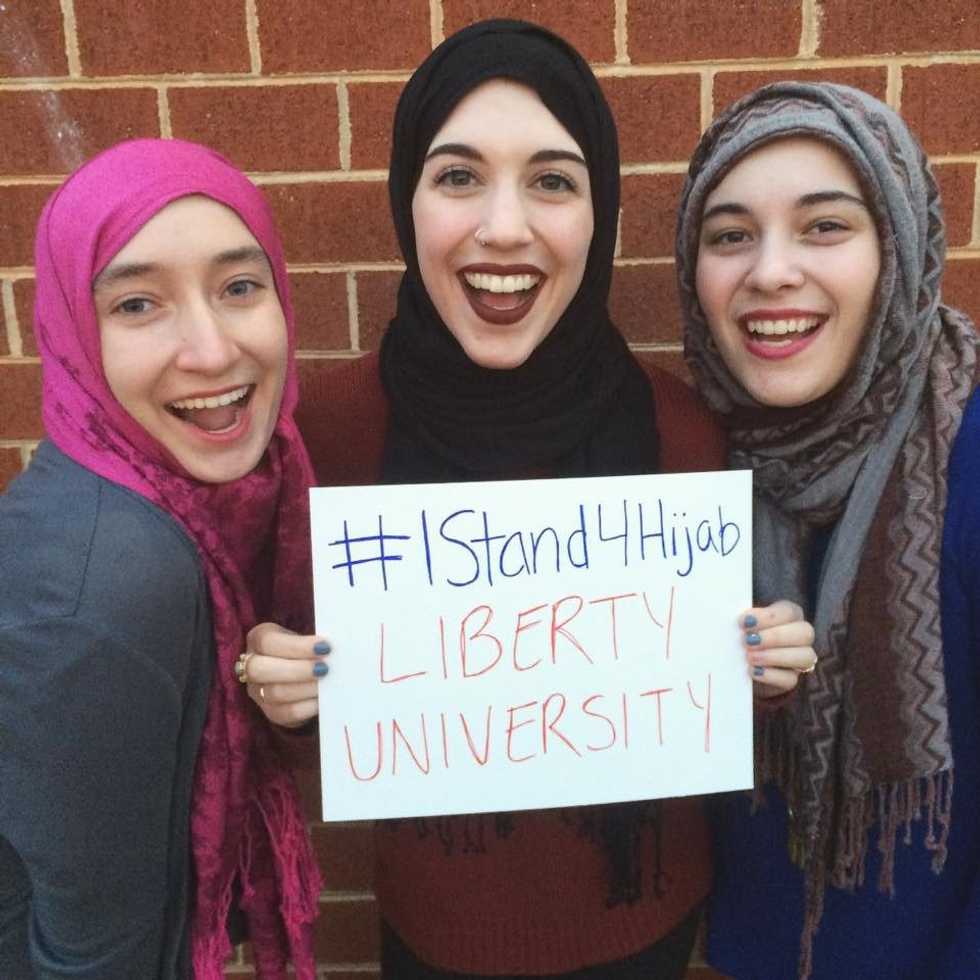
On Sunday January 29, I was excited for World Hijab Day. The week before I had practiced tying my favorite pink pashmina into a scarf for the first time and became a bundle of nerves, although one of my male friends had expressed his support along with the support of his dorm. This is really happening, I thought as I looked in the mirror at my hijab reflection. It’s only one week now. Then on Friday one of my friends eagerly agreed to join me in standing for a woman’s right to cover after I showed her the website and detailed my research. We spent half an hour tying on scarves, planning outfits, worrying about makeup, and agreeing to meet for pictures.
February 1 was a somewhat cold day, although with a pink hijab and a light cardigan I felt comfortable. I woke up fifteen minutes earlier than normal so I would have time to tie my scarf and apply makeup. Butterflies filled my stomach as my roommate and I left the dorm and walked to breakfast. To my surprise, no one said anything. In the dining hall the two friends I normally ate breakfast with asked why I had chosen to wear a hijab on that particular day and I excitedly explained about World Hijab Day: after immigrating to New York City from the Middle East, Nazma Khan found herself discriminated against and bullied for her choice to wear hijab. After graduation, she decided to start World Hijab Day, a day where women of all faiths (or no faith) would be invited to wear hijab for a day in order to understand what hijabi women go through on a regular basis. These women would also be standing for the right of women to cover. It was designed as an epic day of understanding and support. My friends responded positively to all this information, and I moved on to my American Sign Language class.
I had told one of my friends in my ASL class about World Hijab Day several weeks before and she instantly complimented my headscarf. No one else said anything. After our test, I went back to my dorm until Convocation. Convocation started uneventfully, although one of my friends who had also been told in advance about World Hijab Day did ask how my morning had been. Soon after, a girl from my hall sitting behind me tapped my shoulder and asked why I was wearing “that,” which was again followed with an explanation of World Hijab Day. Another girl asked my first friend about my hijab, which led to something like a game of telephone about the subject until the original girl who asked hopped over a row of chairs to address me directly. Worshiping Jesus and my Christian God in something normally seen as an act of obedience to Allah felt weird, but overall Convocation was still a positive experience.
After Convocation I ran to work, where I waited to change in the bathroom and met a nice guy who politely turned and asked me, “Can I ask about your headscarf?” I responded with an “Of course!” and gladly told him about World Hijab Day, which he thought was cool. The encounter made me giddy- he was the first stranger to question me on my choice and he had given such a positive response that I almost stopped worrying about what my boss would say.
My co-worker simply asked how I kept my hijab pinned, which led to an explanation of how I had tucked the corner before my boss said . . . absolutely nothing. There were no problems, and I worked in the back as usual. The worst part was that it took longer to change, as I had to remove my hijab and then re-wrap it four times in an hour.
A problem that had loomed across the entire day was the fact that my Old Testament professor has an extreme dislike for all “head gear.” He especially hated ball caps, as their extreme casualness could cause casual note taking, but I didn’t know how he would react to my hijab. My other hijab friend would also be in the class and I waited outside the lecture hall so we could enter together. To our surprise neither the professor nor the two graduate student assistants mentioned the presence of our headscarves. Taking pictures afterwards was tons of fun.
Ten minutes later as I approached the dining hall with my sister, the guy walking in front of us asked if I was a Muslim. There was an explanation of World Hijab Day once again, to which he did not respond, and we made our may inside. Once inside, I was asked where I was from by a student from Jordan, who thought the idea of World Hijab Day was cool. One of my sister’s friends greeted me with an enthusiastic “happy World Hijab Day!” when I sat down at the table, while another friend asked exactly what World Hijab Day was and where I had managed to procure one. Half an hour later, a girl in my Modern Literature class told me she thought it was awesome that I was wearing a scarf and responded positively to my explanation of World Hijab Day. My C.S Lewis class was completely normal and question-less.
My hijabi friends and I met for more pictures, and then I went with another group of friends to dinner. On the bus, they claimed to notice another group of girls giving me weird glances, but I didn’t notice. Back in the dining hall, we waited for a friend to try a trivia game at a table, and when another student came up to wait his turn, he scanned his eyes over my entire body without saying a word. I found it interesting that an increase in modesty lead to something that seemed like being checked out, although instead of being lustful his eyes seemed either confused or angry. I hope it was the first one.
Wednesday nights always include Campus Community, so we left early to get the best seats. The front row, where I normally sit and had promised myself to sit despite the hijab in order to maintain normalcy, was occupied by cameras, so I sat with my group of friends on the side. On our way there, Nastinka Morgan, David Nasser’s sister and a Farsi instructor, as well as a teacher for the missionary kid meeting classes once a week, ran into us. She was incredibly sweet, but obviously curious about my hijab given the fact that the entire Nasser family was at one point Muslim in their past. However, she only asked if I was a Liberty student, responded with a “praise God” to my affirmative response, and did not ask any more questions.
During worship an hour later, I decided to remove my headscarf. It felt like a distraction, as hijab is normally an act of obedience for Allah and I was trying to commune with God. When asked for an explanation of removal, my supportive male friend agreed that if it was truly affecting me, it was good to take it off. I was sad to have missed out on the opportunity to see David Nasser’s response, as he could have seen me from the stage, but my spiritual walk meant more to me than observing another former Muslim’s reaction.
I was surprised that no one had attempted to share the Gospel with me, although asking about the headscarf might have been a question that would lead to such an explanation if I had responded that I was Muslim. One of my hall mates who had complimented my scarf earlier asked why I no longer had it on during hall meeting and I explained that hijab does not have to be worn if only females are around. I was doing my best to follow what I understood to be the guidelines of hijab wearing and I hope that was the proper explanation, as I would have removed it upon getting into my dorm if it had remained on throughout Campus Community.
My day, as you can see, was largely uneventful. I was never called a terrorist. I was never asked to remove my hijab. But the anxiety I felt as I considered even putting it on for one day does say something about how I perceive the treatment of hijabi women to be in America. I was worried about discrimination, even on a Christian campus that promotes the tolerance and love of Christ. However, I am glad to say that my university is as welcoming and kind as I thought it would be, and that I have a better understanding of what it means for a women to cover. I am proud to say that #IStand4Hijab every day, but instead of merely saying that, I acted on that belief on February 1. Beliefs without action means nothing.