

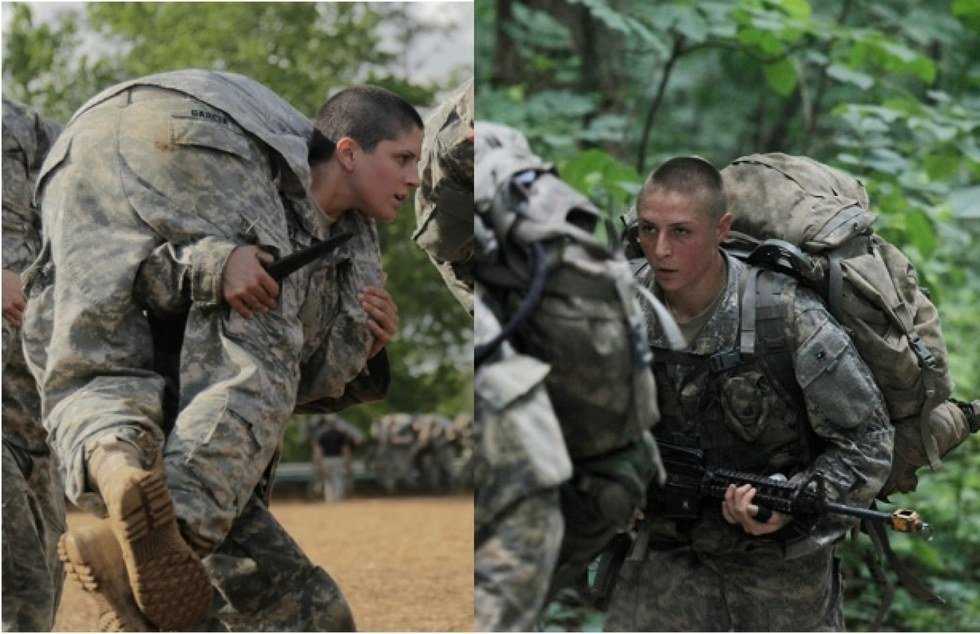
It has long been a major debate in the United States about whether or not women should be able to fight side by side with our soldiers and Marines in the most hostile environments around the world. Having played mostly passive roles since wars as early as the American Revolution, they have slowly progressed up the ladder in our armed forces. They are now serving as nurses and technicians, have flown combat missions in Iraq during Operation Desert Fox, and gained much experience as 280,000 women were deployed in Iraq and Afghanistan, although these occupations were limited (2010). Within the last few years, there has been a major push under the Obama administration to give women an even more active role within our armed forces, and with the first two women passing through the infamous Army Ranger School within the last month, they have all but proved that they are up for the challenge.
However, a recent study conducted by the United States Marine Corp has raised concerns about the Pentagon's push to open all military jobs to women within the next year. The study, which was released Sept. 10, has concluded that all-male ground combat squads were not only faster, but also stronger and more lethal in 69 percent of the 134 tasks given than squads which incorporated females.
“Any time we did movement under load, all-male groups outperformed integrated groups," said Paul Johnson, a Marine civilian official who helped develop and oversee the experiment. On marksmanship, men who had not been through infantry school hit targets 44 percent of the time with M4 rifles, besting infantry-trained women, who hit targets 28 percent of the time (Michaels). Accordingly, women also suffered higher rates of injury during their training, and greatly struggled with obstacle course exercises that required great use of upper body strength. With the deadline set by the Pentagon to open all military jobs to women, including infantry, special forces, and the notorious Navy Seals, it is important to see if these female fighters will be able raise their performance with more experience. The Marine Corp, which is made up of 7 percent women, is based around its formidable infantry and is often engaged in some of the most horrific fighting conditions seen on the battlefield (Michaels). In the types of harrowing scenarios that our military personnel face, even one weak link could mean the difference of life and death; not only individually but to everyone else as well.
Michaels, Jim. "Marine Study Finds All-male Infantry Units Outperformed Teams with Women." USA Today. Gannett, 10 Sept. 2015. Web. 12 Sept. 2015.
"Women in the United States Military." (2010): n. page. Web.