

<iframe width="560" height="315" src="https://www.youtube.com/embed/ghph_361wa0" frameborder="0" allowfullscreen=""></iframe>

James Comey, Director of the FBI, makes statement regarding the investigation into Hillary Clinton's email server, in which it was decided she would not be indicted. <a href="https://www.youtube.com/watch?v=ghph_361wa0">(Source: YouTube/C-SPAN</a>)
James Comey, Director of the FBI, makes statement regarding the investigation into Hillary Clinton's email server, in which it was decided she would not be indicted. (Source; YouTube/Fox 10 Pheonix
On Monday, Director of the Federal Bureau of Investigation (FBI) gave a 13-minute speech, dismissing the notion that Hillary Clinton should be indicted and criminally charged. While there has been much public debate about whether this was the correct decision, both the technical nuances of the case and law itself are complex and should be broken down clearly. This article will discuss first the technology aspect of the case, followed by a breakdown of the laws in which Clinton was thought to have broken, and will end with a simplified equation as to where the decision has come from.
The server and its technology
It's important to recognize that there were two separate technical issues here. First, Mrs. Clinton was using a series of home servers, which were commissioned and taken offline at various times throughout her tenure as Secretary of State, with the last server being taken offline in 2014, with the email management software taken off.
When email management software is taken off of a server, the content never leaves the server itself. Rather the emails are broken into digital fragments and left on the storage components of the server (in Comey's speech, these components are referred to as "Slack Space") That was what occurred in this case. The FBI had to basically put a 30,000+ bag puzzle together from scratch.
The second issue, which is the more concerning one, is that a personal email account was set up on these servers, and mobile devices like iPads and BlackBerry phones were used to exchange both personal and work related emails through one account, which happened to be a personal domain account.
The emails in this account and on these servers were not intentionally deleted. Rather, they were purged in a way that a student who wants to get rid of junk mail would do, by checking all the boxes and hitting delete, not necessarily checking each one individually. Think about how long that would take a single person to do, especially in a position where they're corresponding with people in the office of the State Department and other places around the world!
The statute
In the United States Criminal Justice System, guilt must be proven beyond a reasonable doubt in a courtroom. The same is true in Federal Court. Throughout this election, and certainly those who have followed the FBI investigated into Hillary Clinton's email, have referred to many different statutes, but specifically 18 US Code Statute 793. In case you're not aware of this statute, it's US Federal Law regarding the Gathering, Transmitting, or Loss of Defense Information, which includes seven (7) sections, and more than 1500 words, but most people refer to Section 793-F, as shown in the meme below:
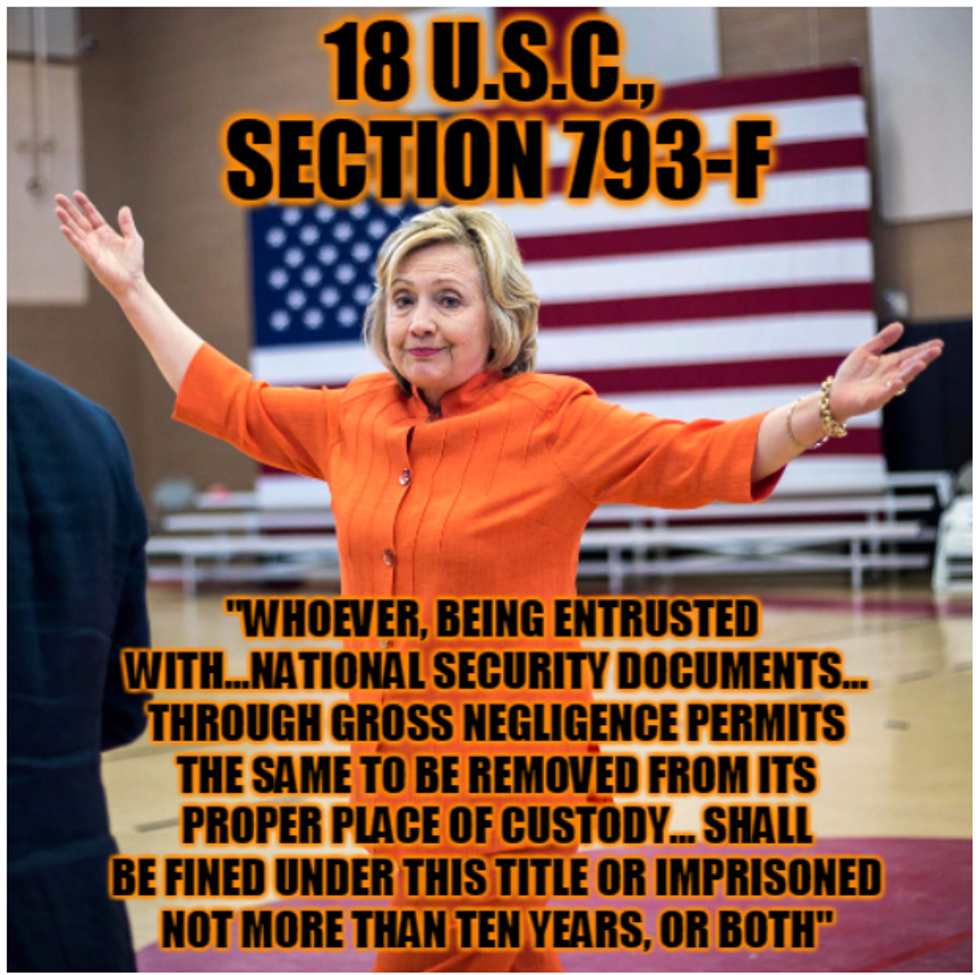
However, this an extremely paraphrased, and slightly mis-written version of the statute in question. Here's the statute (18 USC Statute 793-Fi n full, provided by Cornell University's Law School
Whoever, being entrusted with or having lawful possession or control of any document, writing, code book, signal book, sketch, photograph, photographic negative, blueprint, plan, map, model, instrument, appliance, note, or information, relating to the national defense, (1) through gross negligence permits the same to be removed from its proper place of custody or delivered to anyone in violation of his trust, or to be lost, stolen, abstracted, or destroyed, or (2) having knowledge that the same has been illegally removed from its proper place of custody or delivered to anyone in violation of its trust, or lost, or stolen, abstracted, or destroyed, and fails to make prompt report of such loss, theft, abstraction, or destruction to his superior officer—Shall be fined under this title or imprisoned not more than ten years, or both
The two phrases in bold -- "through gross negligence" and "having knowledge that the same has been illegally removed" are the key to understanding the outcome of the investigation. Why? Because in order to prove negligence, you to have the knowledge of the information being removed or moved.
Not only that, but you would have to prove that there was an intent to remove, alter, or destroy the information. Director Comey, on several occasions in his remarks, noted that while there were many security flaws in the State Department's culture of information, and Mrs. Clinton's use of a private server was careless, the intent to deprive, alter, or remove information from the server and thereby remove it from government archival was never there, nor was there intent to delete classified information, retroactively or otherwise
So why no charges?
So, to make a long story short, here are the key points to take away
1. Hillary Clinton had multiple servers, which were maintained and taken offline after set periods of time
2. No emails were ever removed from the server because it's not possible to remove them, only fragment them.
3. While Mrs. Clinton, and by extension, the State Department, were careless in the handling of emails both classified and unclassified, charges were not brought against anyone because she lacked intent.
One important note, that most people forget to mention: Just because she is not criminally indicted does not mean she won't be fined or otherwise penalized for her action. In other words, though the primal case is done, there may be more to come