


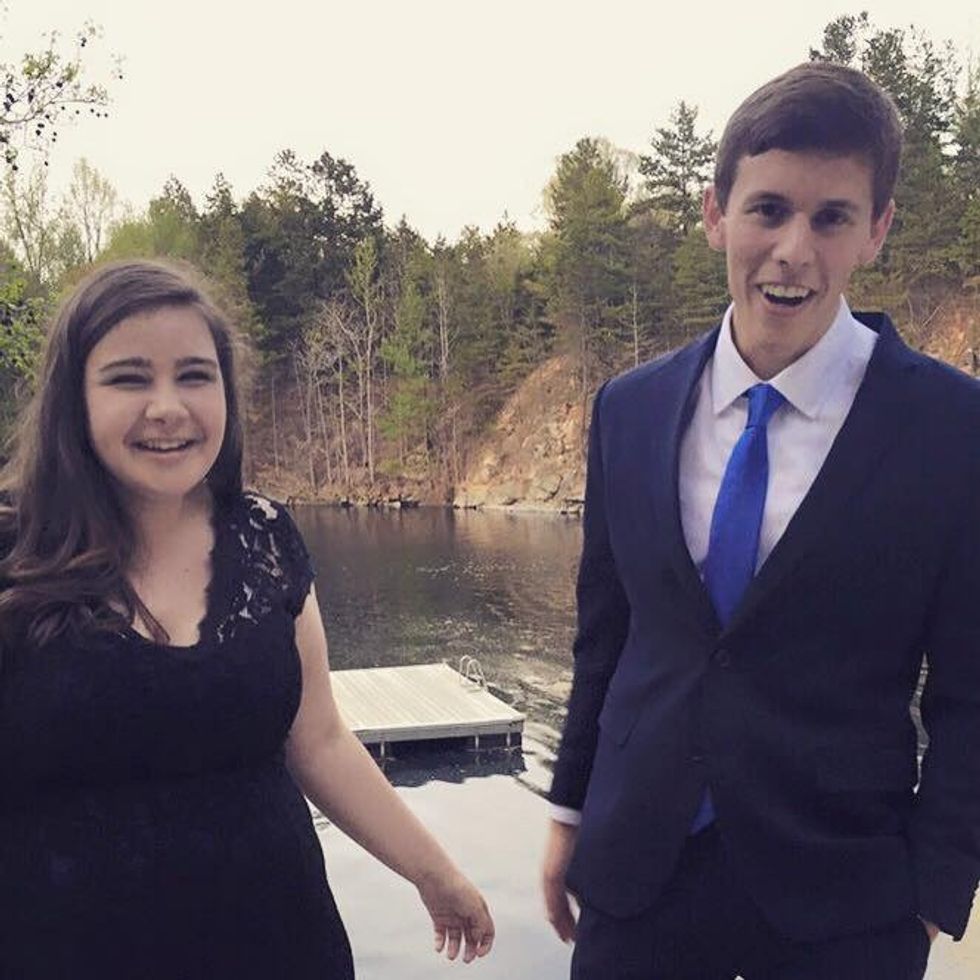
The above picture is a candid moment of me and my close friend, Jonathan. We have been friends for nearly three years and are both satisfied with our relationship to one another. Our friendship is not a result of "friend zoning," but of a genuine appreciation for the other person's thoughts, ideas, personality, perspective, and presence. There is no awkwardness in our friendship, and neither of us feels as though we are settling for friendship. This nonexistent "friend zone" in which we operate is, to us, a reward rather than a punishment.
Last week, an article came to my attention due to its use of the phrase “friend zone.” Upon first glance, this phrase didn’t faze me because it read as a meaningless, millennial term, having lost value through its overuse, as slang phrases are apt to do. Its initial definition is something to the effect of “when the love interest of the pursuer does not reciprocate those amorous feelings, the pursuer is then deemed a better friend than romantic partner.” Perhaps this phrase would not be quite as problematic had all sexes and genders adopted it; however, as it stands today, the phrase has been widely incorporated into masculine dialogue (lovingly termed "bro culture") to offer an explanation as to why women refuse to have sex with them.
To ask a rhetorical question (or perhaps not, if you choose to comment below): have you ever heard a feminine-performing person and/or woman use this phrase to explain or excuse rejection? In my recent conversations, the answer to this question was, resoundingly, no. So, why is that? Why do solely masculine-performing people and/or men use this phrase? How might this perpetuate sexism or be otherwise problematic? I will attempt to answer these questions and offer clarification on this subject in the words that follow.
Men often bond through "bro culture," which includes the use of this phrase "friend zoned." We see examples of bro culture in the media, on television, and in books all the time. From the three musketeers of Ross, Chandler, and Joey on the iconic Friends, to the newer replicas of that threesome in New Girl characters Schmidt, Nick, and Winston, bro culture breeds masculinity. The mythical "bro code" is, in actuality, an attempt to maintain the patriarchy in that it encourages men to talk about women as objects and prizes to be won rather than potential partners. You might be thinking, "But there's a girl code too. Is that not putting men in the same, oppressed position?" The answer is simple: no. Feminism, at its core, is the girl code, and, at its best, serves to create equality for all sexes, genders, sexualities, races, ethnicities, religions, classes, regions, etc. Yes, there is "bad feminism" that excludes everyone who is not white, middle or upper class, heterosexual, and cisgendered, but, by definition, feminism exists to advocate for equality. By that token, the bro code exists as a contrast to feminism, to discourage equality.
While I am by no means an expert, I am pursuing a major in Gender and Sexuality Studies at Davidson, with plans to complete that degree in the coming school year (yikes…entering the “real world” in mere months) and continue my education in the field through graduate school. Much of the GSS major hinges on feminist and queer theory. Both of these theoretical approaches speak to the problematic language surrounding women and the female body. This phrase is no exception to that language. Below, I’ve cataloged some of the reasons that this phrase is problematic, and, for some, I’ve also provided some explanation. This list and these explanations are certainly not exhaustive, but should shed some light on a contentious phrase.
Being friends with a woman is, shockingly, rewarding in its own right.
Odds are if she’s good enough for you to be romantically interested in, she’s also good enough to build a friendship with. Saying you’re “stuck in the friend zone” devalues the idea of friendship in that it suggests that friendship is the punishment for not obtaining the rewarding, and highly sought after, romantic entanglement.
Women owe men nothing.
People in the millennial generation have a rampant sense of entitlement, and, unfortunately, this entitlement extends to romantic involvement. Perhaps this feeling stems from the idea that “everyone wins” at youth award ceremonies and in childhood sports games. Regardless of its origin, entitlement is particularly rampant in masculine forms of communication, as indicated by the idea of the “friend zone.” Women do not owe men anything, and they do not exist to serve men sexually, physically, romantically, visually, emotionally, mentally, etc. Using this phrase demonizes women in that it establishes that they have forced men into a box, one in which they feel they are wrongfully placed.
The person who vocalizes this phrase, whether he knows it or not, often makes the woman involved feel guilty.
By perpetuating the idea that women owe men, this phrase has the potential to make the woman involved feel as if she has failed at performing femininity, being a woman, or, more generally, being a nice, decent person. You do not, and should not, get to make someone feel guilty for expressing her genuine feelings.
You are trying to maintain your masculinity, read: stroking your own ego.
Rather than saying the harsh, “I got rejected,” you opt for the soft, “I mean, yeah, she doesn’t want to have sex with me, but we’re still friends, so, like, not completely rejected.” Women and feminine-performing people don’t do this. Stop pussyfooting around the issue, and own your failure—you got rejected. You are also not doing yourself any favors in engaging with the grieving process, but I guess the first step in any grieving process is denial.
You should be thanking her.
In reality, you should be thanking the woman who supposedly “friend zoned” you. Would you rather her maintain the façade that she reciprocates feelings? Your answer should be no, as this would create animosity and resentment between the two of you, resulting in a toxic, unproductive relationship. So, if you would rather her be honest and forthright about her feelings, you should thank her for her candor, which, can be just as demonstrative of courage as expressing one’s feelings.
There are worse situations than the proverbial “friend zone.”
If at any point, she says she wants to maintain a friendship with you, then you should be grateful. This extension of friendship indicates her valuing you as a person and presence in her life. She could have put you in the “we-can’t-be-friends zone,” which, shockingly, is also nonexistent.
Genuinely nice guys do not finish last.
The cliché that women are only attracted to “bad boys” is just that, a cliché. Movies and books perpetuate this cliché, making both men and women think it is true. Nevertheless, in my experience, and I do feel comfortable speaking for and on behalf of women, women are attracted to men who they think will treat them with the respect that they deserve. Of course, there are some women who are attracted to men under the assumption that they can “fix” them, but those are few. It is human instinct to not put oneself in danger, and, as women are counted as humans nine times out of ten, they have this instinct and would likely take a nice guy over a bad boy.
Last, but certainly not least, consent is necessary.
With the “friend zone” established as a perpetuation of the idea that women exist for the pleasure of men, the “friend zone” strips women of their right to and the importance of consent. It implies that when a woman does not reciprocate romantic interest, she should be shamed for not consenting to her pursuer's manipulative tactics.
Should you be interested in reading more articles by Davidson students, I've attached a few pieces from last week below.
First, the article I referenced in my piece, "Men: We Need To Learn How To Talk About Rejection," emphasizes the rigidity of masculinity and the need for it to be more fluid. Masculinity, like femininity, is a social construct, restricting the behaviors and performances inherent to a person's chosen gender. While I don't believe this article was published with the intent to hurt or alienate anyone, as I've noted in my piece above, it does include a few problematic phrasings that could withstand some tweaking. The overarching critique of masculinity dismissing the importance of feelings is necessary; however, it may have been better received had the problematic phrasings been addressed pre-publication. Though this change likely would have been one with less appeal to a portion of the male population, it would have garnered more appreciation from that of the female one.
This article, "Living With A Parent Who Has Lung Cancer," provides a glimpse into a reality that many people grapple with daily. My favorite part of this piece is the author's recognition of the "waiting game" with cancer. This is something many tend to overlook. Remission is a state in which a number of days, months, or years is of no consequence. Cancer can return whether a person has been in remission for two days or twenty years. This author highlights the mental and emotional taxation this takes on the person's family.
Lastly, if I haven't already offended you through my feminist rantings, or even if I have, and you are interested in reading more or offering suggestions, please feel free to follow my Odyssey page and/or comment below.

















