
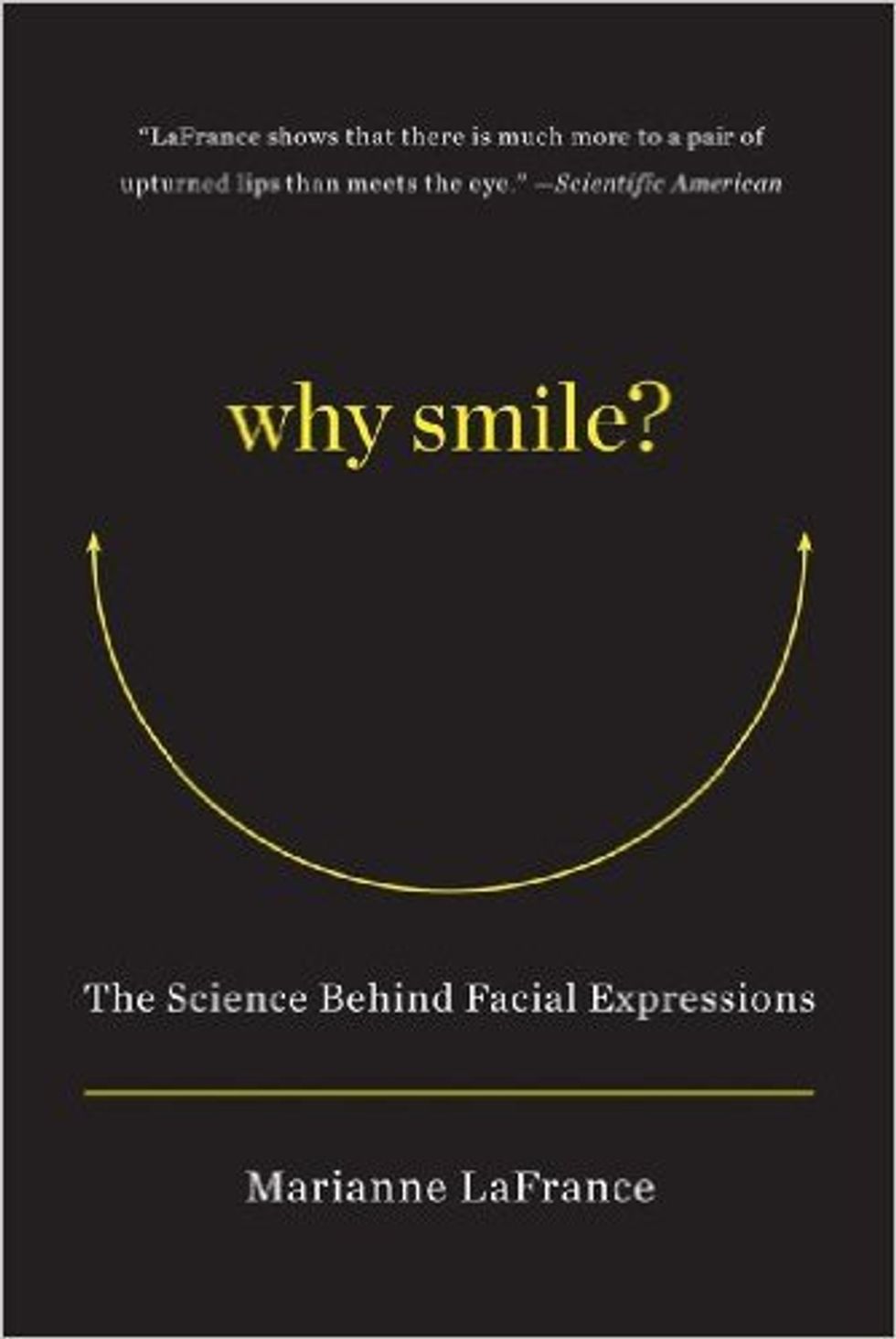
Are smiles always like rays of sunshine? Or are they more complex, often depending on contextual factors, internal intent, and the reaction of the recipient? In "Why Smile: The Science Behind Facial Expressions," Marianne LaFrance explores this very question through a rather holistic lens: incorporating theories and explanations from psychology, medicine, anthropology, biology, and even computer science to explore facial expressions, especially the smile. Throughout the course of this book, Marianne LaFrance enlightens the reader about the deep complexities of the often-simplified smile through three large themes: life, lies, and loyalty, which are each broken into three or four smaller ideas. Under the guise of life, LaFrance explores the history of smile science and the different physical manifestations of smiles including the Duchenne and social smile, the development of smiles in babies, the effects of smiles on social interactions, and how different disorders negatively affect smiling. In the next section, under lies, LaFrance explores the existence of the two-faced smile, the widespread utility of two-faced smiles in political arenas, and smiles as factitious displays of warmth in service jobs. Lastly, under loyalty, LaFrance explores the gender specificity and cultural differences that exist in relation to smiling, the tendency of Americans to smile for the camera, and finally she ends with a look into the future of smile research.
LaFrance begins with characterizing the physical components of two types of smiles: the Duchenne and the social (or simple) smile in terms of the muscles involved. The Duchenne smile is produced by a combination of the lip corner rising as a result of zygomaticus major muscle contracting and the cheeks rising as a result of the orbicularis oculi muscle contracting. Thus, this type of smile incorporates both the mouth and the eyes, and is often seen as more “genuine” and “trustworthy.” The social or simple smile, on the other hand, is achieved simply through retracting the lip corners only through activation of the zygomaticus major muscle. Duchenne smiles are thought to portray more genuine emotions, occurring when a person is truly happy or pleased. In fact, experiments have shown that married couples that exchange more Duchenne smiles compared to simple smiles in conversation are more likely to have longer lasting marriages. However, LaFrance warns against assuming that only two types of smiles exist. She points to composite expressions, including smiles, which occur when two or more feelings occur simultaneously. Furthermore, she discusses how the intensity and duration of smiles are also important, with more preferred smile compositions involving strong intensity, symmetry, and a slow onset but a smooth and quick exit.
After providing readers with a sense of the different types of smiles that exist, LaFrance delves into a discussion of the development of smiles in babies. Babies display smile-like behaviors that are involuntary and occur in their sleep during REM cycles as newborns. As early as 6 weeks, babies develop social smiles, which are seen as pinnacles of innocence meant to entrap parents and caregivers alike. The jury is still out about whether babies’ smiles during this stage represent positive emotions or are simply endogenous smiles but one thing is for sure, they are functional, because they help add to the baby’s repertoire of social relationships, which is important for its survival. At about 3 years of age, babies transition into achieving a strategic control of facial displays that allow their facial expressions to represent their true emotions and to achieve facial expressions that are also manipulative. During this stage, babies are able to exhibit two additional smiles: the coy smile and the duplay smile. LaFrance then explains why babies, as precarious as they are, exhibit smiling behavior so early with respect to all other signs of development. This is because somewhere within the evolutionary history of humans, smiles became indispensable as humans became more social creatures. Smiles, when delivered successfully, help to forge new relationships, ward off other’s fears of rejection, and increase the perception of trustworthiness, all of which contribute to good group dynamics that over time likely helped humans as a species maintain cohesiveness in groups and thus increase their success in evolution. Lastly in this thematic section of life, LaFrance discusses Parkinson’s Disease, depression, Bell’s Palsy, Moebius, and Autism Spectrum disorders as disorders that affect the ability of people to smile and thus complicate their ability to communicate and make connections with others. Studies have shown that adults affected by Parkinson’s disease are lonely because they are unable to make friends, largely because they cannot express emotions on their face through a smile. Moreover, among mothers who are depressed and thus smile less frequently, their babies also exhibit fewer smiles and less playful cooing. During this part, LaFrance also explores the accuracy of the facial feedback hypothesis, which is the theory that facial expressions affect feelings. Though this has not been proven to be exactly true, experiments have shown that facial expressions can moderate or intensify a feeling that is already present though they cannot create one. This was shown by an experiment where participants looked at photographs while some of their muscles were involuntarily contracted and if the muscles for smiling were contracted and the participants already felt joy from the photographs, then this emotion was intensified. Thus, LaFrance argues that people with the previously listed disorders have a harder time in life in general, which underscores the importance of smiles to life and our wellbeing.
In the next thematic section called lies, LaFrance confronts the belief that smiles are inherently friendly and that they warrant trustworthiness. She explores how some smiles in certain contexts are for the sole purpose of manipulation. These smiles, which seem to convey trustworthiness and genuineness but that actually hide a conflicting internal intent, are aptly labeled “two-faced smiles.” In these smiles, there is a disconnect between outward expression and inner feelings. This can be an unconscious disconnect (result of experiences that shape smiles to be a certain way automatically) or a deliberate disconnect which outwardly shows positivity despite known internal feelings of deceit and mal intent. This second type of smile, the two-faced smile with a deliberate disconnect, is seen on scammers, dupers, and evildoers such as Osama Bin Laden. However, because smiling is such a social act, it is also important to consider how the recipient of a smile interprets the smile as recipients sometimes see wickedness in a smile that had none of it to begin with. Despite this confounder, smiles are sometimes truly two-faced. Machiavellians, for example, are infamous for employing such two faced smiles. Other smiles laced with malice include sneers and smirks and those resulting from relishing in the bad misfortune of others or the good fortune of oneself. Next, the importance of smiling in politics is addressed. As technology evolved to allow dissemination of more visual imagery, the presidential smile became of utmost importance for campaigns, needing to be unique and yet relatable at the same time. During this time of visual imagery, smiles, in general, were believed to be indicators of charisma. However, humans and nonhuman primates alike also have certain smiles known as an appeasing smile, that signal content insubordination and appease the dominant entity. In nonhuman primates, this smile is often known as the “silent bared teeth smile” and it establishes order in hierarchal animals or is a friendly, non-confrontatonal greeting amongst non-hierarchical ones. When thinking about humans again, smiles are given based on desire by more powerful humans while more for obligation by those in a lower societal position.
Lastly, in this section of lies, there is an important discussion about smiling in service jobs, which is part of one of the biggest sectors of our economy. Service jobs often require performance smiles which can be achieved either by surface acting which changes the appearance of a worker but not their true internal state or by deep acting which involves creating or drawing on real feelings to stay happy on the job. The age-old adage of quantity vs quality in relation to smiles in service was settled in this chapter, as well. High-quality smiles are able to substantially increase sales and tips but even having a low quality but high quantity of smiles can lead to minimal increases in the two. Sometimes the employees best at smiling at customers were born friendly but in 95% of the cases, they are trained to be this way. To train a person to smile when he or she doesn’t feel that emotion in the moment has a high cost, including leading to lack of feeling emotions correctly and usage of excessive frowns later to recover from the time spent smiling.
The last large theme of the book is loyalty, where gender and cultural differences in smiling, smiling for the camera, and the future of smiling are all explored. Due to prosocial motivations, women smile more from an early age and understand that society expects them to smile more, as well. Men, on the other hand, smile less also due to socialization and partly due to higher levels of testosterone. Moreover, differences exist among cultures in regards to smiling as well, depending on whether a culture is more focused on the individual such as in America or on the collective such as in Japan. This variable will determine who people of the culture smile for, when they smile, and what emotions their smiles show or hide using a smile. Moreover, cultural differences in smiling amongst the Northerners and the Southerners in America are also explored depending on if the region exhibits a culture of honor or not. Next, smiling for the camera was explored as having been prominent after the effect of Kodak’s ad campaign and its invention of a portable camera for amateur photographers. Lastly, the use of emotional robots to explore emotions and people’s responses to emotions, including that of smiling, was introduced as one of the many novel ways to research smiling and facial expressions.